

.webp)
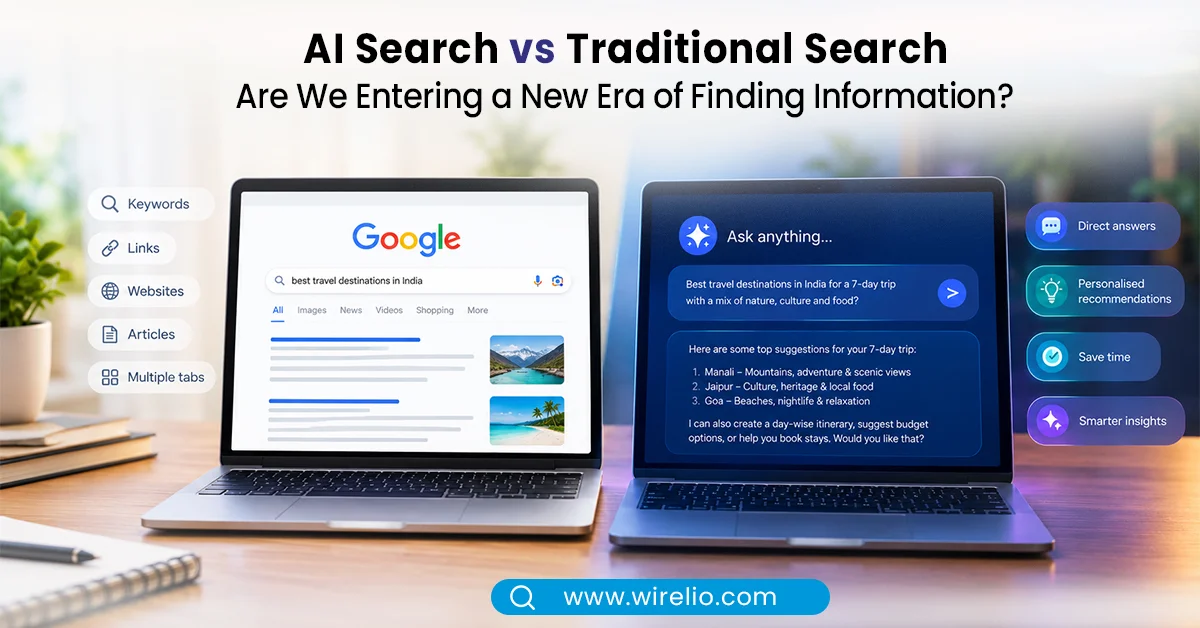
Remember when finding answers meant opening Google, typing keywords, and scrolling through blue links?
You might ask a question like “best laptop for students,” find a few sites, do some comparisons, and read reviews before picking one.
We do this differently now.
Instead of finding links, we can ask questions, and get answers, comparisons, recommendations, explanations, and even further questions in a conversational format.
But that leaves us with an interesting question – are we seeing a shift from traditional search to a completely different way of finding information?
The answer is probably not as simple as it seems. AI search and traditional search are actually coming together, providing us with different ways to discover, compare, and consume information.
What is Traditional Search?
The traditional search is the process most of us are familiar with. We enter a query and get back links, videos, images, maps, products, or anything else that might have an answer. For instance, searching
“Best smartphones under Rs. 30,000 in India” could bring you to smartphone review sites, manufacturer sites, youtube videos, shopping sites, news articles, comparison sites, reviews.
And the user has to decide which ones are the most relevant, read them, and make some form of decision. This process has worked incredibly well, and is likely the result of many hours of research. However, that means it can feel a lot like your own research project.
No one likes opening 12 tabs to find the best smartphone.
What is AI Search?
AI search is a conversational way to get answers. Instead of seeing a list of pages, you can ask a question and get an answer (possibly with a comparison) that includes recommendations, an explanation of why certain criteria matter, and even further questions to ask.
You could ask something like
“I’m a college student who takes a lot of notes, watches movies and needs good battery life, which type of laptop should I consider under Rs. 60,000?”
And instead of getting links that target those keywords, an AI powered search can potentially break the requirements down, explain which specs matter, and narrow the options down for you.
The biggest difference is really in the presentation – where traditional search says: “Here are some places that might have the information you want,”
AI powered search is saying : “Here’s some synthesized information, and here are the sources if you want to learn more.”
How AI is Changing Things Up for Us
The biggest change isn’t really the search bar, but rather the expectations that are being set for us.
We expect more personalized or useful results, rather than keywords and links.
1. Search Queries are becoming more conversational
Humans are pretty good at asking conversational questions. Sometimes we think in keywords, but often we’ll ask questions in a conversational way. For instance,
“What should I pack for a three day trip to Mumbai in October if I want to travel light?” vs “Mumbai October packing list.”
AI is great at picking up on context, and this type of question includes a lot of useful context or requirements for the search. Thus, search is becoming more conversational vs. keyword focused.
2. People want answers, not just links
For example, if you search something like “Difference between OLED and LED TVs”,
Traditional search will give you hundreds of articles, but you’ll need to open them and find the information. With an AI search, you can potentially get the summary information first, such as picture quality, brightness, contrast, viewing experience, price, typical use cases.
picture quality, brightness, contrast, viewing experience, price, typical use cases
And you can ask further questions, like “Which one is best for movies?” which turns into a real conversation, giving better suggestions.
3. AI can make comparisons Easier
Comparison is one area where AI search can really shine. We rarely search for things just to learn, but to make a decision.
When someone is trying to decide:
Which Laptop should I buy?
Which Phone is better for photography?
Where should I go for a week?
Which Streaming site has the shows I want?
Which subscription should I get?
AI can be useful at synthesizing information around those decisions, and making comparisons easier. However, users will need to look into specifics like price, specs, and policies where applicable, especially as things change over time.
4. Search is becoming more Personalized
When you do a traditional search, it mostly focuses on the query. An AI powered search can focus on much more of a conversation. For instance,
User: “Recommend a laptop for editing.”
AI: “What type of editing?”
User: “Mostly short-form videos, and I travel frequently.”
Now the recommendation can be more tailored to the use case, and the user doesn’t have to enter all of that information into a single search. Instead, they have an ongoing conversation, which is much more efficient. This could be the beginning of a new era, where search resembles a conversation more than a database query.
5. Information is being consumed faster
There’s a different change happening – people are looking for faster or more easily consumed information. Instead of immediately reading a 2000 word article, many will want a summary, key points, comparison table, pros and cons, simplified explanation, sources.
a summary, key points, comparison table, pros and cons, simplified explanation, sources
AI can make large bodies of information more easily digested. However, speed comes with responsibility – a shorter answer doesn’t necessarily mean it’s a better or more accurate answer. If an AI misunderstands or misses key context, it could confidently give an incorrect or incomplete answer that is much more succinct than it needs to be.
AI has turned into a vital part of our life, check out how AI influences our daily life here.
The Elephant in the Room – Can We Trust AI Search?
As interesting as AI search is, traditional search has its issues. There are plenty of articles with poor research, misinformation, clickbait titles, and keyword stuffing. AI search does nothing to solve those problems, but it does introduce another issue – that an AI could potentially summarize or synthesize information incorrectly. That means we still need to look at source material, and verify claims, with extra care for anything that seems opinionated or subjective.
When evaluating information, users need to ask themselves:
Who published this?
When was it published or updated?
Can I trust this source?
Does this claim have supporting evidence, and can I find it?
Is this opinion or factual information?
Does the original source support this claim?
That way, people aren’t blindly trusting either search methods, but are evaluating the information with a critical eye. In many ways, AI search might reduce the amount of searching we do, but it doesn’t take away the need for critical thinking.
Will AI Search Replace Google?
Probably not in the ways you’re thinking. The search landscape is becoming much more varied, where:
Someone might do a Google search to find a website.
Watch a YouTube Video to understand something.
Read Reddit Posts to hear other people’s opinions.
Watch TikTok or Instagram for trends.
Use AI Search to understand something better.
Use Amazon to Research Products and Read Reviews.
There are so many options now for how we find information, and the more interesting question is how people combine them for their needs. Search behavior really depends on what someone is looking for, where they expect to find it, and how they want to consume it.
What Does This Mean for Websites and Content Creators?
This evolution also has ramifications for content creators publishing information online. For years we’ve optimized for keywords and backlinks, and that will continue to be important. However, content needs to be much more useful, original, properly structured, and supported, to both serve searchers and work well with AI search. Articles should try to address the expectations behind a search query, rather than just repeating a keyword a bunch of times. For instance, an article about smartphones shouldn’t just focus on “best smartphone under Rs. 30,000.” but should explain the differences between the phones listed, which phones are good for photography or video, what to look for at that price, who should spend more, and what to avoid. It ensures content creators are creating useful information, and not just throwing keywords onto a page in hopes of ranking better.
AI Search Could Change How We Discover Entertainment
This change isn’t just affecting research. It could also greatly impact how we discover entertainment. Instead of doing a search like “best thriller movies 2026” users could ask “I want a thriller that's under 2 hours, not too gory and has a mystery similar to the movies I usually enjoy.”
It creates a much more personalized discovery experience. The same idea could be applied to movies, tv shows, music, podcasts, books, games, events, travel experiences.
And it becomes more important for platforms like Wirelio to evolve in how we recommend stuff (which we're already starting to see!).
The New Skill – Knowing How to Search
For years, digital literacy has meant knowing how to search for information. Now it means knowing how to ask for information in a way that gets you the best results, and the ability to know when to use each method. The ability to
Ask questions
Give proper context
Compare information
Fact check
Know when to doubt information
Go back to the original source
It is potentially just as important as knowing which search engine to use, after all, having an answer isn’t always the same thing as having the right answer.
Final Thoughts
The internet has always evolved in the way we find information. Search engines helped us find pages in seconds. Social platforms helped us find people and trends. Now AI is helping us find the answers to questions, rather than links to answers. We're seeing a shift from “how can I find information?” to “can you help me understand this?” And that could be the start of a much bigger change.
Frequently Asked Questions
1. What is the difference between AI search and traditional search?
AI search uses artificial intelligence to understand natural-language questions and provide contextual answers, summaries, and comparisons. Traditional search primarily returns relevant webpages, links, images, videos, and other results that users can explore themselves.
2. Is AI search better than traditional search?
AI search and traditional search serve different purposes. AI search can be useful for understanding complex questions, summarizing information, and comparing ideas, while traditional search remains useful for finding specific websites, exploring multiple sources, and accessing original information.
3. How is AI changing the way people search for information?
AI is making search more conversational and contextual. Instead of entering short keywords, users can ask detailed questions and continue with follow-up queries. AI can also summarize information and organize complex topics into easier-to-understand answers.
4. Will AI search replace traditional search engines?
AI search may change how people use traditional search engines, but it does not necessarily mean that traditional search will disappear. Users still need search engines to find specific websites, original sources, current information, products, news, and different perspectives.
5. What is conversational search?
Conversational search is a way of finding information by asking questions in natural language, similar to having a conversation. Users can provide additional context and ask follow-up questions instead of creating a completely new search query each time.
For more information, do check out Wirelio - Beyond Headlines.

No comments posted yet. Be the first to express your thoughts!