

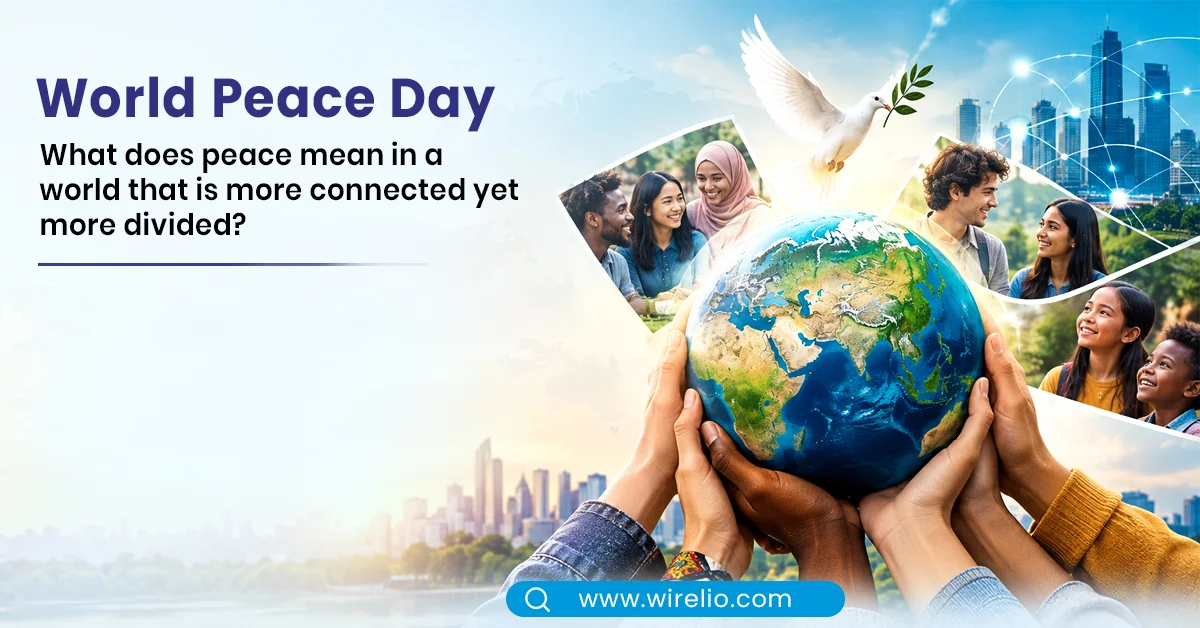
We live in a world where a message can cross continents in seconds, students across oceans are taught by the same teacher, and entirely different cultures forge friendships without ever meeting face to face.
But the world still seems deeply divided.
Wars rage on. Communities are displaced. Identities are argued, beliefs and borders alike. Social media brings people together at the speed of light - but has also made it possible for disagreements to devolve rapidly into hatred in mere minutes.
What, then, is the message of peace during this period of unprecedented connectivity?
World Peace Day (21 September) sees the United Nations dedicate itself to strengthening, every year, ideals of peace and non-violence. The UN's 2026 message focuses on "Invest in Peace: For Everyone, Everywhere, Every Day".
Peace, we are reminded, is not something that exclusively comes from governments or superpowers alone.
Peace, in fact, begins much closer to home.
Peace Is More Than Just The End Of War
When we hear the word "peace", we might think of the end of a war: weapons laid down, treaties signed, borders respected.
That's certainly part of it.
But for an average citizen, peace can take on a more everyday form.
It can mean a child's ability to go to school safely. It can mean a mother being able to sleep at night. It can mean an entire community having the freedom to mingle and bond. It can mean having disagreements, without seeing the other as an enemy. It can even mean having the freedom to fail, learn, question and begin again.
Peace, as the UN Children's Fund UNICEF has noted, also has a special meaning for children living in conflict: peace means much more than the end of hostilities. It means education, health, clean water, security, and the ability to simply be a child.
This is why peace is not merely a political or military term. Peace also exists in our daily lives.
Why Peace Matters?
War can seem like an abstract concept until you see the effects it has on people's lives. Conflict is not only devastating to those directly involved in it - it can have far-reaching consequences for:
- Education
- Healthcare
- Food and water supplies
- Employment
- Families and communities
- Trade and transport
- Mental and emotional wellbeing
- Children's futures
- Access to everyday services
- And for many of these the effects can be long-term.
A child who loses out on a school due to a war can lose potentially years of education. The importance of education in shaping young minds is vital for our world peace. An entire family who are displaced can find themselves unable to re-establish their lives for years. Businesses can collapse. Communities can become isolated. Trust can be difficult to re-build.
This is why peace can be seen as more than a halt to violence. Peace can provide us with the opportunities for learning, working and building lives of all kinds. We need to make sure that the world we leave behind is a gift to our future generations and not a taboo.
The Paradox Of An Interconnected World
Technology has brought us together like never before.
Someone in Delhi talks to someone in Tokyo. A student studies an online class, taught by someone halfway across the globe. People can raise money for a disaster happening on the other side of the world within hours.
But sometimes, that connectivity fails to make us more alike.
We can find ourselves disagreeing with someone simply because they hold a different opinion than ourselves. An argument that might have taken 5 minutes face-to-face can escalate to a public debate online with thousands of people involved. We can find ourselves in an echo-chamber, surrounded only by views that share our own, without the challenge or context of opposing ideas.
This is where peace can be seen as an important value in our digital age. Being peaceful doesn't mean being always in agreement. It means learning to disagree without de-humanising the other person. It means understanding others and learning to listen to them before we react. It means fact-checking before we share a story that may be misleading or without basis. It means remembering to treat the person behind the screen with humanity.
It is astonishing to see how technology is changing the way we communicate and express our emotions.
The World Is Not Without Its Wars
It's one thing to talk about peace, but it's also important to acknowledge that peace is not always present in our world.
As of September 2026, several major conflicts in the world continue to cause loss of life and displacement.
Ukraine
Although the Russia-Ukraine war has seen diplomatic talks continue (in particular around Kyiv in recent September reports), this has not prevented the continued bombardment of Ukrainian cities by Russian forces. At the same time, diplomatic talks continue, focused on finding a way to end the war.
This demonstrates one of the paradoxes of modern diplomacy: although there are mechanisms in place to end a conflict peacefully, the fact that they're necessary means that a conflict is not seen as over. The very existence of diplomatic talks means that there is potential for conflict resolution, but not yet resolution itself.
Gaza and the Middle East
Violence in Gaza has continued to take lives since a ceasefire was announced in October 2025. Reuters carried reports in September 2026 of Israeli strikes hitting Palestinian civilians, including children, with accusations on both sides of the border that the other was violating the ceasefire.
The wider Middle East has also seen renewed unrest. The United Nations' 2026 International Day of Peace message talks of an increase in the scale and complexity of conflicts in the region, while calling for renewed investment in diplomacy, dialogue and peacebuilding.
Sudan
Sudan's war continues to be a major humanitarian concern. In September 2026, the European Union told the UN Security Council that the conflict was continuing to evolve, with expanding drone warfare and fragmentation, while noting increased international efforts to support a new peace architecture.
These are just a few reminders of why peace should not be seen as a mere slogan for one day a year.
Peace can be a daily necessity for millions of people around the world.
But There Is Always Hope
While the news cycle can often seem focused on war and political disputes, there are always ways that people can come together in support of one another.
Here are a few developments taking place in 2026 that demonstrate that humanity is still capable of coming together in harmony.
Connecting Communities In Bangladesh
In Cox's Bazar, Bangladesh a UNESCO-supported Youth for Peace project is bringing together refugee, migrant and host communities through intercultural dialogue, complemented by AI-supported learning to encourage understanding between cultures and the trust-building that can come from such understanding.
This is a reminder that peace can often come in small, everyday ways.
Sometimes it doesn't take place at a government level or even between large organisations. Sometimes it can simply begin with neighbours learning about one another.
Making Peace In Somalia
In Somalia, more than 15,725 girls who had previously been out of school have returned to classrooms thanks to a programme, supported by the Global Partnership for Education and implemented by Somali education authorities and CARE Somalia, that includes scholarships, school support and building of 15 new girls' schools.
Why should this matter to you? Because education is something that peace makes possible. A girl returning to school may not be front-page news, but for her, her family and her community it can be the start of a new future.
New Peacebuilding Leaders Being Trained
In September 2026, the first cohort of the International Geneva Peace Fellowship began their training programme in Geneva for ten emerging professionals, selected from more than 6,000 applicants, who will focus on peace, humanitarian diplomacy and related fields.
This is a reminder that peace is not always a concept that belongs to history books. There are people out there who actively choose their careers to be focused on conflict resolution, humanitarian aid, dialogue and much more.
Diplomatic Channels Are Being Maintained
Despite high tensions between many countries, diplomatic channels remain open.
At the September 2026 BRICS summit in New Delhi, member countries adopted a joint declaration expressing concern about the recent escalation of violence in the Middle East, calling for "restraint, dialogue, consultation and diplomacy".
While a single declaration cannot end a war, the fact that diplomatic channels are still present and functioning is still an important reminder of the importance of peace.
Peace is often built through thousands of difficult conversations, rather than one dramatic moment.
Peace Can Be Made In Everyday Places
One of the most exciting things about peace is that it is not limited to presidents, diplomats or even large-scale international organisations.
Consider a simple school classroom. A teacher gives two students an opportunity to solve a disagreement on their own, rather than punishing them.
That is peacebuilding.
Consider a neighbourhood. People from different backgrounds get together to plan a community event and find that they have more in common than they thought.
That, too, is peacebuilding.
Consider a family. Someone decides to listen to someone else, rather than reacting emotionally.
That also counts as peacebuilding.
These moments may not make headlines, but they form the basis of how people can treat each other kindly and peacefully.
What Can Ordinary People Do To Help Peace?
It can feel easy to be overwhelmed by the thought of global conflicts taking place thousands of miles away. But peaceful societies are built through everyday actions.
1. Listen Before You React
Sometimes it's more valuable to listen to why the other person thinks what they think, rather than trying to be right.
2. Be Cautious With Information
False information can lead to distrust, which can lead to hatred. Before you share a sensational piece of news, it's worth fact-checking to ensure that it's really true and not misleading.
3. Make Room For Differences
People don't need to be from the same culture, believe the same things, live the same lifestyle or even speak the same language to be able to co-exist. Peacebuilding is about making room for differences.
4. Teach Children Empathy
Children learn through observation. They learn how to treat others from the adults in their lives. Teaching children how to share, apologise, listen and include others can be small steps to building peaceful communities.
5. Volunteer, Support And Help Where You Can
Volunteering, supporting good causes, helping a friend in need or even simply refusing to bully someone are all ways of showing support for peacebuilding.
6. Choose Dialogue Over Dehumanisation
Disagreements are normal. Choosing to treat the person you disagree with as less than human is not.
Peace Is Also About Dignity
The key message behind peace is dignity.
Everybody wants to feel safe.
Everybody wants their families to be protected.
Everybody wants their children to have a future and a hope and a way forward.
Everybody wants to be heard.
Everybody wants to imagine a tomorrow.
Despite the vast differences between a child in India, a parent in Ukraine, a student in Somalia or a family in Gaza, the desire for safety and hope is remarkably universal. This is why peace matters.
Peace allows people to focus on living life rather than surviving it.
A More Connected World Needs More Empathy
Connectivity has given us an incredible gift.
We can learn about other cultures in ways that previous generations couldn't dream of. We can connect with people across borders. We can discover stories that might have once been hidden from us. But connection is simply the starting point.
The next step is understanding. And understanding is about empathy. World Peace Day doesn't have to be about wishing for a world without disagreements.
Perhaps a more realistic vision is a world where disagreements don't always become hatred, differences don't always become division, and conflicts can be resolved through peaceful means.
Peace Is A Daily Choice
The most important message behind the 2026 International Day of Peace's theme - "Invest in Peace: For Everyone, Everywhere, Every Day" - is that peace is not something that we can wait for. It is something that needs to be invested in.
Investing in peace means investing in education.
Investing in communities.
Investing in dialogue.
Investing in young people.
Investing in trust.
Investing in institutions that protect human dignity.
Investing in the everyday habit of listening to others.
The world may still have wars.
It may still have disagreements.
It may still be divided.
But it doesn't mean that peaceful actions are meaningless.
Every classroom where a child learns about empathy, every community that decides to put aside differences for the good of all, every person who refuses to promote hatred and every conversation that replaces anger with understanding is a contribution to a more peaceful world.
Frequently Asked Questions
When is World Peace Day observed?
The International Day of Peace is observed every year on 21 September. The United Nations established the day in 1981 and later designated it as a period of non-violence and ceasefire.
What is the theme of World Peace Day 2026?
The 2026 International Day of Peace theme is "Invest in Peace – For Everyone, Everywhere, Every Day."
Why is peace important in everyday life?
Peace allows people to live safely, access education and healthcare, work, build relationships and plan for the future. It also creates the stability communities need to develop.
Does peace only mean the absence of war?
No. Peace can also involve safety, dignity, equality, cooperation, dialogue and the ability of people to live together despite their differences.
How can young people contribute to peace?
Young people can promote peace by practising empathy, resisting bullying, learning about different cultures, checking information before sharing it and participating in community or peacebuilding initiatives.
Why is education important for peace?
Education can give people opportunities, encourage critical thinking and create spaces where people from different backgrounds learn to communicate and understand one another.
Peace doesn't begin when the whole world agrees.
It begins when people decide that disagreement doesn't have to mean division.
Perhaps that is something that we can each practise - not only on World Peace Day, but every day.

No comments posted yet. Be the first to express your thoughts!