

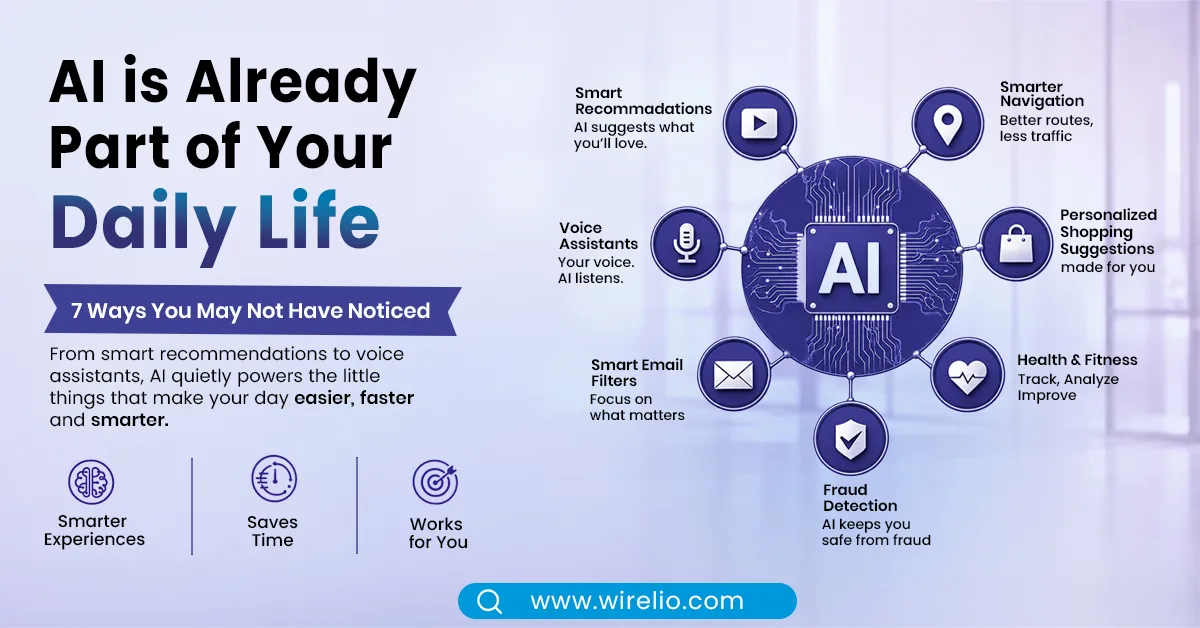

Artificial intelligence can sound like a world in the future: humanoid robots, autonomous machines and computers capable of almost anything humans can do.
But look closer at your own day.
You search for something online. Your phone predicts what you are typing.
A navigation app suggests a faster route. A streaming platform recommends what you might enjoy. Your email automatically separates spam from important messages. Your photo library somehow finds every picture of a dog when you type "dog."
Artificial intelligence is already working behind many of these experiences.
And as generative AI is integrated into more mainstream products, the line between "using AI" and simply "using technology" is becoming difficult to see.
Here are seven ways AI may already be part of your everyday life, even if you don't consciously think about it.
1. The Way You Search Online
Searching the internet once meant entering a few keywords and scrolling through pages of blue links.
That experience is changing rapidly.
Modern search engines are using artificial intelligence to understand not only the words you type, but increasingly the meaning behind your question.
Google, for example, has expanded AI-powered experiences such as AI Overviews and AI Mode. In 2026, it further upgraded AI Mode with newer models and agent-like capabilities to handle more complex questions.
That means a search such as:
"What should I pack for a five-day trip where it might rain?"
can be handled differently from a traditional keyword query such as:
"rain travel packing list."
AI systems can interpret context, compare information and organise results around what the user seems to be trying to accomplish.
Why You May Not Notice It
Because you are still doing something completely familiar: Searching.
The intelligence behind that search is what has changed.
Explore: How Google is developing AI-powered Search
2. The Recommendations You See Every Day
Why does a streaming platform seem to know what you might want to watch next?
Why does an online store recommend a product surprisingly close to what you were considering?
Why does your social-media feed look completely different from someone else's?
Recommendation systems are one of the most established applications of machine learning.
They can analyse signals such as previous interactions, searches, viewing behaviour and other contextual information to predict which content or products may be relevant.
The result is an internet that increasingly looks different for each individual.
Think About Your Typical Day
You may encounter algorithmic recommendations when choosing: a video to watch, music to listen to, an article to read, a product to consider, a restaurant to explore, or the next post appearing in your feed.
In other words, AI isn't always creating something.
Sometimes it's simply deciding what you see next.
Personalisation is becoming more sophisticated. Google, for example, has introduced optional Personal Intelligence capabilities that can use context from connected services to provide more tailored AI responses and recommendations.
3. Navigation Apps Predicting the Better Route
Open a navigation app during rush hour and something remarkable happens almost instantly.
It doesn't only know where the roads are.
It can estimate how long different routes may take, identify congestion and adjust your estimated arrival time as conditions change.
Google explains that navigation data helps Maps provide real-time features including traffic conditions, disruptions and faster-route suggestions.
AI is pushing this further.
Google has integrated Gemini capabilities into Maps in India, including conversational features for discovering places and navigating. More recent mapping technology also combines AI with live information such as travel times, road conditions and route information.
Why This Matters
When your phone suddenly says:
"A faster route is available."
that apparently simple notification may represent an enormous amount of data analysis happening behind the scenes.
What feels like basic navigation is increasingly an intelligent prediction system.
4. Your Email Inbox Is Smarter Than It Looks
Think about how much unwanted email reaches the internet every day.
Yet much of it never reaches your primary inbox.
Spam detection has long been one of the practical applications of machine learning.
Rather than relying only on a rigid list of banned words, machine-learning systems can recognise patterns associated with suspicious or unwanted messages.
But AI's role in email has far moved beyond that.
It can help: suggest replies, complete sentences, summarise long conversations, improve writing, identify important information, and help users search their inboxes.
Google has continued adding Gemini-powered functionality to Gmail, including AI Overviews and writing and reply features.
Apple has similarly been expanding AI-assisted communication features, including context-aware suggestions and Smart Reply capabilities in Mail and Messages.
The Invisible AI Effect
You don't open your inbox thinking:
"I'm going to use artificial intelligence now."
You simply expect spam to disappear and useful messages to be easier to manage.
That's exactly why everyday AI can so easily be overlooked.
5. Your Phone Understands Your Photos
Try opening your photo library and searching for:
Beach.
Or:
Dog.
Or:
Birthday.
Depending on the device or service you use, there's a good chance relevant photos will appear even though you never manually labelled every image.
How?
Computer vision.
AI systems can analyse visual information and recognise objects, scenes or patterns inside photographs. Machine learning has been used for years to make photo libraries searchable based on what's actually visible inside the image. Today's systems can go significantly further, using AI to understand more complicated requests involving images and context.
Why It Matters
Before this technology, organising thousands of photographs required folders, filenames, dates and manual tagging.
AI turned many photo collections into something close to a searchable visual memory.
And millions of users benefit from it, without ever describing themselves as AI users.
6. AI Is Helping You Communicate
Communication may be one of the places where AI is becoming most deeply embedded.
Consider how often you encounter:
Predictive typing.
Autocorrect.
Suggested replies.
Speech recognition.
Automatic captions.
Translation.
All of these can involve machine-learning techniques.
When your keyboard predicts the next word, software is analysing language patterns.
When your phone converts speech to text, AI models help identify spoken language.
When an app translates a sentence between languages, modern machine-learning systems can help interpret context rather than mechanically replacing individual words. AI-powered communication tools are taking another step forward.
Apple's latest intelligence features, for example, include context-aware suggestions in Messages and more personalised Smart Reply capabilities.
The result is a subtle but significant change:
AI isn't only helping machines understand humans.
It's increasingly helping humans communicate with one another.
7. Your Smartphone Is Becoming an AI Assistant
Perhaps the biggest transformation is happening inside the device you already have.
Smartphones are gradually evolving from a collection of apps into systems capable of understanding context across multiple activities.
AI can potentially help organise notifications, summarise information, find photographs, enhance images, translate conversations, identify objects through the camera and retrieve information from connected services.
Google's Personal Intelligence initiative illustrates where this could go. In India, users who opt in can connect services including Gmail, Photos, YouTube and Search to Gemini so that the assistant can reason across personal context and provide more tailored responses.
Apple is similarly integrating intelligence across everyday experiences on its devices.
The Bigger Shift
For years, smartphones have worked largely like this:
You open an app → give it an instruction → receive a result.
AI could increasingly change that to:
You describe what you need → the system figures out how to help.
That may ultimately be one of the most important changes AI brings to consumer technology.
AI Isn't Coming. It's Already Here.
When people talk about artificial intelligence, conversations often jump immediately to the future.
Will AI replace jobs?
Will robots become commonplace?
Will machines eventually think like humans?
Those are important debates.
But they can distract from something happening right now.
Artificial intelligence is already embedded in many ordinary digital experiences.
Every time software predicts traffic, filters spam, recommends a video, recognises a photograph, translates a sentence or understands a complicated search query, you're seeing different forms of machine intelligence at work.
And increasingly, the most successful AI may be the AI you barely notice.
It doesn't announce itself.
It simply makes something faster, easier, more relevant or more personalised.
The Next Question: How Much AI Do We Want?
Convenience shouldn't eliminate scrutiny.
As AI systems become more personalised, important questions around privacy, transparency, accuracy, bias and user control become increasingly relevant.
Users should understand when AI is being used, what information it can access and what controls are available.
AI can make technology more useful, but usefulness and responsibility need to evolve together.
The real story of artificial intelligence, therefore, isn't simply about increasingly powerful models.
It's about how quietly those models are becoming part of ordinary life.
The future of AI may not arrive with robots walking through our front doors.
It may already be sitting in our pockets.
Wirelio — Beyond Headlines
Explore more explainers, technology stories and perspectives at Wirelio.

No comments posted yet. Be the first to express your thoughts!