

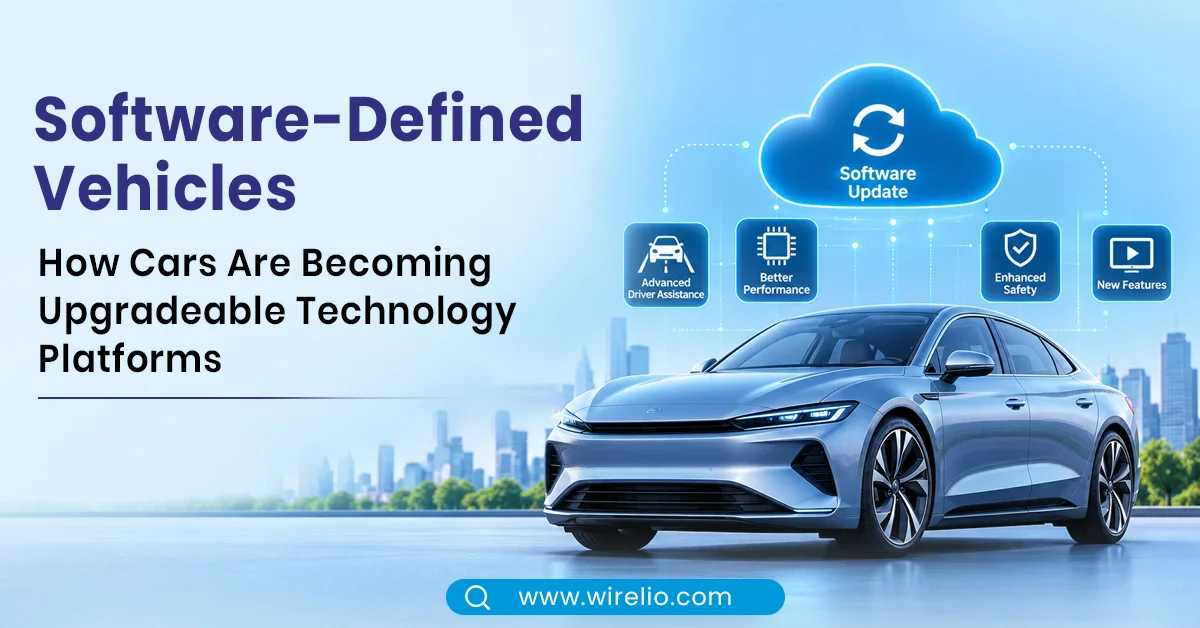

A modern car is no longer defined only by its engine, transmission, design or onboard equipment. Increasingly, its capabilities also depend on software: the systems that manage vehicle functions, power delivery, infotainment, connectivity, driver assistance and the digital experience inside the cabin. This shift is giving rise to software-defined vehicles (SDVs) — cars designed so that software plays a central role in how features work and how the vehicle can evolve after it leaves the showroom.
The idea goes beyond adding a touchscreen or connecting a car to a smartphone app. A connected car can offer remote locking, location tracking and online navigation, but a software-defined vehicle is built around a more integrated electronic and computing architecture. This can allow manufacturers to deliver improvements, fix certain issues and introduce compatible features through over-the-air (OTA) updates.
For drivers, the promise is appealing: a vehicle that can improve over time rather than remain limited to the software installed on its delivery date. However, this model also raises important questions about paid features, cybersecurity, personal data, repairability and what customers actually own when they purchase a connected vehicle.
What Makes a Vehicle Software-Defined?
In a conventional vehicle, many electronic functions are managed by separate electronic control units (ECUs). One controller may handle a particular engine function, another may manage braking-related systems, while others support lighting, climate control, infotainment or body electronics. These units communicate with one another, but the architecture can become complex as manufacturers add more features and electronic systems.
Software-defined vehicles move towards a more integrated approach. Depending on the design, multiple functions can be coordinated through domain controllers, zonal architecture and more powerful central computing platforms. Instead of treating every function as an isolated electronic system, manufacturers can build a vehicle platform in which software manages a larger share of its behaviour and features.
The International Energy Agency (IEA), in its Global EV Outlook 2026 report, explains that the industry is moving from conventional distributed electronic architectures towards domain-based and zonal systems, with fewer controllers handling a wider range of functions. The report also notes that electric vehicles have been at the forefront of this transition, although manufacturers are working towards wider adoption across different powertrains. IEA – Vehicle Software and Software-Defined Vehicles
This does not mean that every part of the car becomes software-controlled or that mechanical components disappear. Tyres, suspension hardware, brakes, motors and other physical components still have to perform their jobs. The difference is that software increasingly coordinates, monitors and influences how many vehicle systems operate.
It is also important to distinguish between a connected car and a fully software-defined vehicle. Connectivity provides the communication link; an SDV uses a software-oriented architecture to make broader vehicle functions more adaptable. Many cars currently sold are somewhere between these two categories rather than fully software-defined.
How OTA Updates Can Change a Car After Purchase
One of the most visible benefits of software-defined vehicles is the ability to receive over-the-air updates. Similar to how a smartphone downloads an operating system or application update, a compatible vehicle can receive software through an internet connection, often using its built-in cellular connection or a Wi-Fi network.
An OTA update may involve different types of software, depending on the vehicle and the manufacturer's support. These can include:
Infotainment updates: Improvements to the touchscreen interface, navigation, voice assistance, media systems and connected applications.
Vehicle control updates: Changes to supported electronic control systems, where the manufacturer has designed and approved remote updating.
Driver assistance improvements: Updates to compatible sensors, software logic or assistance features, subject to the vehicle's hardware and safety requirements.
Battery and energy management: In eligible electric vehicles, software improvements may affect battery monitoring, charging management or energy-use strategies.
Security and reliability fixes: Patches intended to address vulnerabilities, software errors or system performance issues.
The exact scope varies significantly. An infotainment update is not the same as an update to a safety-critical vehicle controller. Some updates can be installed remotely, while others may require a workshop visit, specialist equipment or physical inspection.
Manufacturers also place conditions on the installation process. The vehicle may need to be parked, switched off, in a particular gear position or connected to a stable power supply. Drivers should follow the on-screen instructions and avoid interrupting an update once installation has started.
Indian manufacturers are already communicating these capabilities to customers. Hyundai Motor India, for example, has described OTA capability as part of its connected-car and software-defined vehicle roadmap. Its October 2026 announcement for the India-spec Hyundai BAYON highlighted controller OTA capability across up to 19 controllers, alongside its connected cockpit and Bluelink features. This is a manufacturer announcement about a particular model and should not be interpreted as a claim that every Hyundai vehicle supports the same update functions. Hyundai Motor India – BAYON technology announcement, 12 October 2026
For buyers, the practical question is not simply whether a car has OTA updates. It is worth checking which systems can be updated, how long the manufacturer expects to support the vehicle, whether updates are free, and what happens if an update fails.
Subscriptions, Paid Features and the New Cost of Ownership
As vehicles become more connected and software-dependent, manufacturers have new ways to offer digital services. Some features may be included in the vehicle's purchase price for a limited period, while others may require a paid subscription, a one-time payment or an active connected-services plan.
Examples can include remote vehicle functions, live traffic information, cloud-based navigation, advanced vehicle reports, connected entertainment and certain convenience services. In some markets, manufacturers may also offer software-enabled features that depend on specific hardware already installed in the vehicle.
This creates a different ownership model. A buyer may pay for the car and its hardware but continue paying separately to access selected digital services. A feature that works during an introductory period may become unavailable or restricted when the subscription expires.
Hyundai India's Bluelink subscription information provides a practical example. The company states that Bluelink is offered free for the first three years with a new car, after which customers can renew it on a paid basis. Its published information also states that the subscription is non-transferable and that certain services, including roadside assistance, are handled separately. Terms can vary by model, plan and purchase conditions, so customers should check the applicable agreement rather than assume the same arrangement applies to every vehicle. Hyundai India – Bluelink subscription details
There are potential benefits to this model. Customers may be able to activate services only when they need them, while manufacturers can continue improving supported functions without requiring a new vehicle purchase. But subscriptions can also make long-term ownership more complicated.
Before buying a connected or software-defined vehicle, customers should ask:
Which connected features are included in the purchase price?
How long do complimentary services remain active?
What is the renewal price, and are different subscription periods available?
Will essential functions continue working if the subscription expires?
Are paid features tied to the vehicle, the owner's account or a specific user?
Can subscriptions or digital services be transferred when the car is resold?
What happens to connected features if the manufacturer discontinues a service?
The distinction between a software update and a paid feature is particularly important. A safety or security update should not be confused with a subscription that unlocks a convenience service. Buyers should understand exactly what is being updated, what is being activated and what requires an additional payment.
Cybersecurity, Privacy and the Ownership Questions Buyers Should Consider
A connected vehicle exchanges information with mobile applications, cloud platforms, navigation services, charging networks and, in some cases, external devices. This creates useful functionality, but it also expands the number of systems that need protection.
Potential risks include unauthorised access to vehicle accounts, exposure of location or personal information, compromised connected services and vulnerabilities in software or communication systems. The seriousness of a weakness depends on the system involved. A problem with an entertainment application is not automatically equivalent to a vulnerability affecting a vehicle's critical control systems, but both deserve appropriate safeguards.
Cybersecurity therefore has to be part of vehicle design and maintenance, not an afterthought. The US National Highway Traffic Safety Administration (NHTSA) describes automotive cybersecurity as the protection of vehicle electronic systems, communication networks, control algorithms, software and user data from malicious access, damage or manipulation. Its best-practice guidance also emphasises the importance of treating cybersecurity as an ongoing responsibility for manufacturers and suppliers. NHTSA – Automotive Cybersecurity | NHTSA – Cybersecurity Best Practices for the Safety of Modern Vehicles, 2022
International rules are also evolving. UN Regulation No. 155 addresses vehicle cybersecurity and cybersecurity management systems, while UN Regulation No. 156 covers software updates and software update management systems. These frameworks require manufacturers in jurisdictions applying the regulations to establish processes for identifying risks and managing software updates. The UK's Vehicle Certification Agency explains how the two regulations relate to cybersecurity and software update management. UK Vehicle Certification Agency – Cyber Security and Software Updating
For consumers, these developments make it sensible to check a manufacturer's update policy and data practices. A buyer should understand what information the vehicle collects, how connected services use it, whether location sharing can be controlled, and how personal data is handled when ownership changes.
Ownership itself may become more layered. A customer physically owns the vehicle, but access to some connected services may depend on an account, an active subscription, compatible mobile networks and the manufacturer's servers. If a service is discontinued or a connectivity network is no longer supported, certain digital functions may stop working even though the vehicle remains roadworthy.
Resale is another consideration. A second owner may need to remove the previous owner's account, register the vehicle again and activate eligible services. Buyers of used connected cars should verify the transfer process, subscription status, remaining complimentary-service period and availability of software support before completing a purchase.
What Indian Car Buyers Should Look for Next
Software-defined vehicles are likely to become more relevant as automakers introduce more connected features, electric platforms, digital cockpits and advanced driver assistance systems. India's market will not necessarily follow the same pace or product mix as Europe, China or the United States. Vehicle prices, mobile network coverage, customer expectations, service infrastructure and local regulations will influence how quickly these systems become mainstream.
Recent manufacturer announcements indicate that the transition is moving beyond premium global electric cars. Hyundai Motor India's BAYON announcement in October 2026 highlighted controller OTA capability and connected technology for the Indian market. Mahindra has also described its software-defined vehicle direction through its MAIA architecture. In its announcement about the BE 6 SPORTEQ, the company said new software and technology features would be rolled out to existing BE 6, XEV 9e and XEV 9S customers in phases beginning January 2027, with availability varying by model and variant. These are examples of announced manufacturer plans, not a guarantee that every feature will be available on every vehicle. Mahindra – BE 6 SPORTEQ announcement
For Indian consumers, the best way to assess an SDV is to look beyond the size of its touchscreen or the number of features listed in a brochure. Ask the dealership to explain the update process, demonstrate the connected application and provide the current subscription terms. Check whether important functions depend on a mobile network, whether the car can still be used normally without an active data plan, and how long software support is expected to continue.
It is equally important to remember that software cannot compensate for unsuitable hardware. A car cannot gain a new sensor, a more powerful processor or a different physical component through a software download alone. Some features may be technically possible only on selected variants, and an update may not be offered to older models even if they share the same brand or nameplate.
FAQs
1. What is a software-defined vehicle?
A software-defined vehicle is designed so that software manages and coordinates a significant share of its functions. Its electronic architecture supports software updates and, where compatible, improvements or new features after the vehicle has been sold.
2. Can OTA updates improve a car's performance?
They can improve selected software-controlled functions, fix bugs, update infotainment systems and, in eligible vehicles, refine certain vehicle-management or driver-assistance systems. However, an OTA update cannot overcome hardware limitations or guarantee a measurable improvement in every vehicle.
3. Will I have to pay a subscription to use all connected-car features?
Not necessarily. Some features may be included in the purchase price, offered free for a limited period or provided without a recurring fee. Other services may require renewal or a paid plan. The exact arrangement depends on the manufacturer, model, variant, market and service terms.
4. Are software-defined vehicles safe from hacking?
No connected digital system can be assumed to be completely immune to cyberattacks. Manufacturers need to protect vehicle software, communication channels and user data, while owners should use secure accounts, install authorised updates and review privacy settings. Cybersecurity standards and regulations help establish safeguards, but security remains an ongoing responsibility.
Conclusion: A Car That Can Evolve, but Needs Clearer Ownership Rules
Software-defined vehicles represent a significant change in the relationship between people and their cars. Instead of treating the vehicle as a finished product on delivery day, manufacturers are building platforms that can receive software improvements, connected services and, in some cases, new capabilities throughout their useful life.
That evolution could make vehicles more convenient, adaptable and easier to maintain. It could also introduce recurring costs, greater dependence on manufacturer platforms and new questions about privacy, repairability and resale value.
For buyers, the smartest approach is to evaluate the complete ownership proposition: the vehicle's hardware, its update capability, the manufacturer's software-support commitment, subscription conditions and cybersecurity practices. A car that promises to improve over time is valuable only when those improvements remain useful, secure, transparent and reasonably accessible to the person who owns it.

No comments posted yet. Be the first to express your thoughts!