

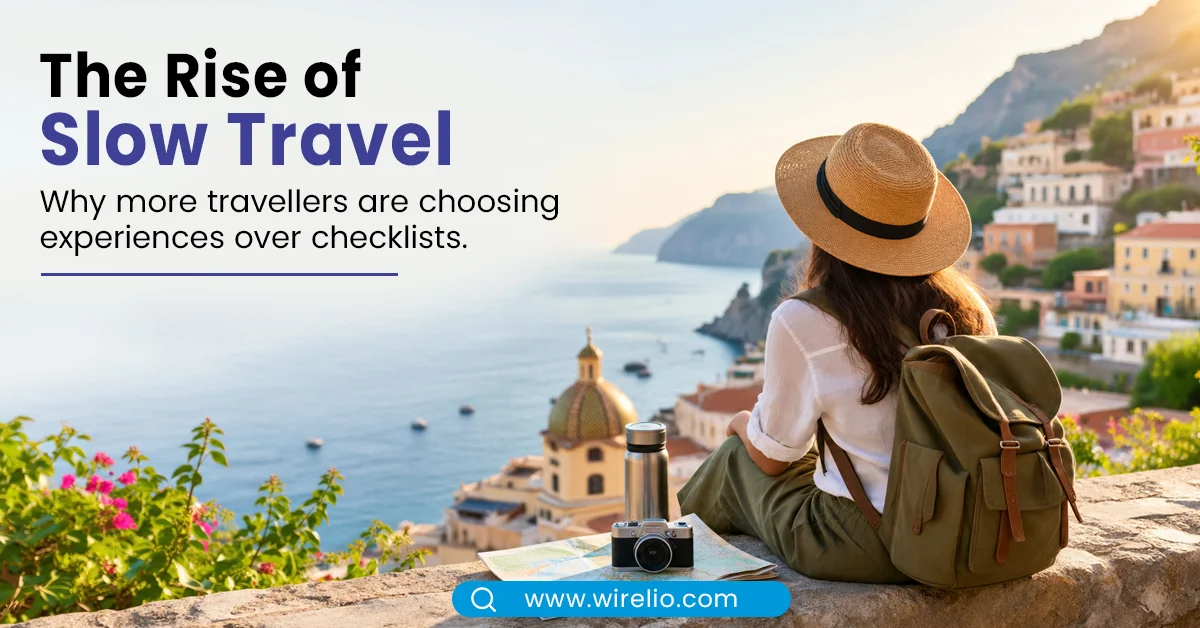

There was a time when I thought a good holiday meant seeing as much as possible.
Five days in a new city? Easy.
I would come up with a list of ten places to visit, six restaurants to try, three markets to explore and maybe include a sunrise viewing spot for good measure. Then I would spend the trip looking on my phone, checking the maps and wondering if I would be able to include the next location on the itinerary.
By the time of my return, I would have hundreds of photos.
But sometimes I could no longer remember how that place felt like.
That is what led me to reflect on the way I travel.
Leaving more gaps between events, sitting in a local café longer, taking walks without a plan, talking to people rather than instantly relying on what an app would suggest.
And in that process, I discovered what is referred to as slow travel.
It is not about limiting the amount you travel, it is about traveling differently
What is Slow Travel?
Slow travel is a travel phenomenon that prioritises experiences in a particular location. Instead of trying to see as much as possible, it seeks to explore a destination in depth.
While a fast paced traveller might try to see five cities in five days, a slow traveller might spend the same five days exploring just one or two. Instead of rushing from one popular sight to see the other, the slow traveller may find themselves:
- Taking a walk on local streets
- Trying regional cuisine
- Having conversations
- Enjoying the local nature
- Using local transport
- Visiting small towns
- Spending more time
- Learning the culture
- Getting engaged in local activities
In short, slow travel is about experiencing a destination rather than simply visiting it. And this concept seems to be capturing the attention of many.
Booking.com's latest travel research found that authenticity and off-the-beaten-track are on the rise with their 2026 sustainability research finding a 43% increase in travellers looking to avoid crowded destinations and 42% looking to travel on off-season months.
Why are Travellers Turning Away from Travel Checklists?
I have often been a victim of my own checklist.
You arrive somewhere and ask yourself, "What should I see here?"
Then the search begins for all the must-see attractions.
You find the most popular ones, the ones featured most on the social media, the places all the tourists are going. From there you begin adding one place after the other, trying to see as many as you can, including another Instagram location and taking photographs.
At the end of the day your phone has over 2000 steps and your mind has been through 50 different locations.
The issue is not that you want to discover these places, the issue is that the whole holiday feels like a checklist. Sometimes the most memorable parts of a trip are not the attraction, but the local bakery which you stumbled upon by mistake or a simple conversation with a shopkeeper, or a local railway or a hour long sit at a lake while doing nothing. These are often the parts that get skipped when looking at travel checklists.
Slow Travel is About Staying Longer
One of the easiest ways to engage in slow travel is to extend the duration of your stay wherever you go.
Using the example of Rajasthan, instead of cramming in all five cities in a single five-day trip, think of staying for a longer period of time and only include places you can genuinely experience.
You will be able to wake up without rushing to the next location and find yourself with more time during the day.
You can spend time on local breakfast places, explore older parts of the city, visit a market, take an afternoon break, have conversations with long-time residents, watch sunsets and then go out for dinner. Fewer Instagram stories may be posted on the trip, but the experience would be significantly richer.
The Joy of Not Having Every Hour Planned
This was perhaps one of the most difficult lessons.
Having a free afternoon in my itinerary felt almost like a waste.
What if I missed out on something? What if I could have found something better nearby? What if everyone else was going elsewhere?
But I have often found that an unplanned afternoon can sometimes lead to the most fulfilling part of a trip.
You end up discovering a local street festival, a small bookshop or family-run dining place or simply exploring a part of the city that was not in any travel guides. With slow travel, the possibilities open up.
Local Food as Part of the Experience
One of the easiest ways to discover a place is to try its food.
And slow travel makes it easier to move away from popular lists and discover what the locals eat.
Rather than sticking to places with great reviews, ask someone who lives here for recommendations or use them as a guide while exploring the city. A simple breakfast joint can often say a lot more about a region than any of the restaurants built specifically for tourists. Regional delicacies, methods of cooking and markets are all valuable experiences that can enhance the travel experience.
Slow travel makes local dining an important part of the journey rather than just something to snack on while sightseeing.
Slow Travel Makes Everyday Activities Feel Special
One thing I have noticed about slow travel is its ability to change the way we think about daily life.
Taking a local bus feels special, buying groceries becomes an opportunity to see what people are eating, walking to dinner becomes a way to explore the city and sitting in a park becomes a memory. You don't need to always spend money on expensive excursions and activities, sometimes all we need is enough free time to make every day activity a fascinating adventure.
Slow Travel Can also Mean Visiting Smaller Locations
Popular destinations do not always provide the best tourist experience.
With slow travel, the sheer number of attractions available becomes less important and other priorities emerge such as spending more time exploring a smaller area.
Instead of looking for the most popular destination, slow travellers may find themselves asking which of the less known or smaller towns can offer the most meaningful travel experience.
This philosophy also overlaps with some of the emerging travel trends.
Booking.com's 2026 research found a 43% increase in travellers looking to avoid overcrowded destinations with 37% looking to limit pressures on the region.
Slow Travel and Sustainable Travel Often Overlap
Sustainable travel and slow travel share similarities.
The longer you stay in one destination, the fewer short-haul internal flights you need to take. Exploring a destination using more local means such as train, buses or walking can reduce the overall carbon footprint. Staying in accommodation and eating at places operated by locals can also have positive effects on the economy and environment of the destination.
Booking.com's 2025 research found that 93% of global travellers wanted to continue making more sustainable travel choices while 58% were already changing their travel habits to do so.
The connection to sustainable travel, in particular, is also something I find to be a good point for slow travel.
When we slow down our trip, it makes it easier to keep track of where our money is going and what level of impact we are having.
Indian Travellers are Seeking More Experiences
Another piece of research on Indian travellers found a shift towards more self-designed travel in preference to generic group packages. This makes perfect sense as the popularity of travel has grown and travellers may find that the usual statements of "I did this" or "I went to that" no longer satisfy their need for fulfilling travel experiences.
They begin looking for what can I experience in a place, what can I learn or discover, what can I do that is interesting or even different.
What can I do to forget about the stresses of my daily life and come back as a more well-rounded person with a different story to tell?
You Don't Have to Stop Planning
Slow travel does not mean you cannot plan anything.
I still plan my trips. I still book accommodation and keep track of transport and save lists of places and meals.
What slow travel enables me to do is stop feeling pressured to utilise every minute of the day. A well-structured slow travel itinerary can have 2 or 3 planned activities alongside plenty of unplanned time. That empty space is important for flexibility.
Sometimes changing up a plan is exactly the chance we need to create better memories.
How to Incorporate Slow Travel Into Your Holiday
You do not need to take a month long holiday to take part in slow travel, you can begin with your next weekend getaway.
1. Stay somewhere a little longer
2. Have a free day or few hours.
3. Take local transport.
4. Eat a meal somewhere local.
5. Ask people.
6. Limit the time you look on your phone.
7. Think of other activities as a substitute for a full sightseeing schedule.
8. Look at off-peak or shoulder season travel.
Looking back on my holidays, one thing I rarely recall anymore is all the places I managed to see.
The real memories were often in the form of the unexpected and unplanned.
The restaurant I stumbled upon and the conversation I had with a stranger that led to them giving me local recommendations. The train ride where I ended up meeting one of the most interesting people I have experienced in my life.
The rains which completely wrecked my itinerary while I was on a holiday. The beautiful evening sit I had in a place that made me feel completely at peace and free from the stresses of my day-to-day.
Those moments are the ones that stayed with me and rarely did I feel they were worth rushing to see. In fact, when unplanned events occurred, I found that my trip had changed and taken a turn towards becoming more fulfilling.
Travelling has become much easier to plan. We have maps, apps for everything, review sites, influencers telling people where to go, AI planning tools, social media and so on. So much information means that people think they need to do more to get the most out of their trip.
Frequently Asked Questions
What is slow travel?
Slow travel is a way of exploring destinations at a relaxed pace, with greater emphasis on local culture, authentic experiences, meaningful interactions and spending more time in fewer places rather than rushing through a long checklist.
Why is slow travel becoming popular?
Slow travel is gaining attention as travellers look for more personalised, authentic and meaningful experiences. Current travel research also points toward growing interest in less crowded destinations, off-season travel, sustainability and experiences that connect travellers with local communities.
Is slow travel better than traditional travel?
Slow travel isn't necessarily better for everyone. It is simply a different approach. Travellers who enjoy flexibility, local experiences and spending more time in one destination may find it more rewarding than tightly packed itineraries.
How can I practise slow travel on a short trip?
You can practise slow travel even on a weekend trip by choosing one destination, avoiding an overloaded itinerary, leaving free time, walking or using local transport, eating at local establishments and prioritising experiences over visiting as many attractions as possible.
Is slow travel expensive?
Slow travel doesn't have to be expensive. Staying longer in one place, using public transport, walking, eating at local restaurants and choosing locally owned accommodation can help manage costs. The focus is on how you experience a destination rather than how much you spend.

No comments posted yet. Be the first to express your thoughts!