

.webp)
Diwali is not simply a time for festive shopping, new clothes and home upgrades - it is also one of India's most popular times to buy a new car. As well as the practicality of getting around, many families also feel an emotional connection to buying a car during Diwali. A new car is a fresh start, it's family time and the excitement of the first festive-season drive.
Car dealerships prepare for a rise in festive demand with promotional schemes, exchange benefits, finance offers and other incentives.
But before you get carried away by a Diwali car offer or a big discount banner, take a step back.
The best car festive deal isn't necessarily the one showing the biggest discount.
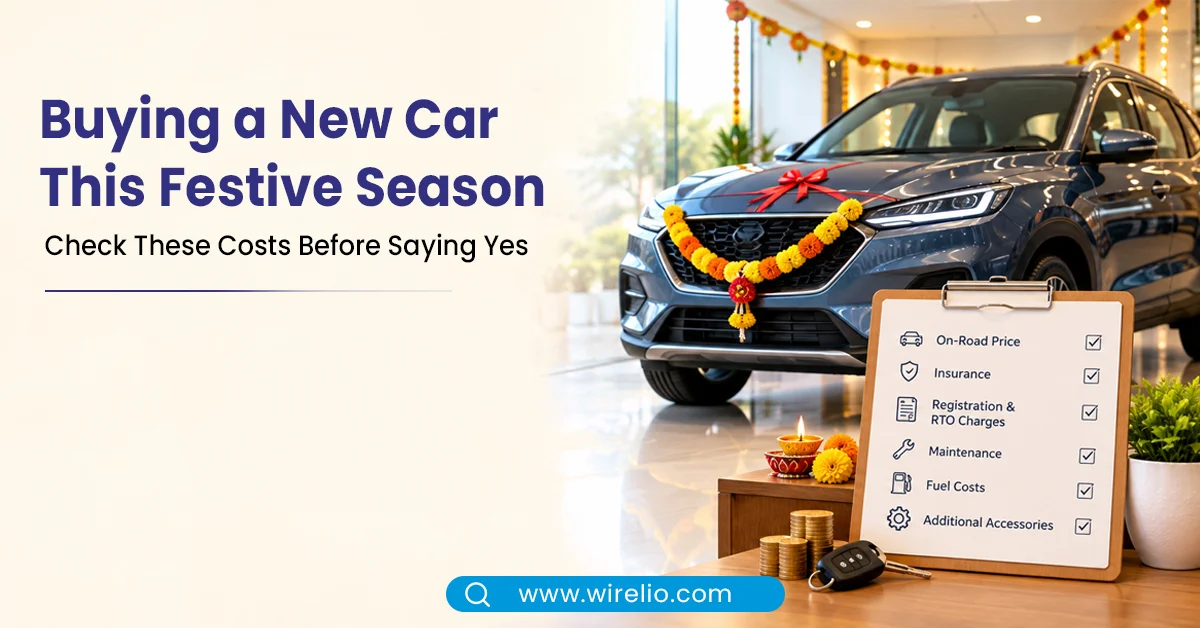
You need to compare the final on-road price, insurance, financing, exchange value, manufacturing date, safety features, warranty, service costs and the condition of the car before delivery.
This Diwali car buying guide tells you all about the things a new buyer should consider - in simple language.
Why Is Diwali a Popular Time to Buy a Car?
The festive season is traditionally an important period for automobile sales in India. Automakers and dealers prepare their inventory ahead of the festive rush, while buyers actively look for Diwali car offers, festive car discounts and new car deals. Recent 2026 industry reports also show manufacturers and dealers boosting inventory to prepare for festive demand.
There is a cultural reason as well.
For many Indian families, Dhanteras, Diwali and other auspicious occasions are considered suitable times for making major purchases. A new car can therefore become part of the family's festive shopping plans.
Depending on the manufacturer, model, variant and dealership, a festive car offer may include:
- Cash discounts
- Exchange bonuses
- Corporate offers
- Loyalty benefits
- Finance offers
- Accessories
- Extended warranty packages
- Scrappage-related benefits, where applicable
- Special festive benefits
However, remember that the maximum advertised benefit may be a combination of several different offers rather than a direct reduction in the car's price.
Current 2026 festive offers are also changing by model, variant, stock and buyer eligibility.
So, how do you know whether a Diwali car deal is actually worth it?
Diwali Car Buying: Don't Look Only at the Headline Discount
Imagine you see: "Get benefits worth Rs.1 lakh on this Diwali car offer!"
It sounds like an excellent deal.
But what does that Rs.1 lakh actually include?
It could potentially be a combination of Rs.40,000 cash discount, Rs.25,000 exchange bonus, Rs.15,000 corporate benefit, Rs.20,000 accessories or other benefits. That doesn't necessarily mean the dealer is reducing the car's price by Rs.1 lakh.
This is why your first question should be: "What is my final on-road price after all applicable discounts?"
Compare the On-Road Price Before Buying a Car
The on-road price is much more important than the advertised ex-showroom price when you're planning your festive car purchase.
In simple terms:
On-road price = what you actually pay to get the car registered and ready for use.
It can include:
| Cost | What it means |
| Ex-showroom price | Basic price of the vehicle |
| Registration charges | Cost associated with registering the car |
| Road tax | Applicable state-level vehicle tax |
| Insurance | Motor insurance |
| FASTag | Electronic toll-payment tag |
| Accessories | Optional products added to the car |
| Extended warranty | Optional additional coverage |
| Other applicable charges | Charges depending on the transaction and location |
Festive car buying tip: Ask for a full written on-road quotation from at least two dealers.
You may find that the other dealer, who is offering a lower headline discount, might actually be giving you a better deal!
Also check out our blog on the comparison for EV vs. Petrol vs. Hybrid cars.
What Should You Compare in a Diwali Car Offer?
1. Asking for the right festive discount
Do not ask the wrong question!
Instead of asking "How much discount are you giving?", ask "Please give me a full breakup of every discount and benefit".
2. Compare Car Insurance
Insurance can make a world of difference to your end-cost of the new car.
Don't settle for the first insurance quotation offered by the dealership
Compare:
- Premium
- Coverage
- IDV ( IDV stands for Insured Declared Value, which is the current market value of your car and the maximum amount your insurance company will pay you if your car is stolen or damaged beyond repair)
- Deductibles
- Add-ons
- Zero-depreciation cover
- Cashless garage network
- Claim process
Third-party motor insurance is compulsory for all vehicles being used on public roads in India. Moreover, by law, IRDAI also encourages consumers to compare policies based on factors other than only the premium.
In short, Don't ask: 'How cheap is the insurance?'
Ask: What am I getting in return for the premium I am paying?
3. Check the Car's Manufacturing Date
A dealer may have cars that were manufactured earlier in the year while newer stock may also be available. An older manufacturing date does not necessarily rule out a car being a good purchase.
However, it helps to understand what you are buying.
Ask the dealer for the manufacturing details of the vehicle and work out the offer on a case-by-case basis.
For example: Older stock + bigger discount versus Newer stock + smaller discount
The former might make sense if the difference in price is significant—but you should do this knowingly.
4. Check the VIN Before Delivery
The VIN, or Vehicle Identification Number, is basically the unique identification number of your car.
Before taking delivery, ensure that the VIN/chassis details match with those found in the documentation provided by the dealer.
Also check:
- Model
- Variant
- Colour
- Fuel type
- Transmission
- Chassis/VIN details
- Engine details where applicable
- Manufacturing information
Don't hesitate to ask the salesperson to clarify any doubts.
5. Don't Let Festive Accessories Inflate Your Bill
Part of the appeal of a festive car purchase could be the enticing accessories bundle that comes with it.
You may be offered Floor mats, Seat covers, Car covers, Door guards, Dashcams, Sunshades, Cleaning kits, Paint protection, and other accessories.
While some of these can be functional, you may not need them immediately.
Simple question: Do I need this right now? Can I get this elsewhere at a lower price?
If you are being offered a 'free accessories package', ask for the value and work out whether the price has been inflated to accommodate it.
6. Compare the Car Loan, Not Just the EMI
A lower monthly instalment may make a new car more attractive than otherwise.
Suppose a dealer tells you: 'Your EMI will be only Rs.18,000 per month.'
That sounds easy to manage
But you should also ask:
- What is the down payment?
- What is the loan amount?
- What is the interest rate?
- What is the loan tenure?
- What is the total repayment?
- Are there processing fees?
- Are there other applicable charges?
Remember: EMI tells you what you pay every month. Total repayment tells you what the loan costs you overall.
This is especially important when comparing Diwali car finance offers.
Documents Required for Buying a New Car in India
With the festive car deal in hand, there is one more crucial element in the process — paperwork.
The precise requirements may vary depending on the state and registration process. Parivahan's permanent-registration guidance lists documents including Form 20, Form 21, Form 22, insurance, proof of address, temporary registration where applicable, PAN/Form 60/61 as applicable and the dealer/manufacturer invoice.
Let's break it down:
1. Identity Proof
You need an approved identity document for the registration and associated processes.
2. Address Proof
The registration authorities require proof of the address of the vehicle owner. The precise acceptable documents may vary depending on applicable process.
3. PAN Card or Applicable Tax Declaration
PAN may be applicable for the registration and financial documentation, with applicable tax declarations such as Form 60/61 depending on the circumstances.
4. Form 20 — Registration Application
Form 20 basically says: ‘Please register this car in my name’ It is the application for vehicle registration.
5. Form 21 — Sales Certificate
It proves a motor vehicle has been sold and delivered by a manufacturer, authorized dealer, or defense department officer.
6. Form 22 — Roadworthiness Certificate
This is the manufacturer's roadworthiness certificate. In simple terms, it is manufacturer's certification concerning the vehicle's compliance with applicable roadworthiness requirements.
7. Insurance Certificate
You need valid motor insurance as part of the registration process.
8. Dealer/Manufacturer Invoice
Your invoice contains important information about your purchase. Check it carefully before accepting the final bill.
9. Temporary Registration, Where Applicable
If temporary registration is issued, retain the relevant documentation until permanent registration is completed.
10. Registration Certificate (RC)
The RC is your vehicle's official registration document. Once registration is completed, ensure that the vehicle and owner details are correct.
PDI: The Most Important Check Before Taking Your Diwali Car Home
Imagine you've done the festive shopping, paid for your new car and you are at the dealership, ready for delivery.
You are eager. But before you take delivery, make sure to perform a PDI — Pre-Delivery Inspection.
In simple words: PDI entails inspecting the car thoroughly before accepting it as yours.
Exterior PDI Checklist
Check for:
- Scratches
- Dents
- Paint marks
- Paint mismatch
- Damaged glass
- Headlights
- Taillights
- Mirrors
- Bumpers
- Wheels
Interior PDI Checklist
Check:
- Seats
- Dashboard
- Infotainment
- Air conditioning
- Power windows
- Central locking
- Reverse camera
- Parking sensors
- USB/charging ports
- Interior lights
- Under the Bonnet
Look for anything unusual, including visible leaks or damages.
Most importantly, verify that the VIN/chassis details on the vehicle match with the documents. If you discover an issue, make sure to bring it up before accepting delivery.
Don't Forget Safety When Festive Shopping for a Car
When consumers compare Diwali car offers, the discussion tends to gravitate towards price, features and discounts. However, safety should be on a higher pedestal.
Before buying, check the safety equipment available on the exact variant you are considering.
Look at:
- Airbags
- Anti-lock Braking System (ABS) is a safety feature that stops your car's wheels from locking up during hard braking so you can keep steering.
- Electronic stability-related safety features
- Parking sensors
- Reverse camera
- Child-safety features
- Crash-test information where available
- ADAS (Advanced Driver Assistance Systems) in cars refers to electronic safety and convenience technologies that use cameras, radars, and sensors to monitor surroundings and help prevent collisions.
The impact of ADAS has been explained more in our blog and you can check it out.
Don't assume that a feature available on the top-end variant will necessarily be offered on the lower variant. Check these aspects separately.
Check Warranty and Service Costs
Your festive car purchase is not complete until you drive out of the showroom. But you also need to budget for:
- Fuel or charging
- Insurance renewals
- Scheduled servicing
- Repairs
- Consumables
- Tyres
- Other maintenance
Before buying, always consider : 'What will this car cost me to maintain over the next few years?'
Check:
- Standard warranty
- Extended warranty
- Service intervals
- Estimated service costs
- Roadside assistance
- Service packages
- Warranty exclusions
A slightly cheaper car is not always the better deal if it doesn't fit into your long-term budget.
Should You Buy a New Car on Diwali or Wait?
This is a question that every consumer faces at some point while festive shopping for a car.
There is no one-size-fits-all solution.
If you already know the exact car and variant you want and find a real good on-road deal, it makes sense to buy during the festive period. However, if you are flexible, compare Current festive discount, Vehicle manufacturing date, Upcoming model updates, New launches, Dealer stock, Financing cost, Expected resale value.
The festive period also brings new model launches and facelifts, so buyers should check out whether the car they are contemplating is about to get an update.
What to Check Before the Car Purchase?
- Compare 2–3 dealer quotations
- Compare final on-road price
- Understand the Diwali discount breakup
- Check exchange bonus conditions
- Compare insurance
- Check finance interest rate
- Calculate total loan repayment
- Check manufacturing date
- Verify VIN/chassis details
- Take a proper test drive
- Check safety features of exact variant
- Complete PDI before delivery
- Check final invoice
- Verify registration documents
- Understand warranty
- Check expected service costs
- Review accessories before accepting them
FAQs
Is Diwali a good time to buy a new car?
Diwali and the broader festive season can be a good time to compare new-car offers because manufacturers and dealerships may introduce discounts, exchange benefits, finance schemes and other promotional offers. However, the actual value varies by model, variant, stock and buyer eligibility.
What are the best Diwali car offers?
There is no single best Diwali car offer for everyone. Compare the complete on-road price, cash discount, exchange benefit, insurance, financing and other applicable benefits before deciding.
What documents are required to buy a new car in India?
Requirements can vary by state and registration process. Common documentation includes identity and address proof, PAN or applicable tax declaration, insurance, sales certificate, roadworthiness certificate, invoice and registration-related forms.
What is PDI in car buying?
PDI means Pre-Delivery Inspection. It involves checking the car's exterior, interior, tyres, features, VIN and overall condition before accepting delivery.
Should I check the manufacturing date before buying a car?
Yes. Knowing the manufacturing date helps you make an informed decision, particularly when comparing a larger discount on older stock with a smaller discount on a newer vehicle.
Is a bigger Diwali car discount always better?
No. A large advertised benefit may combine cash discounts, exchange bonuses, corporate benefits, finance-linked offers or accessories. Compare the actual final on-road price instead.
Should I compare car insurance during festive car buying?
Yes. Compare not only the premium but also coverage, IDV, deductibles, add-ons and claim-related features before choosing a policy.
What should I check before taking delivery of my new car?
Complete a PDI, check for scratches or dents, verify the VIN and vehicle details, inspect the interior and exterior, test important features and make sure the invoice and documents are correct.

No comments posted yet. Be the first to express your thoughts!