

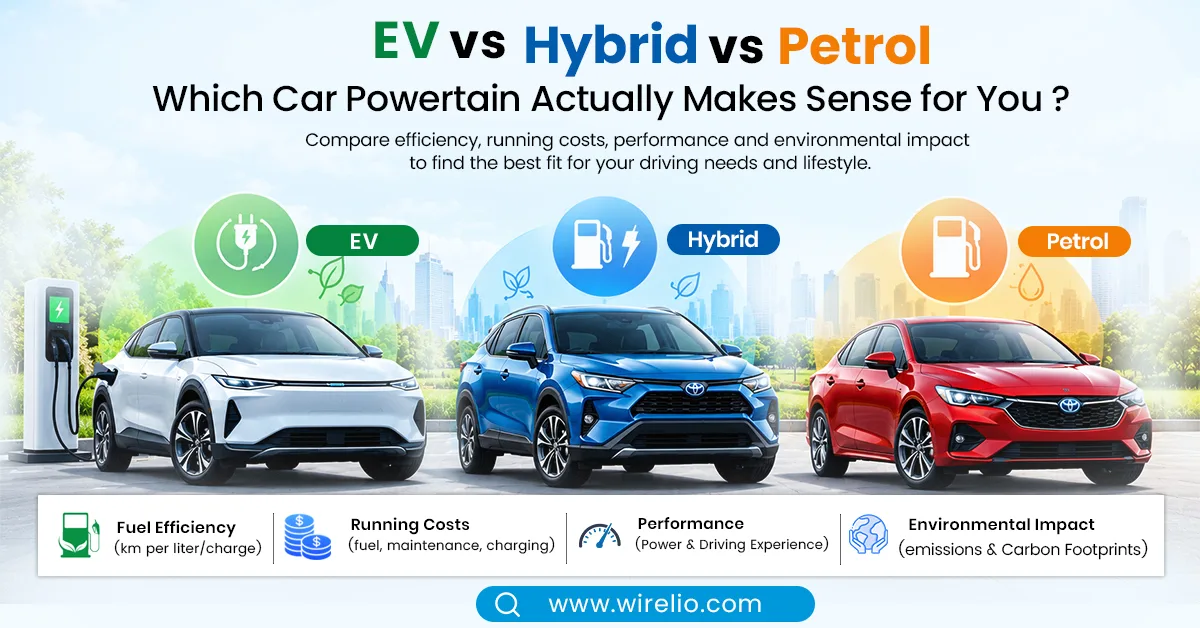

Buying a car used to ask relatively simple questions.
Petrol or diesel?
Manual or auto?
Hatchback, sedan or SUV?
Now there's another decision increasingly confronting Indian car buyers: petrol, hybrid or electric?
And this one isn't as simple as choosing the technology that appears newest.
An electric vehicle may make excellent sense for someone driving 50 kilometres everyday and charging at home. The same EV may be inconvenient for someone regularly travelling long distances through areas where dependable fast charging remains limited.
A strong hybrid can dramatically reduce fuel consumption in stop-start urban driving without requiring a charging point. But someone driving relatively few kilometres every month may struggle to recover the higher purchase price through fuel savings alone.
Meanwhile, the supposedly 'old-fashioned' petrol car can still be a perfectly rational choice for certain buyers.
So forget the powertrain wars for a moment.
The better question is : How do you actually use your car?
First, Understand What You're Comparing
Petrol
The familiar option.
A conventional internal-combustion engine burns petrol to produce power.
Its biggest advantage is the mature ecosystem around it: petrol stations are everywhere, refuelling takes minutes, servicing is familiar and there are options across almost every price segment.
Its weakness is equally obvious: you're continuously buying fuel and stop-start urban traffic isn't particularly efficient.
Hybrid
A hybrid combines an internal-combustion engine with an electric motor and battery.
In a strong or full hybrid, the electric motor can assist the engine and, depending on conditions, propel the vehicle electrically for short periods. The battery is replenished though regenerative braking and the engine, so a conventional hybrid doesn't need to be plugged in.
Regenerative braking captures some energy that would otherwise be lost during deceleration and stores it in the battery.
A mild hybrid is different. Its electrical system mainly assists the engine rather than providing meaningful electric-only driving.
And then there are plug-in hybrids, or PHEVs, which have larger batteries that can be charged externally.
For this comparison we're primarily talking about the conventional strong hybrids increasingly familiar to Indian buyers.
EV
A battery electric vehicle eliminates the petrol engine entirely.
Electricity stored in a large battery powers one or more electric motors.
No petrol.
No tailpipe emissions.
No conventional engine oil changes.
But you do need electricity—and convenient access to charging is part of the ownership equation.
1. Mostly City Driving? EVs and Hybrids Have an Advantage
Consider a typical urban commute:
Home.
Office.
School.
Shopping.
Traffic.
Repeat.
This environment plays to the strengths of electrified vehicles.
An EV is particularly efficient in urban use while regenerative braking allows it to recover some energy during deceleration. Strong hybrids also benefit from frequent braking because regenerative braking helps recharge their batteries.
The petrol engine can be shut down in certain situations, and the electric motor can assist during low-speed driving and acceleration.
Who Should Look Closely at an EV?
Someone who:
- drives regularly,
- has predictable daily kilometres,
- can charge at home or work,
- spends significant time in city traffic,
- and rarely needs spontaneous very-long-distance journeys.
For that driver, plugging in overnight can become similar to charging a smartphone.
2. No Home Charging? Think Carefully Before Buying an EV
This may be the single most important EV question.
Where will you charge it?
India's public charging network is growing rapidly. Government data reported 52,718 public charging stations by July 2026, including 16,561 equipped with fast chargers for cars.
That's meaningful progress, but national numbers don't tell you whether there's a convenient, reliable charger near your home, office or regular highway route.
If you live in an apartment where installing a charger is difficult and nearby public chargers aren't convenient, EV ownership can require more planning.
A hybrid avoid that issue. You refuel it like a petrol car. The vehicle manages its small traction battery through regenerative braking and its engine.
Simple Rule
Reliable home/work charging → EV becomes much more attractive.
No dependable charging → hybrid or petrol deserves serious consideration.
3. Drive Huge Distances? Running Costs Start to Matter More
Imagine two buyers.
Driver A: 5,000 km per year.
Driver B: 25,000 km per year.
Should they evaluate a higher-priced fuel-efficient or electric car the same way?
Probably not.
The more you drive, the more important energy cost is.
An EV can offer significantly lower energy cost per kilometre when predominantly charged at favourable residential electricity rates.
A fuel-efficient hybrid can also reduce petrol consumption substantially compared with a conventional petrol vehicle, particularly in suitable driving conditions.
But if you drive very little, purchase price becomes more important because you have fewer kilometres over which to recover the upfront premium.
Don't Ask Only:
"Which car has the lowest running cost?"
Ask:
"Will I drive enough to recover what I paid extra to get that lower running cost?"
That's a much better ownership question.
4. Frequent Highway Traveller? Convenience Changes the Equation
Suppose you regularly drive:
Delhi to Jaipur.
Lucknow to Delhi.
Mumbai to Pune.
Bengaluru to Chennai.
Or long routes that vary from week to week.
An EV may absolutely handle many highway journeys, particularly as vehicle ranges and charging infrastructure improve.
But EV road trips require a different mindset.
You may need to think about:
- charger locations,
- charging speeds,
- charger availability,
- route planning,
- battery level,
- charging stops.
With petrol or a conventional hybrid the process remains familiar. Find a fuel station. Refuel. Continue.
The Hybrid Sweet Spot
This is one reason hybrids appeal to some buyers. You get improved efficiency without changing your refuelling habits. For someone combining heavy city traffic with frequent long-distance travel, a strong hybrid can offer an appealing compromise.
5. Don't Compare Mileage—Compare Total Cost of Ownership
Car buyers love mileage figures. But mileage tells only part of the story.
A better calculation is:
Purchase price
+ energy/fuel cost
+ maintenance
+ insurance
+ financing
− resale value
That's closer to your real cost of ownership.
Consider an illustrative example.
Car A — Petrol
Purchase price: Rs. 12 lakh
Car B — Hybrid
Purchase price: Rs. 15 lakh
If the hybrid saves money every month on fuel, that's useful.
But it began Rs. 3 lakh more expensive. How many kilometres would you need to drive before fuel savings recover that difference?
Now add resale value, financing costs and maintenance.
The answer may change again.
EV Comparison
The same principle applies.
An EV might cost more initially but potentially save substantially on energy and routine powertrain maintenance. However, insurance, financing, tyre costs, depreciation and resale expectations also belong in the calculation.
There is no universal break-even number.
It depends on the exact cars being compared, your annual mileage and your actual fuel/electricity costs.
6. Maintenance: EVs Have a Structural Advantage
A petrol engine contains many systems that require ongoing maintenance.
Engine oil.
Filters.
Spark plugs.
Cooling components.
Exhaust-related systems.
An EV eliminates many traditional engine-related maintenance requirements because there is no combustion engine. That doesn't mean EV maintenance is zero.
EVs still have:
- tyres,
- suspension,
- brakes,
- air conditioning,
- electronics,
- coolant systems depending on design,
- and eventually battery-related considerations.
Hybrids retain an engine while adding an electric drivetrain, so they're mechanically more complex in principle.
However, hybrid systems from established manufacturers can be engineered for long service lives.
The sensible approach isn't assuming complexity equals unreliability.
Check the actual manufacturer's warranty, battery warranty, service schedule and ownership record of the model you're considering.
7. What About the Battery?
Battery anxiety has replaced engine anxiety for many buyers.
Common questions include:
How long will it last?
How much capacity will it lose?
What happens after the warranty?
How expensive is replacement?
These are legitimate questions, but don't evaluate an EV battery as though it were simply an oversized smartphone battery.
Automotive battery packs use sophisticated battery-management and thermal-management systems, and manufacturers typically provide specific battery warranties.
Before purchasing, check:
Battery warranty + kilometre limit + warranty conditions + capacity/degradation terms + replacement policy
Don't rely on assumptions—positive or negative.
8. Environmental Impact Is More Complicated Than the Tailpipe
An EV produces no tailpipe emissions. That's especially relevant in cities where local air pollution is a serious problem.
But the broader environmental calculation includes:
- electricity generation,
- battery manufacturing,
- raw-material extraction,
- vehicle production,
- transportation,
- lifetime kilometres,
- and eventual recycling.
Petrol vehicles generates emissions throughout their operating lives by burning fuel.
Hybrids reduce fuel consumption but still burn petrol.
EVs shift much of their environmental impact toward electricity generation and manufacturing.
So the useful environmental question isn't simply: "Does it have an exhaust pipe?"
It is: "What is the vehicle's impact across its lifecycle?"
And that answer changes as electricity grids become cleaner and battery manufacturing and recycling evolves.
EV vs Hybrid vs Petrol: Which Driver Are You?
Choose an EV if...
You have reliable home or workplace charging.
You drive frequently.
Most journeys are predictable.
You do substantial urban commuting.
Low running costs matter.
You're comfortable planning charging on longer trips.
Best fit: High-mileage urban commuter with easy charging access.
Choose a Strong Hybrid if...
You drive heavily in city traffic.
Fuel efficiency matters.
You frequently make longer trips.
You don't want to depend on charging infrastructure.
You want some benefits of electrification without changing your refuelling habits.
Best fit: Mixed city-highway driver seeking efficiency with maximum flexibility.
Choose Petrol if...
Your annual mileage is relatively low.
Purchase price matters strongly.
You don't have easy charging.
Your usage is unpredictable.
You intend to keep things simple.
The equivalent hybrid or EV commands a substantial premium that your usage is unlikely to recover.
Best fit: Lower-mileage buyer prioritising upfront affordability and convenience.
There's No Winner—Only a Better Match
The automotive conversation sometimes treats powertrains like teams.
EV supporters: Petrol is finished.
Petrol supporters: EVs aren't practical.
Hybrid supporters: Hybrids offer the best of both worlds.
Reality is less dramatic and much more useful.
A car is a tool.
The best powertrain is the one that fits how you use that tool. Before buying your next car, write down five numbers:
1. Annual kilometres
2. Daily average kilometres
3. Percentage of city vs highway driving
4. How many long-distance trips you make annually
5. Whether you can reliably charge at home
Then compare actual models. Not ideology. Not social-media arguments.
Because the most advanced powertrain isn't automatically the smartest purchase.
The smartest car is the one that makes sense after the excitement of buying it has disappeared.
Wirelio — Beyond Headlines. Understanding What Matters.
Explore more technology, mobility, business and consumer explainers at Wirelio.

No comments posted yet. Be the first to express your thoughts!