

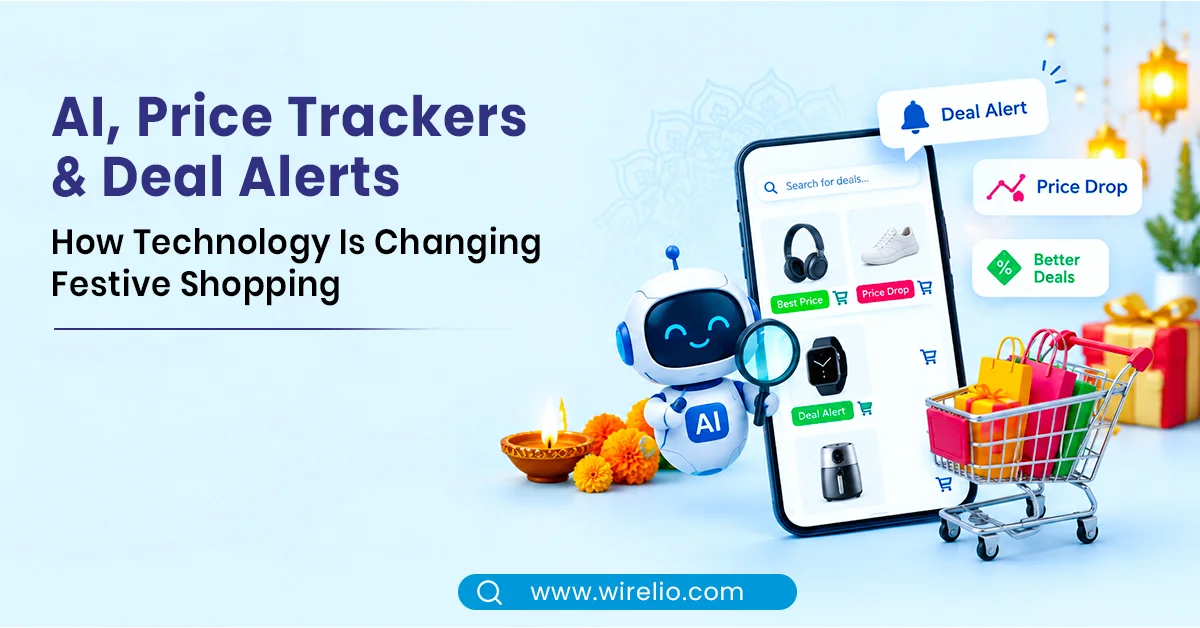

Remember how festive shopping used to be? You'd wander the shops, ask for the price, compare it with a rival store and eventually make a choice.
Online shopping has changed this. Now you can compare hundreds of products without leaving your couch. But a change is coming. Technology is starting to help you do the comparison work for you.
Some price trackers can watch a product for you.
Browser extensions can find coupons for you.
Deal alerts can keep an eye out for the price drop.
And AI shopping assistants can understand a request such as, "Find me a good smartphone under Rs.30,000 with a strong camera and battery."
During India's festive shopping season, that can be especially useful.
With major events such as Amazon Great Indian Festival and Flipkart Big Billion Days, shoppers can face thousands of offers at once. The challenge is no longer simply finding a discount. It is figuring out whether the discount is actually worth it.
This is where shopping technology can be interesting.
1. Price Trackers Can Tell You Whether a "Sale Price" Is Actually Low
One of the biggest pain points of online shopping is that a product's sale price rarely tells you much on its own.
Take this example.
MRP: Rs.49,999
Sale Price: Rs.34,999
Looks like a huge discount. But what if the same product was available for Rs.32,999 a few weeks ago?
A price tracker can help you answer that question. Tools such as Keepa provide price-history charts for supported Amazon sites and allow users to set price-drop or availability alerts.
For Indian shoppers, tools such as Buyhatke and Flipshope also provide price history, price comparison and price-drop tracking across popular shopping platforms.
This is especially crucial during festive sales. Instead of asking, "Is this 40% discount good?"
You can ask "Is this actually a good price compared with its recent history?"
That's a much more valuable question.
2. Deal Alerts Mean You Don't Have to Keep Checking the Same Product
Let's say you want to buy a washing machine.
You've found the model you want, but you're not in a rush to buy the moment it hits your target price. Checking the product page every day would be exhausting.
A price alert can help you out here. You can choose your target price and let the tracker watch the product for you.
Flipshope, for example, allows users to set target prices and receive browser, mobile or email notifications when the tracked price reaches the target.
This changes the shopping process from Search → Check → Refresh → Check again To Choose → Track → Wait for the right price
For expensive festive purchases, that can save you both time and money.
3. Browser Extensions Can Become Your Shopping Assistant
You don't always need a separate shopping app. Browser extensions can provide useful information directly where you view your shopping page.
Keepa is particularly useful for Amazon shoppers. Its Chrome extension adds price-history charts and price-drop or availability alerts to supported Amazon sites.
Buyhatke's extension provides price history, price comparison, coupon discovery and shopping tools. Its current platform supports comparisons across a large number of stores.
Flipshope's browser extension provides price tracking, price-drop alerts and coupon-related features, with support for platforms including Amazon, Flipkart and Myntra.
What should you use?
You don't need to install every extension. Choose one or two that fit how you shop. If you shop primarily on Amazon, a dedicated Amazon price tracker can be useful.
If you frequently compare Amazon, Flipkart, Myntra and other Indian marketplaces, a cross-store tool may be more practical. The point is not to gather shopping extensions. It is to eliminate some of the checks you have to do manually.
4. AI Can Now Help You Search for Products Differently
Traditional online shopping requires typing in a keyword. You type something like: "best smartphones under Rs.30,000"
With AI shopping, you can change that approach. You can describe what you want. For example,
"I need a phone under Rs.30,000 for someone who takes lots of photos, plays games occasionally and wants good battery life."
That provides more context for an AI shopping assistant. Amazon's Rufus, for example, can provide natural-language shopping prompts, provide personalised recommendations and help shoppers compare products. Amazon India says Rufus can also surface deals and provide price insights.
This can be especially valuable when you know your requirements but not which product fits.
5. Amazon Rufus Is Moving Beyond Simple Product Search
Amazon's AI shopping assistant Rufus is one of the clearest examples of how AI is changing online shopping in India.
Instead of searching product by product, shoppers can ask questions such as,
"Show me smartphones under Rs.40,000 with good cameras."
"What should I buy for a Diwali housewarming gift?"
"Which laptop is suitable for video editing?"
"Compare these two products."
"Which option is better for a small kitchen?"
Amazon India says Rufus can provide personalised recommendations, product comparisons and deal discovery. It also integrates with Amazon's price-history features, while Lens AI allows users to search using an image. It can also help in price tracking.
That last feature is interesting. Imagine seeing a lamp in someone's Instagram post. Instead of randomly typing in keywords, you could potentially use image search to find similar products. Shopping becomes less about knowing what to type, and more about knowing what you want.
7. AI Review Summaries Can Save You From Reading 500 Reviews
Reviews can be helpful. But let's be honest. Who wants to read 700 reviews before buying a mixer grinder?
AI is being used to condense large volumes of product feedback. Amazon's AI Review Highlights summarises customer reviews into key themes so that shoppers can get an overview without having to read every single review. Amazon also offers tools such as Quick Learn and Buying Guides for certain shopping journeys.
This can be helpful when comparing products. But there is one important rule: Treat the summary as a shortcut, not the final authority.
If you are buying an expensive appliance, laptop or smartphone, make sure to check the actual reviews, specifications, warranty and return conditions. AI can help you narrow the list. But it should not make the final decision.
8. The Next Step Is AI Shopping Agents
This is where things get even more interesting. While an AI agent answers your question, an AI agent is designed further to carry out tasks or coordinate multiple steps toward a goal.
Imagine telling an agent,
"Find a 55-inch 4K TV under Rs.50,000, compare the best options, check whether the current price is good and tell me which ones meet my requirements."
Instead of simply returning search results, an agent could potentially carry out several parts of the shopping process. The technology is still evolving, and the level of autonomy varies between platforms. So it is important to remember not to confuse today's shopping assistants with fully autonomous purchasing agents.
Amazon: Amazon's Rufus is currently positioned primarily as a conversational shopping assistant, helping with discovery, comparisons, recommendations, deal discovery and price tracking.
It is therefore better to think of Rufus as AI-assisted shopping, rather than an agent that will complete every individual purchase.
SearchMyDeals: Another Layer Before You Buy
There is another approach between finding a product and checking out: looking across shopping opportunities before settling on a seller or offer.
This is where SearchMyDeals can fit naturally.
Instead of seeing it as a place to randomly browse, think of it as a deal discovery and comparison layer. Welist products and you can always come back to the website and check its price.
Use price alerts where available.
This creates a much more deliberate shopping journey, and it can be especially useful during the festive season because there may be thousands of competing offers.
11. Don't Forget Coupon Extensions
Price tracking is just one part of online shopping. Coupons can sometimes reduce the final checkout price further.
Browser extensions such as Buyhatke and Flipshope offer coupon-related features. The important thing is to look at the final payable amount, not the number of coupons applied.
And remember that some offers have minimum purchase requirements or payment-method restrictions. Always check the conditions.
What Could Festive Shopping Look like in the Future?
The shopping journey could potentially be much more conversational. Instead of opening an e-commerce website and searching through hundreds of listings, you could say something like, "I need a washing machine for a family of four, under Rs.35,000, with good energy efficiency and reliable reviews."
An AI system could potentially
- Understand your requirements
- Find suitable products
- Compare specifications
- Summarise reviews
- Check prices
- Monitor price changes
- Identify usable offers
- Alert you when your target price is reached
And eventually, increasingly capable agents may handle even more steps. This does not mean that humans are eliminated from the shopping process. It means that the role of the shopper can change from searching everything to setting goals, checking recommendations and approving decisions.
The Bottom Line
Technology is changing festive shopping in a simple but important way. Earlier, the shopper did most of the work. Now, some of this can be delegated. Price trackers watch prices. Deal alerts watch for drops. Browser extensions find shopping information and coupons. AI assistants find and compare products. Shopping agents are exploring more autonomous journeys. And deal-discovery platforms can bring a much more complete comparison before you make the final purchase. But there is one thing that technology cannot decide for you: Whether you actually need the product.
So this festive season, use AI. Use price trackers. Use deal alerts. Use browser extensions. Compare prices. Set alerts. Ask better questions. But don't let the technology turn every discount into a reason to buy. The smartest festive shopper may not be the person who finds the most deals, but the person who finds the right deal for something they actually needed.
FrequentlyAskedQuestions
How can AI help with festive shopping?
AI can help shoppers discover products, compare options, understand reviews, find recommendations based on a budget and find products that match specific requirements. Amazon's Rufus is one example of an AI-powered shopping assistant available in India.
What is a price tracker?
A price tracker monitors a product's price over time and can show historical prices or notify you when the price reaches a certain level. Tools such as Keepa, Buyhatke and Flipshope offer price-tracking features for supported stores.
Which browser extensions are useful for online shopping in India?
Keepa is useful for Amazon price history and alerts, while Buyhatke and Flipshope provide broader shopping features such as price comparison, tracking and coupon discovery across supported Indian marketplaces.
Can AI agents buy products for me?
The level of automation varies between platforms. Current shopping assistants such as Amazon Rufus primarily help with discovery, recommendations, comparisons and price-related information. More agentic shopping systems are being developed that can handle increasingly complex tasks, but shoppers should not expect that every AI shopping assistant can independently complete purchases.
Does Flipkart have AI shopping features?
Flipkart has developed conversational AI shopping experiences including Flippi, which was designed to help shoppers find and narrow down products through natural-language interaction. Flipkart has also discussed developing more comprehensive AI-powered shopping assistance.
How can I check if a festive sale price is actually a good deal?
Use a price-history tool to compare the current price with previous prices. You can also compare the final payable price across marketplaces, check applicable coupons and bank offers, and review the product's specifications and ratings.
Are AI shopping recommendations always accurate?
No. AI recommendations can be useful for narrowing down options, but shoppers should independently verify specifications, seller information, reviews, warranty, return policies and final prices.
How can SearchMyDeals help with festive shopping?
SearchMyDeals can be used as a deal discovery and comparison layer, helping shoppers explore deals and shopping opportunities across marketplaces before making a purchase. It can complement price trackers, AI shopping tools and browser extensions rather than replacing them.
Should I install several price-tracking extensions?
Usually, there is no need. Choose tools based on the marketplaces you use most often and the features you need. Too many overlapping extensions can make the shopping process more complicated rather than easier.

No comments posted yet. Be the first to express your thoughts!