

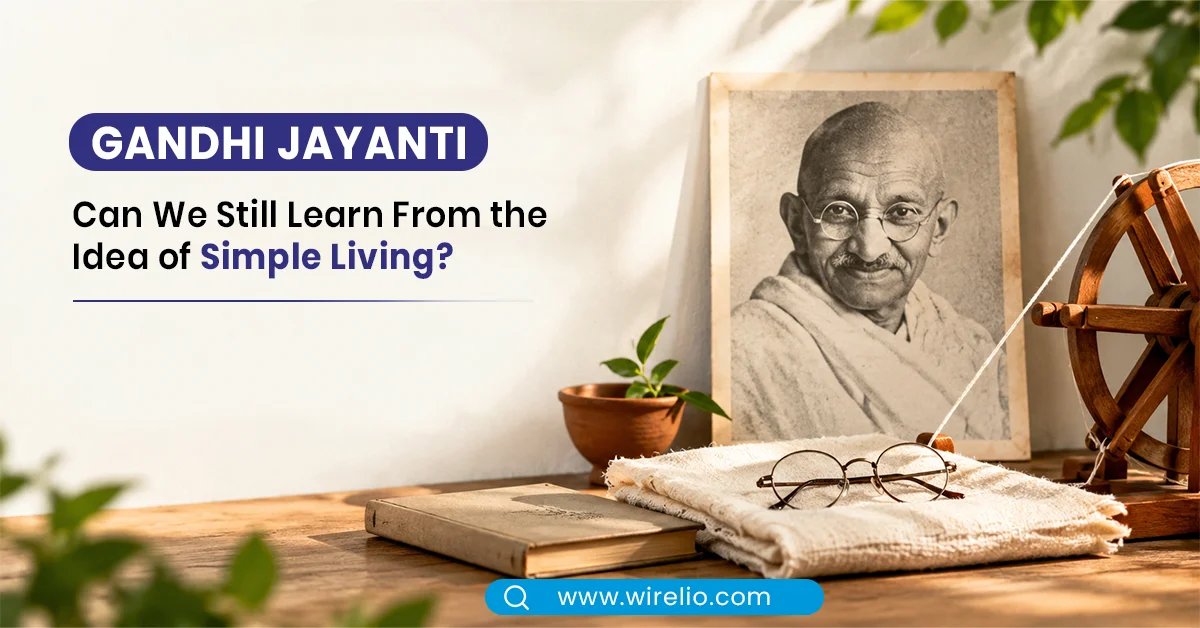

The Gandhi Heritage Portal showcases a number of personal belongings of Gandhi Ji, including his writing desk, spinning wheel, walking stick and slippers. Another record displays common household items such as dinner bowls, a wooden fork and spoon, a diary, prayer book, a watch and a few pairs of sandals. These simple belongings are the remnants of a life lived with great purpose. They remind us that it is not our material possessions that should be grand, but the meaning we give to life.
Gandhi Ji did not view simplicity as a matter of having less. He associated it with the mindset of one's needs, wants, possessions and responsibilities.
In his writings of November 1944, Gandhi Ji wrote about the concept of non-possession. His perspective was that we should not continue to acquire more than what is actually needed by us as individuals.
During a trip on the train through South India, Gandhi went to promote the use of Khadi (hand-spin) and to call upon the natives to boycott wearing foreign fabric. After he had finished his work, the activist tried to convince the local people of the worth of home products and invited them to wear hand-woven clothes.
They responded "We are too poor to buy Khadi. It is far too expensive for us to afford a full length of cloth."
Looking at himself in the mirror, Gandhi realized that he was too arrogant to act like that, as he wore a full-length dhoti and a vest, besides a cap and a scarf. The activist remembered that he was a representative of India, where most people could barely afford a piece of garment to cover their body, and that he, therefore, did not have a right to dress like that.
The next morning, while staying for a while in West Masi Street of Madurai, Gandhi shaved his head and cut his dhoti into two parts. After that, he started to wear a short dhoti and a shawl, when it was cold.
Gandhi continued to dress modestly and comfortably for the rest of his life, being both in northern villages among poor farmers and attending official functions, such as a tea session organized for him by the King at the Buckingham Palace.
When asked if he felt underdressed while being dressed in a simple way at the function, so that it might seem that the activist did not respect the guests, Gandhi Ji said "The King had enough on for both of us."
Gandhi believed that dressing modestly meant being respectful and thoughtful towards others and having fundamental principles.
Now think about our current lifestyle. We have apps for shopping. We receive notifications for new launches. We see deals as we scroll through social media.
And we also buy things simply because they are on sale.
So what can we learn from the simple life philosophy in a culture of consumption?
What Did Simple Living Mean to Gandhi Ji?
Simple living can often be misunderstood.
It does not necessarily involve a complete lack of comforts and modern appliances.
For Gandhi Ji, simplicity was tied in with ideas such as self-discipline, non-possession, mindful consumption and the ability to distinguish between a need and a want.
His notes highlight that the idea of non-possession is not quite about the complete absence of possessions. In his writings, Gandhi Ji explained that the objective of non-possession was to avoid unnecessary accumulation. He described non-possession as not accumulating what one does not need.
That distinction is important.
Consider the example of purchasing a new phone due to a malfunction in your current one. That is a need.
But buying a new phone despite having one that works flawlessly because a newer model was launched is a want. The key is not to judge whether purchasing something is inherently wrong.
The question is: Do I actually need this?
Why Does Simple Living Matter Today?
Our relationship with products has changed dramatically. With modern advancements in technology, shopping has become significantly faster and more convenient.
A couple of taps can deliver a wide range of products at our doorstep. While this may appears to be a benefit, it can also encourage mindless buying due to the convenience of it all.
This is where the concept of simple living comes into play again. It reminds us to pause and consider whether we need the product or not.
Will we actually use it?
Can something else we already have serve the same purpose?
Will we still want it in a couple of months?
These questions do not suggest that we should never buy a product. They simply encourage us to become more mindful shoppers.
Simple Living Is Not the Same as Living Without Technology
It would be unfair to suggest that we should live in the same way as we did when Gandhi Ji was alive.
Technology has transformed our lives in significant ways. It has revolutionised the way we shop. There is nothing wrong with using technology.
The issue arises when we use it irresponsibly.
For example, online shopping can save us time. It can also help us compare prices and get better deals. However, the problems start when convenience overrides the necessity of a purchase.
A simple lifestyle in 2026 does not mean we should give up on our smartphones or online shopping. It simply means that we can be more intentional with the use of these products.
From Simple Living to Mindful Consumption
As mentioned above, mindful consumption means being deliberate about our spending.
Consider two scenarios.
In the first one, you need a new pair of shoes because your old pair is worn out. You compare prices and select a pair of shoes that suits your needs.
In the second scenario, you come across a flash sale with a choice of three pairs of shoes on heavy discount. While you may not need them, the discount tempted you to buy the products.
A simple pause in such situations can make us more mindful of our spending. A discount does not necessarily mean a good deal.
The best deal can be the product you actually need and will use.
That, in fact, is how many people have found Gandhi Ji's concept of simple living surprisingly applicable to their everyday purchasing.
Can Simple Living Help Reduce Waste?
It can help us change our perception towards waste. Every item we buy comes at the cost of resources.
There are raw materials, production, energy, packaging and waste to consider. That does not mean every single purchase has the same environmental impact.
However, it does mean that buying a product we do not need can lead to wasteful consumption.
A simple approach to a more sustainable lifestyle would be to ask oneself these questions:
Can I repair the product?
Can I use it again?
Can I buy something durable?
Will I actually use the product?
Do I already have something similar?
Can I avoid buying unnecessary packaging?
Can I donate or responsibly dispose of something before buying a new one?
These small considerations can help us cut down on wasteful consumption.
What Can We Learn From Gandhi Ji's Idea of Non-Possession?
One of the fascinating aspects of Gandhi Ji's philosophy is that he associated possession with responsibility.
In his writings of 1944, Gandhi Ji described non-possession as avoiding the accumulation of unnecessary items. He wrote that non-possession also goes hand-in-hand with non-stealing and not keeping what one does not need.
The concept may appear to be impractical in the context of a modern lifestyle.
But the underlying question is surprisingly relevant: How much is enough?
We often measure our achievements based on how much we can afford to buy. Simple living encourages us to consider how much we actually need. That is an incredibly different approach to consumption.
Gandhi Ji and the Idea of Doing More With Less
Gandhi Ji's connection with the charkha is a famous example of his adherence to simple living.
The charkha was not a luxury item for Gandhi Ji. It was a symbol of self-reliance and hard work. Gandhi Ji's writings often highlighted the importance of spinning and encouraging others to adopt a self-sufficient lifestyle.
The charkha and Gandhi Ji are often used together to illustrate the concept of doing more with less.
His message repeatedly connected everyday aspects of life with a larger purpose.
Simple things such as clothes can turn into deep questions about sustainability and consumption when we adopt a mindful approach to them.
This is an important reminder today as we consider sustainability.
We often believe that a radical shift in our approach is required. But sometimes, it is as simple as buying fewer clothes, using a product for longer, repairing a broken appliance or choosing quality over quantity when making a purchase.
The Rise of Decluttering Shows That We Are Thinking About This Again
Consider walking into a modern house and finding common clutter.
Old clothes.
Unnecessary kitchenware.
Boxes of old chargers.
Items bought on sale.
Decorations that looked good on a website but are hardly ever used.
And then comes the familiar sight of someone doing a decluttering session on the weekend.
We buy, accumulate and then spend time trying to organise everything we bought. The entire process makes us reconsider the idea of simple living again.
Perhaps the aim should not be to become minimalist immediately. Perhaps the goal should be to become more selective.
Simple Living Can Also Mean Buying More Carefully
As mentioned above, simple living is not about giving up on shopping completely.
We still need clothes.
We need phones and laptops.
We need furniture.
We need kitchen appliances.
We need household products.
And sometimes, we also want things simply because they make us happy. There is nothing wrong with that.
What we should focus on is distinguishing between buying something with intent versus buying it mindlessly.
Before purchasing something, think about these questions:
Need or want?
Useful or temporary?
Will I use it often?
Can I afford it comfortably?
Is there something I already have at home that can do the same job?
Am I buying it because I need it, or because the offer looks tempting?
A few minutes of contemplation can help us avoid months of clutter.
What Does Gandhi Ji's Thinking Mean for Online Shopping?
This is probably one of the most interesting applications of his philosophy for the current generation.
Online shopping is unlikely to disappear anytime soon. Neither are sales, coupons or offers.
The better approach is to shop more thoughtfully.
Before buying a product online, think about these points:
1. Compare Prices
Do not assume that the price you see is the best one available. Compare similar prices across different marketplaces, if possible.
2. Check Reviews
The best price is useless if the product fails to meet your expectations. Check the latest reviews and ratings.
3. Check What You Already Own
This seems like a common-sense suggestion, but it is surprising how often we overlook it.
Before buying another storage box, kitchen appliance or piece of clothing, consider whether you already have something that can serve the same purpose.
4. Look Beyond the Discount
A product on "50% off" is not always a good deal. Consider the final price, features, quality, warranty and intended usage.
5. Think About Longevity
Ask yourself whether the product is likely to remain useful for a long time. Sometimes, it can be more cost effective to invest in a durable product instead of cheaper ones that require regular replacements.
In today's market, platforms such as SearchMyDeals can be incredibly useful when comparing shopping options across different marketplaces. Shoppers can browse through multiple deals and offers without wasting time browsing through different sites. Instead, they can use deal-discovery platforms to shortlist their options before making a purchase.
The idea is not to encourage shoppers to stop buying.
It is to encourage more deliberate purchasing.
Simple Living Does Not Mean a Joyless Life
There is one more point to consider. Simple living can definitely be more enjoyable when we choose the right items to buy.
You can choose to eat delicious food.
Buy a new outfit.
Upgrade your phone.
Decorate your home.
Go on vacations.
Enjoy technology.
And everything else that brings you joy.
The idea is to ensure that consumption does not become the answer to every craving we develop.
Gandhi Ji's writings repeatedly connected simplicity with discipline rather than deprivation. The Gandhi Heritage Portal also documents his belief that there is goodness and greatness in simplicity rather than wealth.
The modern interpretation can be surprisingly practical:
Buy what adds value to your life. Be conscious of what may only add clutter.
7 Simple Habits to Try This Gandhi Jayanti
You do not have to overhaul your lifestyle when it comes to adopting the principles of simple living. You simply need to implement a few simple habits.
1. Follow a 24-Hour Rule
Before buying something you do not really need, give yourself 24 hours to think about it.
2. Check Your Existing Supplies
Before buying anything related to your household, check your supplies. You may discover that you actually have what you need.
3. Repair Before Replacing
If something can be repaired at an affordable price, go ahead and repair it.
4. Declutter One Area
Choose one drawer, shelf or cupboard and remove everything that you no longer need.
5. Unsubscribe From Unnecessary Shopping Notifications
Constant notifications about sales will encourage impulse buying. Keep only the notifications that are genuinely useful.
6. Compare Before You Buy
A little research can ensure that you are making more informed purchasing decisions.
7. Ask One Question
Before making any unnecessary purchase, simply ask yourself:
"Do I need this, or do I simply want it right now?"
You can be surprised by how often this question can change your mind.
Can We Really Live Like Gandhi Ji Today?
Probably not in a literal sense. As mentioned above, our modern lifestyle is significantly different from his era.
We live in a digital economy.
We use smartphones.
We shop online.
We travel differently.
We have access to products and services that Gandhi Ji could never have imagined.
Trying to replicate his exact way of life may, in fact, miss the point.
The more important question is: Can we integrate certain aspects of his lifestyle into our own?
The answer is subjective.
For one individual, it may mean buying fewer clothes.
For another, it may mean stopping unnecessary upgrades.
For someone else, it could mean repairing products instead of replacing them.
It could even mean becoming more aware of the reasons behind our purchases.
Frequently Asked Questions
What did Gandhi Ji believe about simple living?
Gandhi Ji associated simplicity with concepts such as self-discipline, non-possession and avoiding unnecessary accumulation. His writings describe non-possession as not hoarding things that are not needed.
What is Gandhi Ji's idea of non-pos possession?
Non-possession refers to the avoidance of unnecessary accumulation and attachment to material things. Gandhi Ji wrote that people should not hoard what they do not need.
Does simple living mean buying nothing?
No. A modern interpretation of simple living can suggest being more deliberate about what to buy, use, keep, repair and replace.
How is simple living connected to sustainability?
Buying fewer unnecessary products can potentially reduce waste and resource use. Simple living can encourage us to be more mindful about consumption.
Can simple living work with online shopping?
Yes. Online shopping can still be part of a simple lifestyle. Comparing prices, checking reviews, avoiding impulse purchases and buying products that genuinely meet your needs can make online shopping more intentional.
What can we learn from Gandhi Ji's lifestyle today?
One possible idea is to be more mindful of the difference between our needs and our wants. His writings on non-possession can be a good starting point for thinking about our consumption and material possessions.
How can I practise simple living?
Start with small habits such as decluttering, repairing products, avoiding unnecessary purchases, comparing before buying and waiting before making non-essential purchases.

No comments posted yet. Be the first to express your thoughts!