

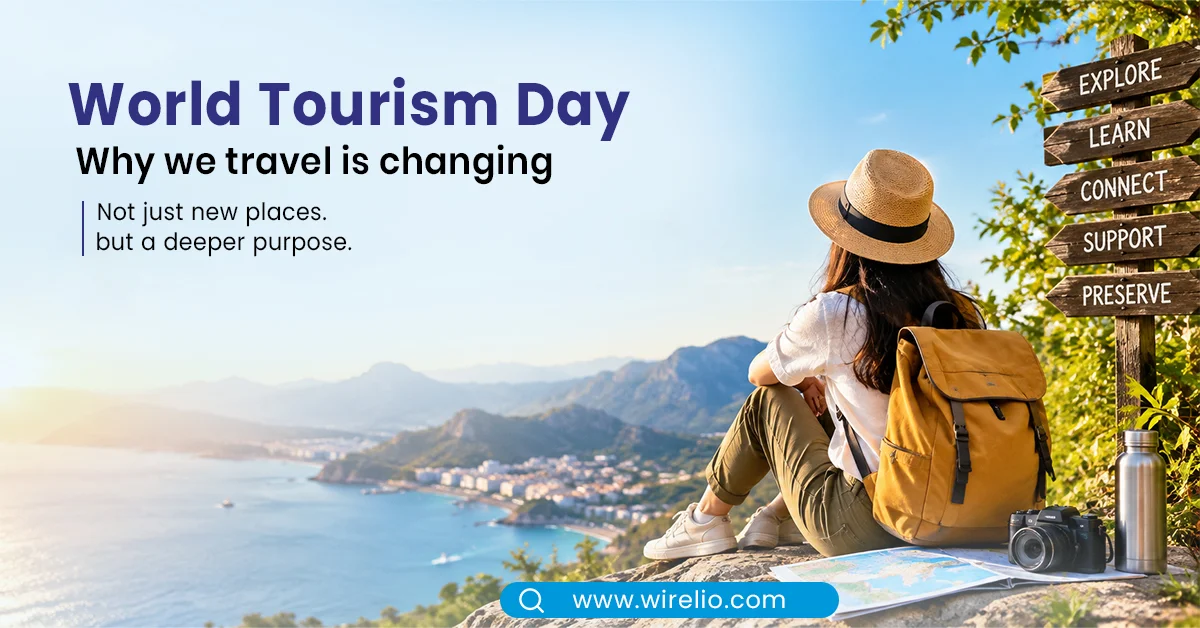
There was a time when travelling somewhere new meant a checklist.
See the Eiffel Tower.
Take a picture.
Visit the famous market.
Try the local food.
Buy a souvenir.
Post the pictures, of course.
And then somewhere between the airport lounge and heading back home would be a strange question. "Did I actually experience the place, or did I just visit it?"
Today, more and more travellers are craving something different. We still want to see beautiful places and capture that perfect photograph. But increasingly, we are drawn to the feeling a place can evoke.
A quiet morning at a neighbourhood coffee shop.
A conversation with a local shopkeeper.
Getting slightly lost and wondering the street you've never heard of.
Learning how a traditional dish is actually made.
Sitting by the lake, only to remember that you're not at home - yet you feel right here for the first time.
This means something interesting about how the psychology of a traveller works.
We are not only travelling to see the places but also to feel, learn, disconnect, connect, and sometimes rediscover ourselves.
It makes celebrating World Tourism Day a little more interesting too.
World Tourism Day: More Than Just Celebrating Travel
World Tourism Day is observed every year on September 27 and is held by the United Nations World Tourism Organization (UN Tourism) to highlight tourism's social, cultural, political and economic importance.
But then, how about the travel statistics for a moment? Travel is deeply personal.
It is the excitement of the night before, or when you finally check and recheck the weather forecast just three days ahead of time. It is the moment you get off the plane or train, and you think to yourself, “Okay, this is actually happening.” It could be complex why we sometimes travel.
To escape the mundane? To satisfy the curiosity?
We may long for adventure or a well-deserved break. Or perhaps, we just want to be someone else for a while.
The Psychology of a Traveller: Why Do We Feel Different When We Travel
Think of the routine in your life.
You know which way to take on the way to work or college.
You know where you'll have your lunch most of the time.
You generally know how your day or week will be.
It's all familiar to you.
But when you travel to somewhere you've never been, or even somewhere you've only heard about, it can be fascinating.
You're seeing new things.
New streets you've never explored before.
New places with different languages.
New dishes you've never tasted.
New systems of transport.
Even just deciding where you want to have your coffee can be exciting.
This kind of novelty can have some interesting effects, according to psychologists. Essentially, our brain notices new things and unexpected discoveries.
That is why sometimes that walk you took in a new area stays with you more than you anticipated.
We do change our relationship with our environment when we travel. We don't always want to escape life but sometimes pause it.
One of the biggest reasons for travel is the deep longing to escape the routine of life. But perhaps in modern times, the modern traveller does not always want to escape it completely. We may want just a pause to reset ourselves.
A weekend trip can be a perfect example. Yes, you might still check your phone or message someone if you have a long queue at the airport.
But for those two or three days, your routine is paused.
You wake up without an alarm.
You decide where you want to go after breakfast.
You spend the afternoon doing absolutely nothing.
And somehow, it's not a waste of time.
Because for a moment, you had a psychological distance from your daily life. As a result, you are not only you from Monday to Friday.
You experienced being someone else.
From "Must-See" to "Must-Feel"
There is something interesting about how travel is shifting. Traditionalists will often speak about the "must-sees" when talking about travel.
But modern travellers are increasingly considering the "must-feels".
It's a small difference, but it can mean a world of difference. While some may rush around trying to tick a huge bucket list in one day, others will choose to spend more time in one place.
Instead of a ten-item landmark list, perhaps someone will explore a neighbourhood for three hours.
Instead of a famous restaurant, perhaps someone will take a cooking class.
Instead of seeing a place full of tourists, perhaps someone will discover a local market.
Instead of photographing more, perhaps someone will collect more memories.
Of course, that doesn't mean landmark destinations have become irrelevant.
The Taj Mahal is still as beautiful as ever.
The Eiffel Tower still draws crowds.
The Great Wall of China is still astonishing.
But increasingly, the landmark is no longer the experience. The postcard is becoming the departure point, not the finish line.
Planning a trip these days? Check out the best recommended places to visit before September.
Why Getting Lost Can Sometimes Be the Best Part
There is something wonderfully strange about getting lost on travel. At home, it can be annoying.
But on the road, it can be the trip highlight.
You took a wrong turn somewhere, and discovered a delicious bakery.
Somebody there recommended a local dish.
You wandered into a bar that wasn't on your radar before.
And now, your favourite travel memory is not the "must-see" but the "discovery".
That is one of the reasons why slow travel is becoming more popular.
Instead of asking, "How many places can I cover?", it's more about "How much can I delve into one place?"
It's less about quantity, but more about quality.
And, creating more memories.
Check out how the process of slow travel has been taking the travellers of the world on.
The Traveller Doesn't Always Want Luxury — They Want Authenticity
Spa resorts, private villas and five-star hotels are still sought after by many.
But increasingly, people are looking for something different.
Something authentic.
Imagine you have a choice between two restaurants.
One is beautifully designed, and serves food that could be found in most major cities across the globe.
The other is a small family-run restaurant, which serves food with handwritten note about how it was prepared.
Which experience would be memorable for you?
For many travellers, authenticity is increasingly valued.
And it's not just food. It's about making a place and its people feel special. It is increasingly important in a world where cities and countries can start to blur together.
The same shops, the same brands, the same architecture, the same hotels and even the same coffee shops.
We want places to feel authentic because it is different to what we have at home.
Social Media Changed How We Travel — And Now Travel Is Changing How We Use Social Media
Most of us have taken a picture because we want to remember a place.
But sometimes, we take a photo because we want to share it. Travel and social media have become deeply linked.
We look for Instagrammable cafes.
We save Pinterest destinations.
We watch travel reels before we even book our flights.
We research hotels before we choose where to stay.
And we may even plan our trip around places we have seen online.
But there is a strange contradiction with this.
The more we photograph our travel, the more some travellers discuss wanting to be present in the moment.
You may stand in front of a beautiful place and think how great it would be to post it, but you suddenly realise you've barely taken it in because your phone was in your way.
It's creating a new travel paradox. Do I want to document this or experience this?
And increasingly, the answer is both, but perhaps not at the same time.
Why Travellers Are Searching for "Meaning"
There is a reason why experiences around food, culture, nature, crafts and local communities can be so enriching.
They require participation.
Compare: Watching someone make pottery and Making the pottery yourself
Compare: Photographing a traditional dish and Learning how to make it
Compare: Walking around a historic area and Hearing a local talk about what the buildings mean to them
The second experience in each scenario requires you to be a part of it, and it creates a lasting memory.
You are not simply an observer in your own travel.
Travel Can Also Change the Way We See Ourselves
Perhaps the biggest reason we travel is identity.
At home, you have roles.
Student, employee, parent, friend, someone who answers emails and responds to work calls. When you are travelling by yourself somewhere else, you are also someone else. Perhaps, simply a traveller figuring out which train to take.
And that can be a liberating experience.
Solo travel can be an empowering experience because it creates opportunities for independence.
You choose where you eat.
When you wake up.
Change your plans.
Solve problems.
You also learn that you can navigate the world on your own. Sometimes, you even come home with a new perspective on yourself.
The Rise of "Slow Travel": What If We Stopped Rushing?
Modern life can be busy with emails, notifications, meetings, deadlines, traffic and scheduling.
Once we take a trip, we sometimes re-create the same problem - but on a smaller scale.
Day 1: Three attractions.
Day 2: Five attractions.
Day 3: Another city.
Day 4: Airport.
By the end, you need another holiday to recover from the holiday. Slow travel is an opportunity to stop doing this. It encourages travellers to spend more time in fewer places.
Stay longer.
Walk more.
Take local transport.
Eat at local places.
Talk to people.
Observe.
Take your time.
The goal is not to maximise the number of places visited, but the depth of the experience.
Beyond the Postcard: The New Question We Ask When We Travel
The traditional travel question was, “What can I see?” Then it changed to, "What can I photograph?"
Perhaps, the modern traveller is asking, "What can I experience?". And maybe the next question is, "What can this journey teach me?"
It could teach a different culture.
It could teach how people live differently.
It could teach to slow down.
It could teach to be comfortable being alone.
It could teach that getting lost is not always a bad thing.
Or it could just simply remind us that our daily routine is not the be-all-end-it.
That is the psychology of the modern traveller.
We still want beautiful destinations and to see beautiful things. We still want photographs and to experience famous landmarks. But increasingly we are looking for something more that cannot fit in a photograph.
A feeling.
A story.
A connection.
A memory that doesn't need a filter.
So, this World Tourism Day, perhaps the best way to celebrate travel is to not ask where everyone else is going.
Ask yourself: Where do I want to feel something new?
Because sometimes the most important journey starts when we stop travelling for the postcard, and start travelling for the experience behind it.
Beyond the postcard.
For more insights, check out Wirelio - Beyond Headlines.

No comments posted yet. Be the first to express your thoughts!