

 Technology
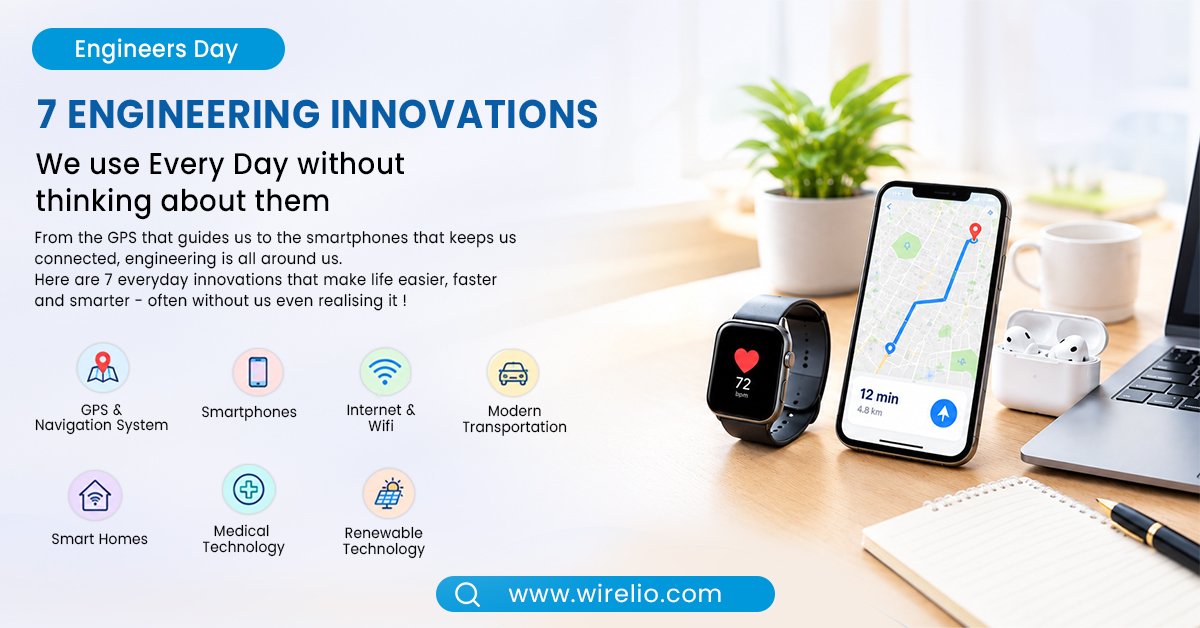
Engineers' Day: 7 Engineering Innovations We Use Every Day Without Thinking About Them
Celebrate Engineers' Day by exploring everyday engineering innovations—from smartphones and GPS to QR codes and elevators—that make modern life seamless.
What if you had to spend a day without the everyday technology and machines you take for granted?
No smartphones. No GPS. No elevators. No washing machines. No microwave. No air conditioners. Even something as simple as switching on an LED light would feel like something of a luxury.
You wake up to an alarm on your smartphone, take an elevator to the ground floor, check the weather using an app, pay for breakfast with a QR code, and perhaps travel to work using GPS navigation. All of these activities feel completely normal today.
We use hundreds of engineering innovations in our everyday lives that we take for granted.
Engineering solutions often become invisible parts of our everyday routines.
India celebrates Engineers' Day on 15th September, the birth anniversary of the renowned engineer and statesman Sir Mokshagundam Visvesvaraya. It is a day to acknowledge and appreciate the contribution of engineers to technology, infrastructure, industry and society.
From the moment your alarm rings until the moment you switch off the lights to go to sleep, engineering is at work in the background.
Let's look at 10 engineering innovations that we use almost everyday but never give a second thought to.
1. Smartphones
Let's start with something most people reach for within minutes of waking up--your smartphone.
Smartphones have come a long way from just being able to make and receive calls and send text messages.
Now, your smartphone can function as a camera, GPS, calculator, wallet, entertainment system, fitness tracker, alarm clock, and even a mini office.
A smartphone combines several different engineering technologies: processors and computer chips, touchscreen, cameras, batteries and charging, sensors, wireless communication and charging, GPS, and audio technology.
Engineers have been able to fit all of these in to a device so small that you can carry it in your pocket and also fold these days.
Think about it
You can video-call someone thousands of kilometres away, take a photograph, edit it, upload it, and send it to someone-all from the same device. That's something that previously required several different machines, now all sitting in your hand.
2. GPS navigation
Do you remember when you had to ask someone for directions or stop to buy a map when you were travelling somewhere new?
Now, all you have to do is open a navigation app.
GPS enables devices to determine their approximate location based on signals from satellites. Navigation systems use GPS data along with digital maps, traffic information, road data, and algorithms to help get you to your destination.
GPS has been so useful for personal navigation but also other purposes including food and grocery delivery, ride-hailing, fleet tracking, emergency services, travel, package tracking, and location sharing.
Think about it
When your navigation app tells you that there is heavy traffic ahead and suggests an alternate route, you benefit from a number of technologies working together. All you have to do is follow the blue line.
Engineers take care of everything happening behind it.
3. QR codes and digital payments
QR codes have become a part of everyday life, especially in India. You can find them everywhere-from local shops and cafes to restaurants, petrol pumps, taxis, and even roadside stalls.
Instead of having to carry cash around with you, you can scan a code and make a payment within seconds. The convenience of this has a complex combination of technologies behind it.
Think about it
You have a Rs. 30 snack.
You scan the QR code, enter the amount, confirm the payment, and get a notification. The whole process might take less than a minute. But behind that simple scan is a sophisticated infrastructure designed to transfer information and money securely.
This is one of the clearest examples of how engineering innovations have transformed everyday life.
4. Elevators
Next time you step in to an elevator, do you ever think about the engineering that goes in to it? Probably not.
You press a button.
The doors close.
You arrive at your floor.
But the modern elevator involves a number of mechanical, electrical, electronic, and safety systems that it uses to control speed, direction, position, doors, weight, emergency brakes, and passenger safety.
It's also these kinds of technologies that make high-rise buildings practical.
Think about it
Otherwise, imagine having to climb 15 floors to reach your office each morning. Suddenly, that button feels much more impressive.
5. Washing machines
Laundry used to be something that required way more time and effort.
Now, you can simply toss your clothes and some detergent in to a washing machine.
A washing machine uses a combination of mechanical, electronic, water management, sensors, and software. Various sensors in a washing machine can determine water levels, load size, washing time, spin speed, water temperature, and cycle selection, depending on the machine.
Think about it
Think about how much easier laundry becomes when you don't have to manually scrub, rinse, and wring every item. The washing machine is a simple example of engineering doing exactly what it is supposed to do: solving a repetitive problem and saving you time and effort.
6. LED bulbs
Switching on a light is probably one of the most mundane things you do at home.
But lighting technology has come a long way in recent years.
LED (Light Emitting Diode) bulbs last for longer and use less electricity than traditional incandescent bulbs. LED technology is now used in a number of different lighting applications, including homes, offices, streetlights, cars, traffic lights, and TVs and monitors.
Think about it
Imagine every light in a large building being switched on for several hours every day. Improving the energy efficiency of those lights can make a huge difference to energy consumption.
All you have to do is flip a switch. Engineering makes the light more efficient.
7. Microwave ovens
Did you forget to take your food out of the refrigerator?
No problem. Just pop it in the microwave, and wait a few minutes. Microwave ovens use electromagnetic waves to heat up food. The appliance creates and holds the microwave energy in a chamber that heats the food up.
This technology has transformed the way many of us deal with leftovers and quick meals.
Think about it
Yesterday's dinner is today's lunch in a few minutes. So many children and people are living away from their families, and microwave ovens become a life saver option for them there.
That convenience may seem mundane now, but it's another example of engineering turning a time-consuming task in to something incredibly simple.
8. Air conditioners
Whether you're trying to escape India's summer heat, or trying to warm up a room, climate-control systems make us feel more comfortable.
A modern family cannot imagine a life without the comfort of air conditioner on a hot day. Air conditioners work by transferring heat from one place to another.
An air-conditioning system typically consists of a compressor, condenser, evaporator, refrigerant, fans, temperature sensors, and electronic controls.
Modern systems can also automatically adjust based on the temperature you select.
Think about it
You enter a room. You pick up the remote. You set the temperature.
And that's it.
The complicated part is happening inside the machine.
9. Traffic lights
Imagine a busy intersection with no traffic lights.
Cars, bikes, buses, pedestrians, and other vehicles would all have to negotiate their way through the crossing. Traffic lights provide a simple system for organising traffic.
Modern traffic-management systems can involve timers, sensors, cameras, control systems, pedestrian signals, and traffic-monitoring technology.
Some systems can even adjust signal timing based on traffic conditions.
Think about it
Traffic lights are a perfect example of an innovation that becomes invisible when it works. It's just another part of our everyday lives.
You see red.
You stop.
You see green.
You move.
10. Automatic doors and motion sensors
Have you ever walked into a supermarket, hotel, airport, or shopping centre and watched the doors open automatically?
You don't have to touch anything.
You simply approach, and the door opens.
Automatic doors use sensors to detect movement or the presence of a person and then activate a motor or mechanical mechanism to open the door.
Think about it
A mother entering a supermarket with her child in her arms does not need to push her way through the doors. The things that have become very common in our life, has actually made life so easy that living without them in not imaginable.
What Do All These Innovations Have in Common?
At first glance, smartphones, washing machines, elevators, GPS, LED bulbs, and automatic doors don't seem to have much in common.
But they all demonstrate one important principle:
Engineering is about solving problems.
We don't necessarily need to understand how something works to benefit from it.
We simply use it.
We don't think about the engineering inside a washing machine when we're doing laundry.
We don't think about electromagnetic waves when reheating food.
We don't think about satellites when following GPS directions.
We don't think about sensors when an automatic door opens.
And we rarely think about processors and wireless communication when sending a message from our smartphone.
That's actually the beauty of successful engineering.
Take a Second to Notice the Engineering Around You
The next time you wake up, don't rush through your routine without noticing what's around you.
Your alarm goes off on a smartphone.
You switch on an LED light.
You use an elevator.
You check GPS to find your destination.
You pay for something using a QR code.
You return home and put your clothes into a washing machine.
You heat your food in a microwave.
You turn on the AC.
You walk through an automatic door.
None of these things may feel extraordinary anymore.
But every one of them represents engineering ideas, experimentation, design, testing, and innovation.
Perhaps that's what makes engineering so fascinating: the most successful innovations are often the ones we stop noticing because they have become part of everyday life.
This Engineers' Day, take a moment to appreciate the technology around you—and the engineers who made it possible.
FAQs
1. When is Engineers' Day celebrated in India?
Engineers' Day is celebrated in India on September 15 every year to commemorate the birth anniversary of Sir Mokshagundam Visvesvaraya.
2. What are some engineering innovations used in everyday life?
Common examples include smartphones, GPS navigation, QR codes, digital payments, elevators, washing machines, LED bulbs, microwave ovens, air conditioners, traffic lights, and automatic doors.
3. How does engineering make everyday life easier?
Engineering helps solve practical problems and makes everyday activities faster, safer, more convenient, and more efficient.
4. What is the importance of engineering innovation?
Engineering innovation helps improve existing products and systems, solve everyday problems, reduce resource consumption, improve safety, and create new technologies.
5. What is an example of engineering innovation at home?
Washing machines, refrigerators, microwave ovens, LED bulbs, air conditioners, water purifiers, and smart home devices are everyday examples of engineering innovation used at home.

Swati Rani (Author & Editor)
<p>Content Author and Editor at Wirelio.</p>
 Automobile



No comments posted yet. Be the first to express your thoughts!