

.webp)
Imagine walking in the front door of your house.
The lights instantly turn on. The air conditioning has already set the perfect temperature. Your robot vacuum has just finished cleaning the hardwood floors. Your washing machine sent a notification that the clothes are ready to be picked up.
Your phone reminds you that the front door is still unlocked.
This is a glimpse into the future.
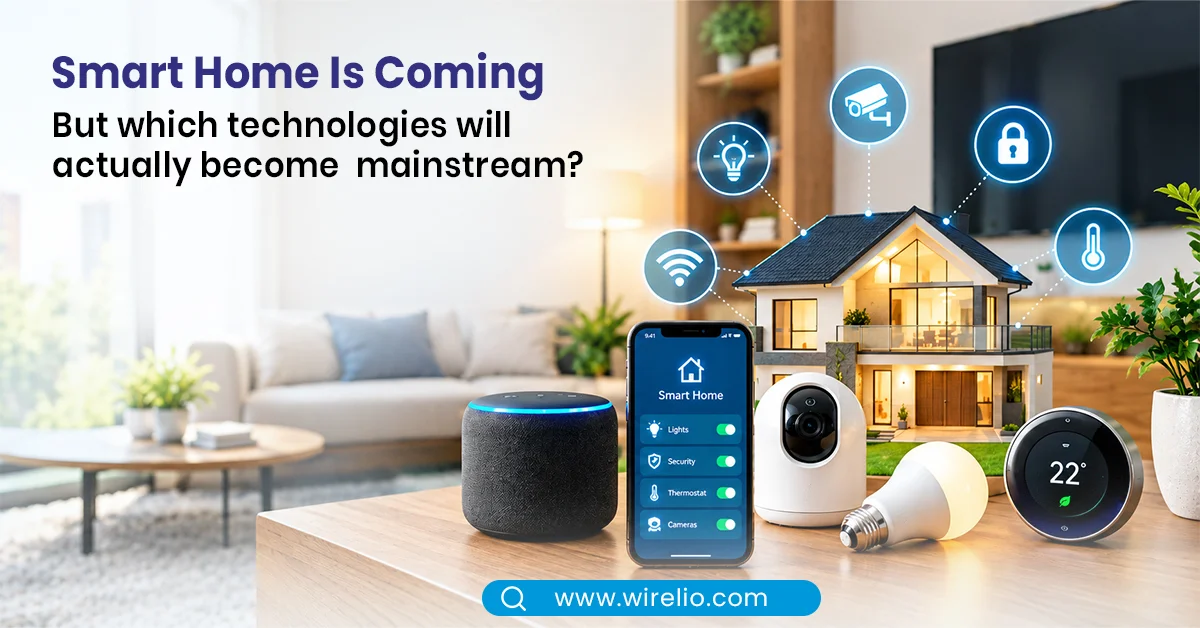
But what's interesting is that some of it is already here. Smart speakers, connected lighting, robot vacuums, smart TVs, video doorbells and connected appliances are becoming increasingly common. At the same time, the smart-home market is flooded with futuristic products that don't necessarily solve a real-world need.
That means the question isn't "what can smart-home technology do?" but rather "what smart-home technologies will become mainstream?"
The answer likely has less to do with futuristic technology and more to do with
whether it makes everyday life easier without making everyday life more difficult.
What Actually Makes a Home "Smart"?
A smart home isn't necessarily a house with Wi-Fi-connected devices. At its core, a smart home enables tasks to be performed with less human input.
A connected light, for example, isn't as interesting as a connected light that knows when to turn itself on and off.
A connected home is about sensors, automation, artificial intelligence, mobile apps, voice recognition, data and contextual awareness enabling devices to do more with less.
Why Some Smart-Home Technology Will Succeed — and Some Won't
Smart-home adoption has little to do with how futuristic a product is and everything to do with:
Convenience: Does it save time or effort?
Reliability: Does it work consistently?
Affordability: Does it provide value for the additional cost?
Compatibility: Will it work with the other devices in the home?
Privacy: What information does it collect?
Setup:Is it simple to install or configure?
Maintenance: Will it constantly require attention?
These factors will ultimately determine what smart-home technologies become mainstream.
1. Smart Lighting Could Become Completely Normal
Smart lighting is one of the most accessible smart-home technologies.
Instead of turning a light on and off, Wi-Fi-enabled lights can be controlled through apps, scheduled to turn on and off, dimmed, changed to different colors, motion-activated and more.
But the most mainstream version of connected lighting likely won't involve changing the color of the light based on your mood.
It'll be about automating lights based on location and time of day.
6:30 PM: Outdoor lights turn on.
10:30 PM: Most lights in the home automatically turn off.
11:00 PM: Bedroom lights dim.
Morning: Selected lights slowly turn on.
That's the most valuable application of smart lighting: being able to control lights without giving it much thought.
Mainstream potential: High
Smart bulbs, switches and motion sensors are relatively easy to grasp and can be introduced slowly to the average household.
2. Smart Security May Become One of the Biggest Categories
Smart home security is another category where the technology addresses a very real-world need.
Products such as video doorbells, security cameras, smart locks, motion sensors, window and door sensors, alarm systems and indoor cameras are all about making the home safer.
The value is obvious to most: instead of wondering if you locked the door, you can check with a smart lock.
Instead of seeing someone at your door after the fact, a video doorbell can notify you when motion is detected.
Smart security also has an advantage over some other smart-home technologies in that the need is already understood.
The challenge will be balancing convenience with privacy, security and reliability. A camera connected to the internet has the potential to hold highly sensitive information about the household.
Mainstream potential: High
Security is a practical application, making connected security products more accessible to the average consumer than other novelty-focused smart devices.
3. Smart Thermostats and Energy Management Could Quietly Transform Homes
One of the most interesting aspects of smart-home technology is that it doesn't always involve flashy products. Energy management solutions, for example, aren't as exciting as a robot vacuum but can have a major impact on the household.
Smart thermostats, smart plugs, energy monitoring products and connected appliances can all help the household become more energy efficient and save money in the process.
Imagine your home knowing:
When you're usually at home
When you're leaving and returning
When cooling is necessary
When electricity consumption is at its peak
When devices are unnecessarily using electricity
The result isn't a house that seems futuristic — it's a house that wastes less energy.
Mainstream potential: High
Energy savings is a major incentive for most consumers, particularly in areas where cooling makes up a significant portion of electricity bills.
4. Robot Vacuum Cleaners Are Moving From Novelty to Utility
A few years ago, robot vacuums were something that only appeared in science-fiction movies.
Today, they're becoming a common sight in many homes.
Modern robot vacuums can provide a range of benefits, including floor cleaning, mopping, obstacle avoidance, mapping, scheduling, app control and returning to their charging dock automatically.
The most interesting aspect of robot vacuums isn't that they can clean the floor: it's that they can require less human input.
That could be a recurring theme with successful smart-home products.
Mainstream potential: High
Vacuuming is repetitive, time-consuming and easy to automate.
5. Smart Appliances Will Become More Useful When They Stop Feeling “Smart”
Smart appliances are often associated with impressive technology.
But the truth is that few consumers want to use apps to operate everyday appliances.
Ask yourself: would you really open an app to start the washing machine when you're standing right next to it?
Most people would likely say no. Which means the most valuable connected appliances are those that provide meaningful convenience beyond simply being connected.
A washing machine that can notify you when it's finished, for example, goes beyond "I want to use an app to control my appliances" and gets to the heart of "how can app connectivity make my life better?"
What smart appliances can really excel at is providing automation and intelligence that the traditional appliance simply can't provide.
A connected washing machine might be able to:
Notify the user when a cycle is complete
Detect potential maintenance issues
Suggest washing cycles based on load
Track electricity or water usage
Adjust settings based on load
A connected air conditioner might be able to:
Learn about typical usage patterns
Adjust temperature automatically
Provide electricity usage information
Detect when filters need cleaning
Mainstream potential: Medium to high
Connected appliances can become more desirable when the technology provides tangible benefits beyond simply being able to control it through an app.
6. Smart Speakers Will Evolve Beyond Playing Music
Smart speakers are largely responsible for putting voice-assisted technology in the hands of everyday consumers.
The early appeal of smart speakers was simple: being able to say, “Play music.” They've since evolved to become timers, weather assistants, home-security hubs and much more.
But their true value may lie in becoming the interface for managing connected devices.
Instead of managing dozens of different apps, a single voice command might be able to perform a task.
"Turn off the downstairs lights."
"Is the front door locked?"
"Start the air purifier."
"What's the temperature in the bedroom?"
The most interesting aspect of smart speakers is that they enable people to control connected devices throughout the home.
Mainstream potential: High, but dependent on ecosystem compatibility
7. Matter Could Help Solve One of Smart Home's Biggest Problems
One of the biggest challenges with smart homes is that many products are incompatible with one another.
Smart locks, for example, may only work with one type of ecosystem. That means buying smart devices from different manufacturers can result in the need for multiple apps, some of which may not work consistently.
This is where common standards such as Matter become critically important.
The goal is to ensure that "connected" products actually work together.
If "smart home interoperability" becomes more reliable, it will ultimately lead to greater mainstream adoption of products that otherwise may seem incompatible.
Mainstream potential: Very high if interoperability continues improving
The technology that most consumers see may be the product, but the technology that allows products to work together may be even more important.
8. AI Could Change the Smart Home More Than Voice Commands Did
Artificial intelligence has the potential to change the way smart homes operate. Traditional automation typically involves a simple set of instructions, such as IF motion is detected THEN turn on the lights.
AI could enable the home to be more contextually aware, such as knowing that people typically only watch TV in the living room during the evenings.
Instead of having to program every single rule, the system could recommend or implement automation scenarios based on user preferences.
This could ultimately make the smart home feel less like a series of gadgets and more like a cohesive environment.
But the big question with AI-assisted smart homes is: how much control are people willing to give up?
A smart home could know when people are asleep, when they're away from the home, which rooms they typically use and how much electricity they consume.
Mainstream potential: Very high
But consumer adoption will be contingent on trust, security and proper implementation.
9. Smart Locks Could Change How We Think About Keys
Keys haven't changed much in the last century or so.
Smart locks, however, offer a variety of alternatives for securing the home, including smartphone access, PIN codes, fingerprint recognition, temporary access codes, remote locking and activity notifications.
Giving a family member a temporary code instead of making a physical key, for example, can be much more convenient.
Allowing a service provider access to the home at a specific time can be much more secure.
But the big challenge with smart locks is reliability.
What happens if:
The battery dies?
The internet goes down?
The app stops working?
The phone is lost?
The system is hacked?
The most successful smart locks will need to provide smart convenience without eliminating reliable backup methods.
Mainstream potential: Medium to high
10. Smart Plugs May Be One of the Most Underrated Smart-Home Products
Not every smart-home product has to be expensive or futuristic. A smart plug can actually be a great way to introduce basic automation to the home.
Depending on the product, users can schedule power, turn an appliance on or off remotely, automate tasks and monitor electricity usage.This is important because not every consumer will want to replace every single appliance in the home to make it “smarter.”
Mainstream potential: High
Low-cost, simple products can be much more effective at driving adoption than high-end futuristic devices.
What About Smart Refrigerators With Giant Screens?
Here's where the difference between innovation and hype comes into play.
A refrigerator with a large touchscreen may seem futuristic at first.
But ask yourself: does it solve a real-world problem?
If the benefit is being able to display recipes, calendars or entertainment, then the truth is that few consumers will want to replace their refrigerator with one that has a screen. A smartphone or tablet is likely to be much more convenient.
The same question can be applied to almost every smart-home feature.
Does it save time?
Does it save money?
Does it improve safety?
Does it reduce effort?
Does it improve accessibility?
Does it solve a problem that existing technology doesn't solve well?
If the answers are "no" then the feature likely won't become mainstream.
The "Smart Everything" Problem
There's a certain appeal to connecting everything.
Smart kettle. Smart mirror. Smart toothbrush. Smart bin. Smart coffee maker. Smart mattress. Smart curtains. Smart fridge. Smart oven. Smart lights. The list can go on.
At some point, consumers are going to reasonably ask: "do I really need an app for this?"
That's the big challenge with smart-home technology: while it's easy to connect products, it's much harder to provide a valuable experience.
That's the difference between an app for the kettle and an intuitive, intelligent home.
A product becomes much more valuable when its intelligent features fade into the background and simply make the experience better.
The Future Smart Home May Actually Have Fewer Interfaces
You might actually expect the future connected home to have more displays, apps and interfaces.
But it's the exact opposite that will ultimately make the connected home intuitive and desirable. Instead of an app for the lights, an app for the AC, an app for the cameras, an app for the locks and an app for the appliances, the most intuitive smart homes will minimize the number of interfaces by relying on voice control, sensors, automated routines and a single app.
The best interfaces for a smart home might not actually be an interface at all.
Lights can simply turn on and off. The air conditioning can automatically adjust. The robot vacuum can clean without assistance. The security system can notify the user when something is amiss. The consumer doesn't have to constantly manage the technology — they simply get to enjoy the home.
What Will Make a Smart-Home Technology Mainstream?
Looking at these technologies, there are five characteristics that define mainstream smart-home technology.
1. It Solves a Real Problem
2. It Works Reliably
3. It Doesn't Require Constant Attention
4. It Works With Other Devices
5. It Provides Enough Value for the Price
How Consumers Should Shop for Smart-Home Technology
If you're looking to make your home smarter, there's one big question to ask before buying any products: what problem are you trying to solve?
Want to improve security? Explore cameras, sensors and smart locks.
Want to reduce energy waste? Look into energy monitoring products, smart plugs and connected appliances.
Want to reduce cleaning? Consider automated devices.
Want to have better lighting control? Explore smart bulbs, switches and motion sensors.
Want to connect an ecosystem of devices? Check compatibility before buying products from different manufacturers.
Check Compatibility Before Buying
This is one of the most important smart-home shopping tips.
Before buying a device, it's crucial to check:
Supported ecosystems
Connectivity standard
Wi-Fi requirements
Smartphone compatibility
Voice assistant support
Hub requirements
Subscription requirements
Local versus cloud processing
Firmware-update support
A cheap smart device that doesn't support the required features may ultimately cost more than a slightly more expensive compatible product.
Don't Ignore Privacy and Security
Smart-home technology enables convenience, but it's important to remember that these connected devices can collect information about the household.
Depending on the product, this can include:
Device usage
Voice recordings
Camera footage
Location information
Energy consumption
Household routines
Before buying a connected device, it's crucial to look at the privacy policy, security features, software-update practices, account requirements and whether local control is available.
A smart home should ideally make life easier while not making you uncomfortable about how much information it collects.
Frequently Asked Questions
What smart-home technology is most useful?
The most useful technology depends on the household, but smart lighting, security devices, smart plugs, robot vacuums and energy-management products address practical everyday needs.
Will smart homes become mainstream?
Mainstream adoption is likely to depend on factors such as affordability, reliability, interoperability, privacy, security and whether products provide meaningful everyday benefits.
What is the biggest problem with smart-home technology?
Compatibility, reliability, privacy, security and unnecessary complexity remain important challenges. Having many connected devices can also create multiple apps and ecosystems that are difficult to manage.
Is AI important for the future of smart homes?
AI could make smart homes more contextual by helping systems understand patterns, automate routines and reduce the need for manual commands. However, privacy, transparency and user control will remain important considerations.
Are smart appliances worth buying?
A smart appliance can be useful when connectivity provides practical benefits such as automation, maintenance alerts, energy monitoring or remote control. Smart features that add little functionality may not justify a higher price.
Are smart lights worth it?
Smart lights can be useful for scheduling, remote control, automation, brightness adjustment and motion-based routines. They can be especially practical when combined with sensors and automated routines.
What should I check before buying a smart-home device?
Check compatibility, connectivity, required apps or hubs, subscription costs, privacy policies, security features, software-update support and whether the device provides a benefit you will actually use.
Is a smart speaker necessary for a smart home?
No. Many smart-home devices can work through smartphone apps or other controllers. A smart speaker can make voice control and device management more convenient, but it isn't essential.
What is Matter in smart homes?
Matter is a smart-home interoperability standard designed to help compatible devices work across supported ecosystems. Greater interoperability can make it easier for consumers to build connected homes without depending on incompatible platforms.

No comments posted yet. Be the first to express your thoughts!