

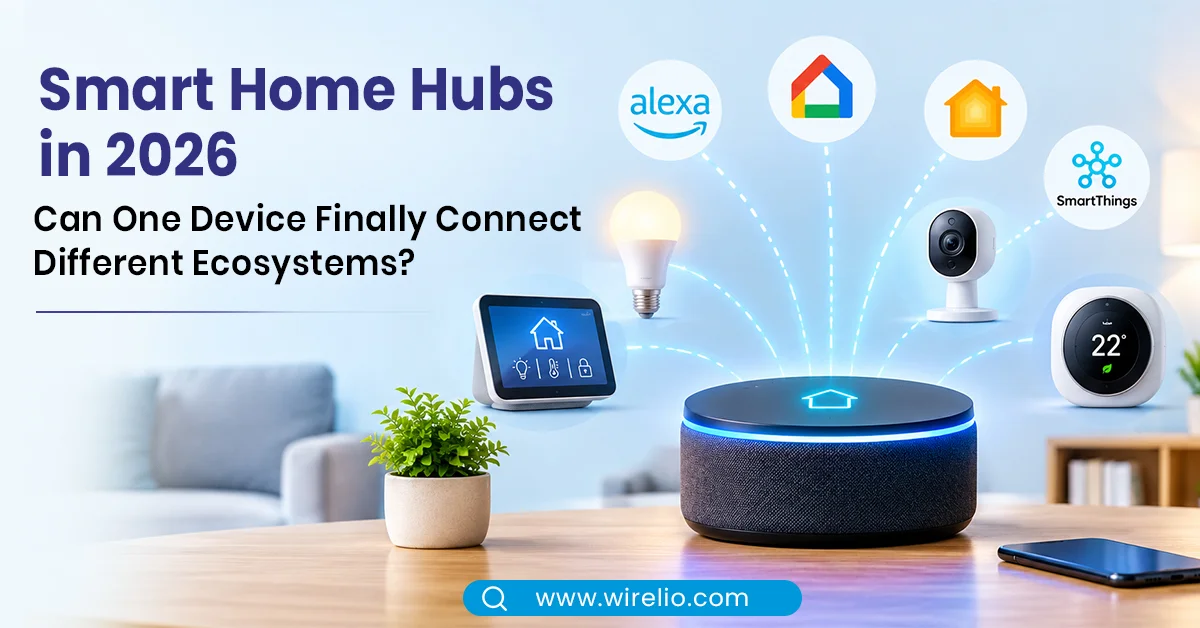

A smart home sounds simple in theory. You switch on the lights using a voice command, adjust the air conditioner through an app, check a security camera remotely and automate appliances according to your daily routine. The complication often begins when these products come from different manufacturers. One may work with Alexa, another with Google Home, while a third requires its own application or a dedicated gateway.
This is where smart home hubs become important. Designed to act as a central control point, these devices help users manage connected lights, switches, sensors, locks, speakers and other equipment. The growing adoption of Matter, an industry-wide connectivity standard, is also making it easier for products from different brands to communicate across supported platforms.
But has the smart home industry finally reached a stage where one device can connect everything? Not quite. Matter has improved interoperability, and newer hubs support multiple ecosystems, but differences in hardware, software, device categories and manufacturer features still create limitations.
For Indian households considering home automation, understanding these differences can prevent unnecessary purchases and help build a connected home that remains useful as technology changes.
Why Smart Home Hubs Matter in a Multi-Brand Home
A smart home hub is a central device or software platform that connects and manages compatible smart-home products. Depending on its capabilities, it may control devices directly, coordinate automations, connect wireless networks or provide access through voice assistants and mobile applications.
Without a suitable hub, users may end up managing every product through a separate application. A smart bulb may have its own lighting app, a security camera may need a manufacturer's application, and a smart switch may depend on a different platform.
This creates several inconveniences:
Multiple applications to install and maintain.
Separate accounts and login credentials.
Different automation systems for individual products.
Limited communication between devices from different brands.
Difficulty managing the home when family members use different smartphones or voice assistants.
A compatible hub can reduce this fragmentation by bringing supported products into one control system.
However, the term "hub" covers several different types of equipment. A smart speaker or display may act as a Matter controller, a dedicated gateway may connect older Zigbee devices, and a Thread border router may provide connectivity for low-power wireless devices.
These functions are related, but they are not interchangeable. Before buying a hub, consumers should understand what it actually supports rather than relying on the word "smart" in the product description.
Matter and Thread: Bringing Different Smart Home Ecosystems Closer
The biggest development in smart-home interoperability is Matter, an open connectivity standard developed by the Connectivity Standards Alliance (CSA). It is designed to help compatible smart-home products communicate across supported ecosystems, reducing the need for every device to depend on a separate brand-specific integration.
In practical terms, a Matter-certified smart bulb or plug can potentially be set up and controlled through supported platforms such as Apple Home, Google Home and Amazon Alexa. Users are not necessarily required to purchase every accessory from the same manufacturer or remain within one company's product range.
Matter also supports Multi-Admin, which allows compatible devices to be shared with more than one smart-home ecosystem. For example, a household may use Google Home for everyday voice commands while also making compatible devices available through Apple Home.
The standard has continued to develop. Matter 1.5, announced in November 2025, introduced support for cameras, additional window and door-related products, soil sensors and energy-management capabilities. In June 2026, the CSA announced Matter 1.6, which focused on improvements to device setup, shared ecosystem management and context-aware controls. Its Joint Fabric capability provides another approach to allowing multiple authorised controllers to administer a shared Matter network. The CSA's specifications page also lists Matter 1.6.1 documents as of November 2026. However, a specification being published does not mean every existing hub or accessory automatically supports it. (CSA – Matter 1.5; CSA – Matter 1.6; CSA – Specifications)
Where Thread fits into the picture
Matter is the communication standard, while Thread is one of the networking technologies that compatible devices can use.
Matter devices commonly communicate over Wi-Fi or Thread. Wi-Fi is familiar to most households and is suitable for products such as smart plugs and appliances. Thread is a low-power wireless mesh network designed for devices such as sensors, switches and certain smart locks.
A Thread Border Router connects the Thread network to the wider home network. Some smart speakers, displays and Wi-Fi routers include this capability, while others support Matter over Wi-Fi but do not provide Thread connectivity.
This distinction matters when buying a hub. A device that supports Matter over Wi-Fi may not be sufficient for a home containing Matter-over-Thread accessories.
The practical goal is not simply to purchase a hub carrying the Matter logo. It is to ensure that the hub supports the communication method used by the accessories you intend to install.
What Devices Can One Hub Actually Connect?
The range of compatible products is expanding, but support depends on the hub, its software version and the device categories implemented by the platform.
Common smart-home categories include:
Lighting: Smart bulbs, dimmers and compatible switches.
Power management: Smart plugs and supported electrical controls.
Climate control: Compatible thermostats, fans and air-conditioning-related equipment.
Home security: Supported door locks, contact sensors and motion sensors.
Window coverings: Compatible blinds, shades and motorised curtains.
Entertainment: Selected speakers, televisions and media devices.
Home monitoring: Supported cameras, doorbells and environmental sensors.
Matter support does not automatically mean that every function of a product becomes available in every ecosystem. A smart camera may have advanced AI detection, cloud recording or person-recognition features in its manufacturer's application, while another platform may offer only basic camera controls or may not support that camera category yet.
The same issue can affect appliances. A connected air conditioner might support basic power and temperature control through one platform, while advanced scheduling, energy reports and maintenance alerts remain exclusive to the manufacturer's app.
What about older smart devices?
Many households already own smart products that use Zigbee, Z-Wave, Bluetooth or proprietary wireless connections. These products do not automatically become Matter-compatible simply because a new hub is installed.
A compatible bridge or gateway can help bring some of them into a Matter-enabled environment. For example, a Zigbee gateway may expose supported connected bulbs or sensors to a Matter controller. The gateway itself needs to support the relevant integration, and not every device function will necessarily be available.
Infrared-based appliances present another common situation in Indian homes. Older air conditioners, televisions and fans may respond to traditional infrared remote controls. A compatible smart IR hub can send the same commands through an application or voice assistant, making these appliances easier to automate without replacing them.
An Indian example is TP-Link's Tapo H110 Smart IR & IoT Hub, announced in August 2026. The company describes it as a way to control compatible infrared appliances, including air conditioners, televisions and fans, while supporting Matter-based interoperability. Buyers should still check the exact appliance compatibility and supported integrations before purchasing it. (TP-Link India – Tapo H110 announcement)
Compatibility Limitations: Why One Hub Still Cannot Control Everything
Despite the progress made by Matter, a completely universal smart-home hub remains an unrealistic expectation for most consumers.
The first limitation is that Matter supports defined device types and functions rather than every feature offered by every connected product. A certified accessory may provide basic controls across different platforms, but proprietary functions can remain limited to its original application.
The second limitation is the difference between a Matter controller and a bridge. A controller manages compatible Matter devices, while a bridge connects certain non-Matter products to a Matter environment. Buying a controller does not automatically provide support for Zigbee, Z-Wave, infrared or every proprietary wireless technology.
The third limitation is platform implementation. Apple, Google and Amazon maintain their own smart-home systems. Even when all three support Matter, the availability of individual device categories, automation options and advanced controls may differ.
Official platform documentation illustrates this distinction:
Google requires a compatible Matter hub, and Thread accessories need a Thread Border Router. Its supported-device documentation lists different capabilities across Nest speakers, displays, routers and streamers. (Google Home – Matter setup)
Apple requires a compatible home hub for Matter accessories in the Home app. Thread-based accessories also require suitable Thread-enabled hardware or a supported third-party border router. (Apple Support – Set up a home hub)
Amazon lists specific Echo and eero products that support Matter, with a separate list identifying models that include Thread Border Router functionality. (Amazon – Matter support)
There are also practical network and account considerations. Google, for example, specifies that IPv6 must be enabled on the home network for Matter to function correctly in its setup. A weak Wi-Fi signal, router configuration problems, outdated firmware or an incompatible smartphone application can also interrupt the installation process.
For consumers, the lesson is clear: interoperability reduces the number of compatibility barriers, but it does not eliminate the need to check individual product specifications.
What Indian Buyers Should Check Before Investing in a Smart Home Hub
For Indian households, the best smart-home setup is not necessarily the one with the most expensive display or the largest list of supported brands. It is the one that works reliably with the products already installed and the devices the family expects to buy later.
Before investing in a hub, consider these points:
1. Check Matter certification and device compatibility
Look for the Matter logo and verify the exact model in the manufacturer's compatibility documentation. Do not assume that every product from a particular brand supports Matter.
2. Confirm Wi-Fi and Thread support
Check whether the hub supports Matter over Wi-Fi, Thread or both. If you plan to use Thread accessories, confirm that a suitable Thread Border Router is included or available separately.
3. Understand the role of Zigbee and other protocols
If your home already uses Zigbee or Z-Wave devices, check whether the hub includes the necessary radio or supports a compatible bridge. Matter support alone does not replace these protocols.
4. Review supported device categories
A hub may support lights, plugs and sensors but have limited support for cameras, doorbells, appliances or advanced automation. Check the product's supported device list rather than relying on broad compatibility claims.
5. Check local network requirements
Confirm that your home router, Wi-Fi coverage and network settings meet the manufacturer's requirements. Some devices use 2.4 GHz Wi-Fi, while others support additional bands. Check the exact setup instructions and whether IPv6 is required.
6. Consider local availability and after-sales support
For products sold in India, check warranty coverage, replacement availability, power compatibility, app availability and customer support. A device purchased through an overseas seller may have different warranty or service conditions.
7. Understand cloud dependence and privacy
Find out whether automations operate locally or depend on internet connectivity and cloud services. Review what data the hub collects, whether cameras or microphones are involved, and how user accounts and permissions are managed.
8. Think about future expansion
Choose a hub that can support the device categories and protocols you are likely to use over the next few years. Firmware updates and manufacturer support are important because a new Matter specification does not automatically upgrade older hardware.
For most first-time buyers, starting with a few compatible smart lights, plugs and sensors is more practical than automating an entire home immediately. Once the system works reliably, additional devices can be introduced gradually.
FAQs
1. What is a smart home hub?
A smart home hub is a central device or platform that connects and manages compatible smart-home products, allowing users to control them and create automations through an application or voice assistant.
2. Does Matter make all smart home devices compatible?
No. Matter improves interoperability between certified devices and supported ecosystems, but compatibility depends on device categories, implemented features, firmware and platform support. Older Zigbee, Z-Wave and proprietary devices may need a compatible bridge.
3. Do I need a Thread Border Router for Matter?
Only if you plan to use Matter-over-Thread devices. Matter devices that communicate over Wi-Fi do not require a Thread Border Router, although a compatible Matter controller may still be necessary depending on the platform.
4. Can I use Google Home, Apple Home and Alexa together?
Compatible Matter devices can be shared across supported ecosystems using Multi-Admin, subject to platform and device support. This does not mean that every automation or advanced feature will work identically in all three platforms.
Conclusion: A More Connected Home, but Not Yet a Completely Universal One
Smart home hubs in 2026 are making connected living more flexible. Matter has reduced some of the barriers between competing ecosystems, while Thread and improved multi-platform management are helping compatible devices work together more effectively.
However, the idea of one device controlling every smart product remains a work in progress. Differences in wireless protocols, device categories, software features and manufacturer support continue to matter.
For Indian consumers, a sensible buying decision begins with the devices already in the home, the ecosystem the family prefers and the kind of automation it actually needs. Check the hub's Matter, Thread and bridge capabilities before purchasing, and pay attention to long-term software support.
The smartest home is not necessarily the one with the most devices. It is the one where the devices you choose work together reliably, securely and without unnecessary complexity.

No comments posted yet. Be the first to express your thoughts!