

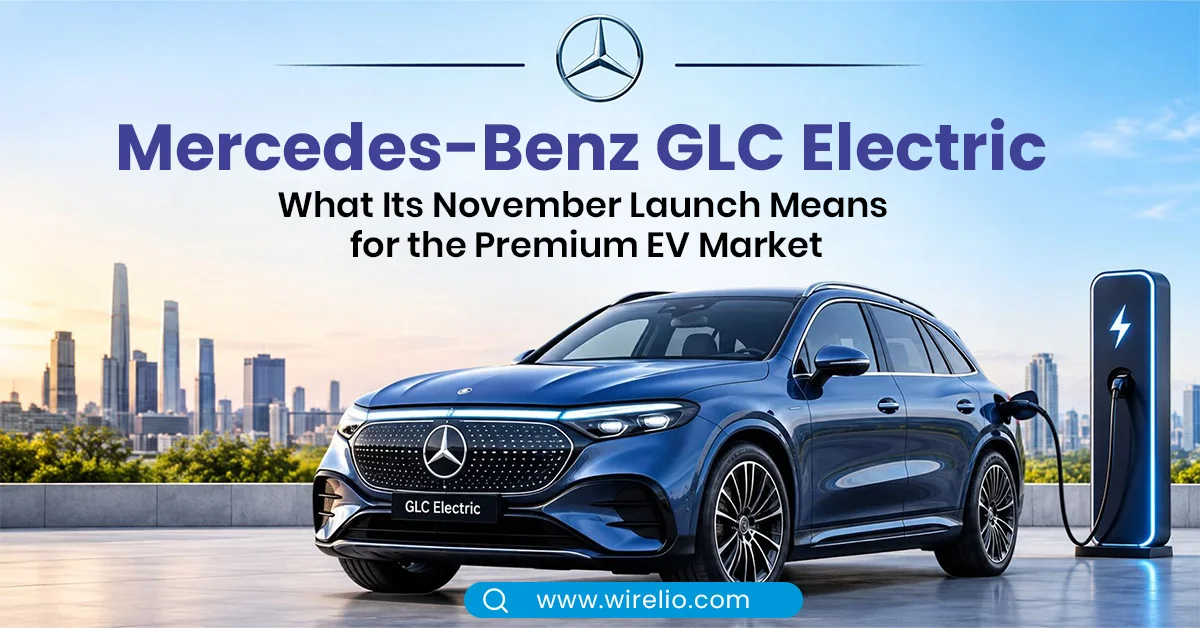

The Indian luxury electric vehicle market has another important entrant. Mercedes-Benz has launched the GLC 400 4MATIC electric in India on 4 November 2026, bringing an all-electric version of one of its established SUV nameplates to the country's premium automobile segment. Priced at ₹78.50 lakh (ex-showroom), the new electric SUV combines a dual-motor all-wheel-drive system, a large battery, fast-charging capability and a technology-focused cabin.
The launch is significant for more than the addition of another luxury EV. Mercedes-Benz is locally assembling the vehicle at its Chakan facility near Pune, indicating a push to bring newer global electric models to India more quickly. It also places the GLC Electric in a price bracket where buyers may consider both established luxury brands and newer electric vehicle platforms.
For Indian consumers, the central questions are practical: How much range does it offer? How quickly can it charge? What features justify its price? And how does it compare with electric SUVs from BMW and Audi?
Mercedes-Benz GLC Electric Launch: India Price and Market Positioning
Mercedes-Benz introduced the GLC Electric in India in the GLC 400 4MATIC configuration. Its starting price has been announced at ₹78.50 lakh (ex-showroom). The vehicle is locally assembled at the company's Chakan plant in Pune rather than being sold as a fully imported model.
The GLC Electric is an important addition to the manufacturer's Indian EV portfolio because it brings an electric SUV into a segment where customers may already be familiar with the GLC nameplate. However, the electric model is built on a dedicated electric vehicle architecture. It should therefore be understood as a distinct product rather than simply a petrol or diesel GLC converted to battery power.
The local assembly strategy is relevant to its market positioning. It allows Mercedes-Benz to introduce a global electric model through its Indian manufacturing operations and potentially manage pricing differently from a completely imported vehicle. The actual customer cost, however, will depend on applicable taxes, insurance, registration, optional equipment and dealer-level charges.
The launch also comes as premium EV buyers increasingly look beyond conventional range figures. Cabin technology, charging convenience, driving assistance, after-sales support and the availability of charging infrastructure are becoming important parts of the purchase decision.
According to launch coverage by Autocar India and CarWale, Mercedes-Benz had received more than 1,000 bookings before the launch and reported that the initial allocation was sold out until March 2027. These are manufacturer-reported booking and allocation figures, rather than independently audited retail sales.
Autocar India+1
Battery, Range, Performance and Charging: What Buyers Get
The GLC 400 4MATIC electric is equipped with a 94 kWh battery and a dual-motor all-wheel-drive system. Its combined output is approximately 360 kW (489 hp), with peak torque of 800 Nm. Mercedes-Benz claims acceleration from 0 to 100 km/h in 4.3 seconds.
These figures put the electric SUV firmly in the performance-oriented luxury category. The dual-motor arrangement provides power to both axles, while the all-wheel-drive configuration is intended to balance acceleration, traction and stability across different driving conditions.
Range and charging capability
Range is one of the most important considerations for buyers moving from petrol or diesel SUVs to electric vehicles.
The global GLC 400 4MATIC specification has a manufacturer-quoted WLTP range of up to 715 km. Indian launch reports have also cited a figure of approximately 711 km. These are laboratory test-cycle estimates, not guaranteed distances under everyday Indian driving conditions. Actual range will depend on traffic, speed, temperature, air-conditioning use, road conditions, driving style and vehicle load.
Mercedes-Benz Media+2
The SUV uses an 800-volt electrical architecture and supports DC fast charging at up to 330 kW under suitable conditions. Mercedes-Benz quotes a charging time of approximately 22 minutes for a 10–80% charge when connected to an appropriately powerful DC charger.
This is a useful technical advantage, but the charging figure needs context. A vehicle's maximum charging capacity does not mean every public charging station can deliver that power. The actual charging speed depends on the charger's capacity, battery temperature, state of charge and other operating conditions.
Mercedes-Benz India also highlights access to more than 22,000 public charging points through its MB.CHARGE Public service. The network figure is useful for understanding the manufacturer's charging ecosystem, although buyers should check the availability, location and operating status of stations along their regular routes.
Mercedes-Benz India+1
Cabin technology and practicality
Inside, the GLC Electric places considerable emphasis on digital equipment. Its headline feature is the 39.1-inch MBUX Hyperscreen, which brings the driver, central infotainment and passenger displays together under a continuous glass surface.
Other highlighted equipment includes:
Fourth-generation MBUX infotainment.
Burmester 3D surround sound system with 15 speakers.
SKY CONTROL panoramic roof with adjustable transparency.
MB.DRIVE Level 2 driver assistance features.
Digital lighting technology.
Connected vehicle and charging services.
The vehicle also offers 570 litres of boot space and a 128-litre front storage compartment, commonly called a frunk. Together, these provide additional luggage flexibility for family travel.
For buyers, the large screen and connected functions may be attractive, but the overall experience will depend on ease of use, software responsiveness, smartphone integration and how conveniently frequently used controls can be accessed while driving.
Mercedes-Benz India+1
How It Compares With BMW and Audi's Electric SUVs
The GLC Electric enters an international premium electric SUV market that already includes established products from BMW, Audi and other luxury manufacturers. However, comparisons need to account for different battery configurations, vehicle sizes, equipment levels, prices and regional specifications.
BMW iX3: BMW's new-generation iX3, based on its Neue Klasse platform, is an important global comparison. The company has highlighted its 800-volt architecture, high-power charging and advanced electronic and software systems. Selected international versions have manufacturer-quoted WLTP range figures of up to 805 km, depending on specification and market. BMW has also announced a more powerful iX3 M60 xDrive variant, with up to 754 km of provisional WLTP range. These figures should not be directly compared with the Indian GLC's price or specifications without accounting for the exact versions involved.
BMW Group Newsroom+1
Audi Q6 e-tron: Audi's Q6 e-tron is another relevant global competitor. Its quattro version uses a dual-motor all-wheel-drive system and an 800-volt electrical architecture. Audi's published technical data for one Q6 SUV e-tron quattro configuration lists a 94.9 kWh net battery, up to 270 kW DC charging and a 10–80% charging time of approximately 21 minutes. Its specifications and availability vary by market and version.
uploads.audi-mediacenter.com
The GLC Electric's positioning is therefore not based on range alone. Mercedes-Benz is combining its brand appeal, cabin technology, local assembly and established dealership presence with a new electric platform.
At the time of launch, Autocar India reported that the GLC Electric had no direct rival in the Indian market at its price and body-style positioning, while the BMW iX3 was expected to join the market in 2027. This makes the GLC's immediate competitive position different from its global rivalry.
Autocar India+1
For prospective customers, the most useful comparison will eventually be between India-spec models with confirmed prices, equipment, warranty terms and delivery schedules—not simply the highest range figure advertised in another country.
What the Launch Means for India's Premium EV Market
The arrival of the GLC Electric reflects a broader change in how luxury car manufacturers are approaching India's electric vehicle market. Instead of limiting electric offerings to a small number of imported flagship models, manufacturers are beginning to introduce locally assembled products aimed at a wider premium customer base.
Local assembly is an important part of this transition. It can help manufacturers manage costs and improve access to the market, although the final price still depends on battery costs, import content, taxation, production volumes and equipment choices.
The GLC Electric also highlights the growing importance of charging infrastructure. A claimed range of more than 700 km may look impressive, but buyers need reliable charging access to make long-distance journeys convenient. Public charging availability, home-charging installation, charging speeds and service support all influence the ownership experience.
Before booking a premium electric SUV, buyers should consider the following:
Home charging: Check whether a suitable parking space and electrical connection are available for installing a home charger.
Public charging: Review the availability of compatible fast chargers around home, workplace and frequently travelled routes.
Real-world range: Treat WLTP figures as test-cycle estimates rather than expected everyday mileage.
Warranty: Understand the battery warranty, vehicle warranty and conditions covering charging and battery use.
Service network: Check the availability of trained EV technicians and high-voltage repair facilities.
Ownership costs: Compare insurance, charging expenses, maintenance, tyres and any applicable connected-service costs.
Resale value: Consider how battery health, future EV technology and software support may affect resale demand.
The launch also raises expectations for other luxury manufacturers. As more electric SUVs enter this price segment, buyers will have greater choice and may increasingly compare the complete ownership experience rather than focusing only on brand reputation.
FAQs
1. What is the price of the Mercedes-Benz GLC Electric in India?
The Mercedes-Benz GLC 400 4MATIC electric was launched at ₹78.50 lakh (ex-showroom) in India on 4 November 2026. On-road prices will vary by city, taxes, insurance and other charges.
2. What is the claimed range of the Mercedes-Benz GLC Electric?
The global GLC 400 4MATIC electric has a manufacturer-quoted WLTP range of up to 715 km. Indian launch reports have cited approximately 711 km. Actual driving range will vary with conditions and usage.
3. How long does the GLC Electric take to charge?
Mercedes-Benz quotes approximately 22 minutes for a 10–80% DC charge using a suitable 330 kW charger. Actual charging time depends on the charger, battery temperature and state of charge.
4. Is the Mercedes-Benz GLC Electric locally manufactured in India?
The GLC Electric is locally assembled at Mercedes-Benz's Chakan facility in Pune. It was introduced in India in the GLC 400 4MATIC configuration.
Conclusion: A New Benchmark for Premium Electric SUVs?
The Mercedes-Benz GLC Electric brings together performance, digital technology, fast charging and local assembly in a package aimed at India's premium EV buyers. Its ₹78.50 lakh starting price gives the luxury electric SUV market another important reference point, while its dedicated electric architecture distinguishes it from conventional petrol and diesel SUVs.
However, its long-term success will depend on more than launch specifications. Charging convenience, real-world range, ownership costs, service support and resale confidence will matter just as much to customers.
For buyers considering a luxury electric SUV, the GLC Electric deserves attention as a new option in the segment. The more meaningful test will be how effectively it delivers its promised technology and convenience in everyday Indian conditions.

No comments posted yet. Be the first to express your thoughts!