

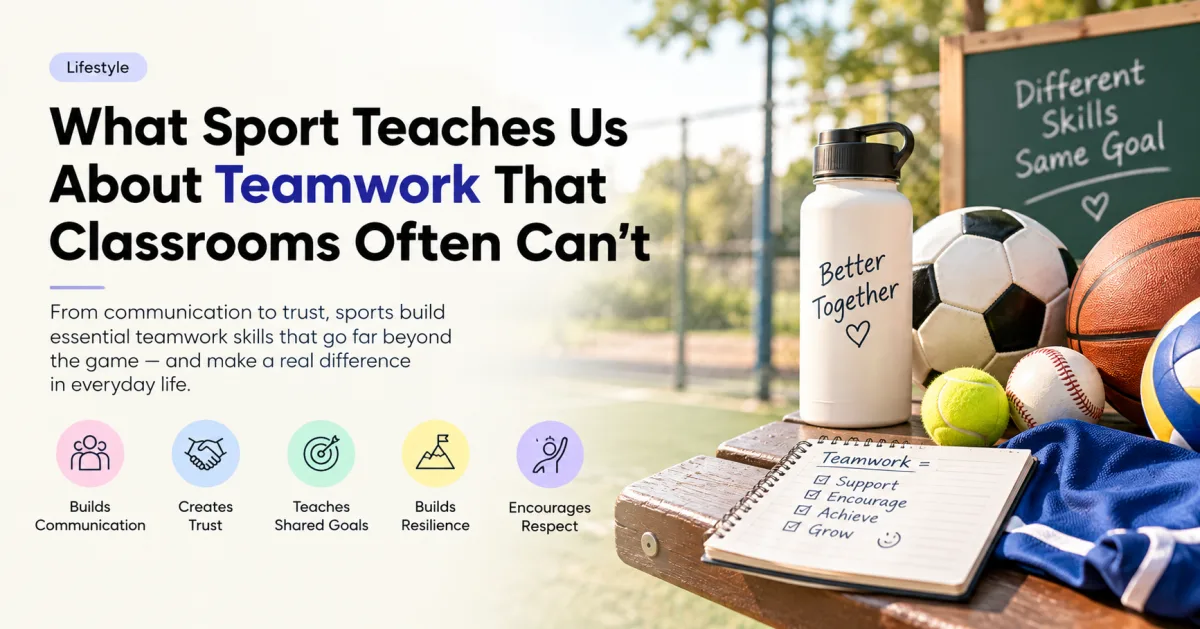

A classroom can explain teamwork. A playing field makes you depend on it. A teacher can discuss leadership.
A match can suddenly put you in a position where everyone is looking at you for a decision.
A textbook can tell you that failure is part of life.
Sport can make you experience it with the scoreboard displaying the result for everyone to see.
That difference matters.
Some lessons are understood intellectually.
Others have to be lived.
Sport provides an unusually powerful environment for learning about trust, responsibility, discipline, communication, leadership and failure because the consequences of our choices are often immediate.
UNESCO's International Charter of Physical Education, Physical Activity and Sport recognise that properly organised sport can help develop attributes including cooperation, communication, leadership, discipline and teamwork--skills that can carry into learning and other areas of life.
Here are seven lessons the playing field can teach which become much harder to forget.
1. Teamwork Means Trusting Someone Else With the Result
Imagine a cricket team where every batter refuses to take a single because they don't trust the player at the other end.
Or a football team where nobody passes.
Or a basketball player who attempts every shot.
Talent might produce occasional moments of brilliance. It rarely produces a consistently successful team.
Sport teaches one of the hardest lessons about teamwork: You cannot control everything yourself.
At some point, you have to pass the ball. Trust the bowler. Back the goalkeeper. Follow your teammate's call.
Accept that the outcome depends partly on someone other than you.
The Lesson Beyond Sport
The same thing happens in professional life.
Strong teams aren't groups of people trying to prove they can do everything individually.
They divide responsibility according to strengths and trust other people to deliver.
True teamwork begins when "I can do this" becomes "we can do this better."
2. Your Role Matters Even When You Aren't the Star
Sport naturally creates visible stars.
The player who scores the winning goal.
The batter who makes a century.
The athlete who crosses the finish line first.
But teams also depend on contributions that attract far less attention.
The defender who prevents an opportunity.
The fielder who saves runs.
The player who creates space so someone else can score.
The substitute who stays prepared despite not starting.
The teammate who keeps morale from collapsing after a setback.
Sport teaches that importance and visibility aren't the same thing.
Think About a Workplace
Not every successful project is completed by the person giving the final presentation.
Someone researched it.
Someone checked the numbers.
Someone designed it.
Someone solved a technical problem.
Someone coordinated the team.
Someone noticed the mistake before the client did.
Healthy teams recognise contribution beyond applause.
That lesson begins naturally in sport.
3. Discipline Is What Happens When Motivation Disappears
It's easy to practise when you're excited.
It's harder when you're tired. When it's cold. When you're losing. When nobody is watching. When improvement feels painfully slow.
Sport teaches the difference between motivation and discipline.
Motivation says:
"I feel like doing this."
Discipline says:
"This needs to be done."
An athlete can't become fit by training only when inspiration appears.
A team can't improve by practising only after winning. Progress requires repetition.
The same drill.
The same movement.
The same correction.
Again.
And again.
Until something difficult becomes instinctive.
The Bigger Lesson
This applies almost everywhere.
Studying.
Building a business.
Learning an instrument.
Developing professional skills.
Saving money.
Writing.
Fitness.
Most worthwhile achievements aren't created by occasional bursts of extraordinary effort. They're built through ordinary actions repeated consistently. Sport makes that visible.
4. Leadership Isn't Always About Being Captain
Give someone a captain's armband and you give them a title. You haven't automatically given them leadership. Sport teaches that leadership can emerge from anywhere. A player who encourages a teammate after a mistake is leading. A senior athlete who helps a younger player improve is leading. Someone who stays calm when the team begins panicking is leading. A player who takes responsibility instead of blaming others is leading.
Sometimes the most important leadership happens without a speech.
Great Leaders Read the Moment
There are times to push.
Times to listen.
Times to challenge.
Times to reassure.
Times to take responsibility.
And times to let someone else take the opportunity.
These are difficult things to learn from definitions alone.
Sport puts people into situations where leadership has to become behaviour.
5. Communication Becomes Real When Seconds Matter
In a classroom exercise about communication you can think carefully before responding.
Sport doesn't always offer that luxury.
"Mine!"
“Leave!”
Sometimes a single word changes what happens next. Players learn that effective communication isn't necessarily about saying more. It's about making the right information clear at the right moment.
They also learn non-verbal communication.
Eye contact.
Positioning.
Movement.
A gesture.
Knowing where a teammate is likely to go before they move.
That understanding develops through experience.
The Workplace Parallel
If you see the same things in a professional background, many professional problems aren't caused by a complete absence of information.
They're caused by unclear communication.
Who is responsible?
What's the deadline?
What changed?
Does everyone understand the plan?
Strong teams communicate early enough for information to be useful--not after the mistake has happened.
6. Failure Stops Being Theoretical
This may be sport's toughest lesson.
Someone loses.
Sometimes that someone is you.
You can prepare perfectly and still lose.
You can play brilliantly and make one mistake that changes everything.
You can be the favourite and get beaten.
You can train for months and miss selection.
You can take the final penalty and miss.
There is nowhere to hide from the result. The scoreboard doesn't care how badly you wanted to win. And yet, eventually, practice begins again. This is where sport teaches resilience without using the word.
Failure Becomes Information
Why did we lose?
What did the opponent do better?
What should we change?
Where did I make the wrong decision?
What can I improve before the next game?
That shift--from "I failed" to "What can I learn?"--is one of sport's most valuable lessons.
Recent discussion around youth sport in India has similarly emphasised its role in building resilience and teamwork. Life doesn't guarantee that effort will always produce victory. Sport teaches you to put your shoes back on anyway.
7. You Learn to Respect the Person Trying to Beat You
This sounds contradictory.
It isn't.
One of sport's most interesting traditions is that fierce competition and mutual respect can exist simultaneously. You can desperately want to defeat someone while respecting their skill. You can disagree with an opponent without treating them as an enemy. You can compete intensely and shake hands afterwards.
This principle is embedded in the Olympic tradition. The Olympic values emphasise excellence, friendship and respect while associated educational principles include fair play, joy of effort and respect for others.
Modern life often encourages people to treat disagreement as hostility. Sport can teach something healthier:
Competition doesn't require contempt.
Your competitor can make you better.
Your opponent can reveal your weaknesses.
Someone else's excellence doesn't automatically diminish your own.
Learning how to compete without losing respect is useful far beyond a stadium.
The Lesson Nobody Notices: You Need Different People
A good team isn't made by finding eleven identical people. Teams need different strengths.
Someone is fast.
Someone sees opportunities others miss.
Someone remains calm under pressure.
Someone is technically exceptional.
Someone organises.
Someone communicates.
Someone brings energy.
Someone does the unglamorous work.
The challenge isn't eliminating those differences.
It's making them work together.
That's why sport can become such a practical lesson in diversity. People don't need to be the same to move in the same direction. This applies to classrooms, workplaces, families, organisations and communities.
Can Classrooms Teach These Lessons?
Of course.
Great teachers teach teamwork, leadership, discipline, communication and resilience every day. Group projects can build collaboration. Debates can develop confidence. Difficult assignments can teach persistence. Student leadership can create responsibility. The difference is that sport often makes these lessons immediate, emotional and physical.
You don't simply discuss trust.
You pass the ball.
You don't define pressure.
You feel it.
You don't write an essay about losing.
You lose.
And then you decide what happens next.
That experience can make the lesson unusually memorable.
Sport Isn't Automatically a Teacher
There is an important qualification.
Simply playing sport doesn't automatically create character.
Sport can also produce unhealthy pressure, exclusion, aggression, cheating and a win-at-any-cost mentality when poorly managed.
The environment matters.
Coaches matter.
Parents matter.
Institutions matter.
Research into Olympic values education continues to emphasise that sporting values need to move beyond slogans into meaningful educational experiences.
The goal shouldn't be to teach children that winning is everything.
It should be to help them discover what worthwhile competition requires:
Effort.
Preparation.
Fairness.
Respect.
Responsibility.
Courage.
And the ability to begin again after losing.
The ability to work with people they didn't choose.
The discipline to practise when nobody is applauding.
The courage to take responsibility.
The humility to recognise someone else's contribution.
The resilience to lose and return.
And the understanding that no matter how talented you are, sometimes you still have to pass the ball.
Perhaps that is sport's greatest lesson.
The match eventually ends.
But what you learn about yourself--and about other people--can travel with you for life.
Also do check out our blog on how teachers have changed our life without our noticing it here.
Wirelio -- Beyond Headlines. Understanding What Matters.
Explore more education, sport, culture and human-interest stories at Wirelio.

No comments posted yet. Be the first to express your thoughts!