

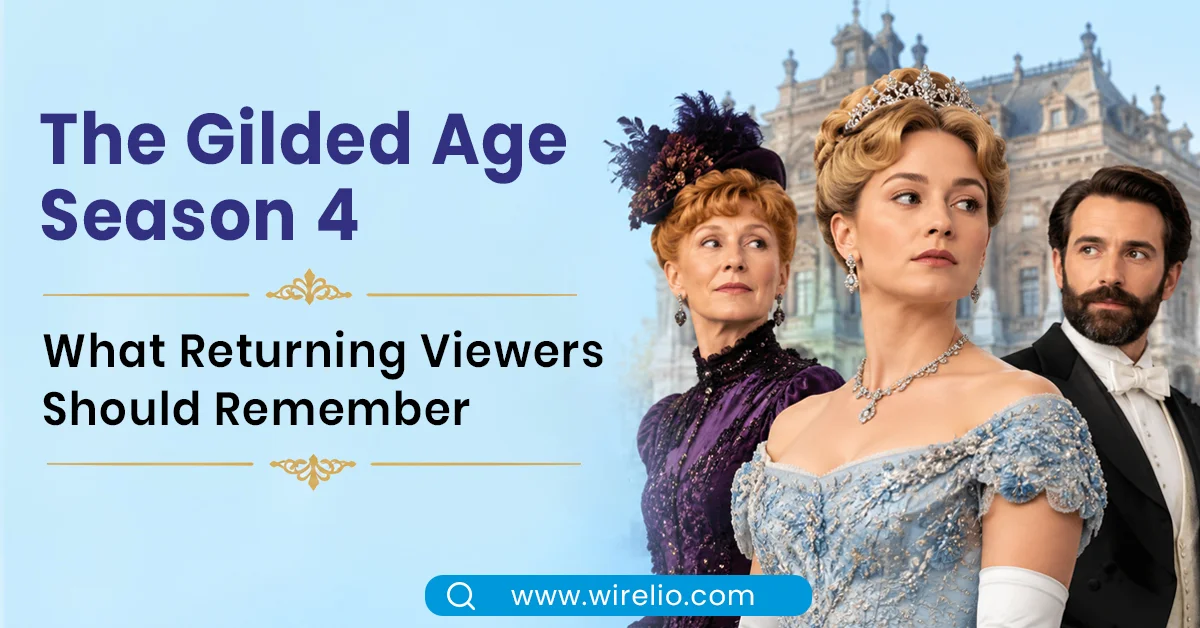

After a long wait, HBO's lavish period drama The Gilded Age has returned with its fourth season. Created by Julian Fellowes, the mind behind Downton Abbey, the series brings together family ambitions, old-money traditions, social rivalries and the changing fortunes of New York's wealthy elite in the 1880s.
Season 4 premiered on 1 November 2026 in the United States, with new episodes scheduled weekly. For viewers in India and other international markets, the new season is also becoming accessible through regional streaming platforms. However, anyone returning after the previous season may need a quick refresher before stepping into the latest chapter.
The third season ended with several important developments: George Russell survived a shooting but walked away from his marriage, Gladys entered a new phase of family life, Peggy received an unexpected proposal, and Marian and Larry found their way back to each other. Meanwhile, Agnes van Rhijn faced a changing household hierarchy, and Bertha Russell discovered that achieving social power does not necessarily mean securing personal happiness.
So, before watching The Gilded Age Season 4, here is a spoiler-conscious catch-up guide to the characters, relationships and storylines worth remembering.
Spoiler note: The following sections discuss major developments from Season 3, including its finale. They avoid revealing the major outcomes of Season 4.
Why The Gilded Age Remains More Than a Period Drama
Set in an era of extraordinary industrial expansion and growing economic inequality, The Gilded Age explores the tensions between established wealth and newly acquired fortunes.
The story follows two contrasting households. On one side are the Russell family, whose enormous wealth comes from business and industrial ambition. On the other are the van Rhijns, who represent an established social class determined to preserve its traditions and influence.
Bertha Russell, played by Carrie Coon, wants acceptance among New York's most powerful families. Her husband, George Russell (Morgan Spector), is a formidable businessman whose financial ambitions frequently intersect with the family's social position.
Across the street, Agnes van Rhijn (Christine Baranski) defends the customs of old New York, while her sister Ada Brook (Cynthia Nixon) gradually develops a more independent outlook.
The series also gives considerable attention to characters who exist outside the traditional centres of power. Peggy Scott (Denée Benton), a talented writer, navigates racial prejudice and professional ambitions, while Marian Brook (Louisa Jacobson) attempts to build a life that is not dictated entirely by society's expectations.
This combination of personal relationships, class differences, business competition and changing social values is what makes the show interesting beyond its costumes and elaborate interiors.
Season 3 Recap: The Important Storylines to Remember
The third season, which concluded on 10 August 2025, left several characters facing significant personal and family decisions. Its eight episodes moved the central conflicts beyond social competition and into questions of trust, independence and responsibility.
Bertha and George Russell: Success Comes at a Personal Cost
Bertha's determination to secure her family's place at the top of New York society became one of the most consequential storylines of Season 3.
Her ambition to arrange a prestigious marriage for her daughter Gladys created serious tension within the Russell household. George disagreed with the way Bertha handled their daughter's future, particularly because he believed that Gladys's personal wishes were being sacrificed for social advancement.
George's own business ambitions also placed him in danger. During the season's final episodes, he was shot in an attack that threatened both his life and his family's stability.
He survived after receiving urgent medical attention from Dr William Kirkland, with Marian helping during the emergency. However, the experience forced George to reconsider his priorities.
The season ended with a major fracture in the marriage. Despite Bertha's efforts to maintain appearances and host a successful Newport ball, George made it clear that he could no longer accept the way she had used their children to advance her ambitions.
He left her, making their separation the central emotional question heading into Season 4.
Gladys Russell: A Marriage Arranged for Status
Gladys's marriage to the Duke of Buckingham was among the most significant developments of the previous season.
Bertha viewed the match as a major opportunity to elevate the Russell family's social standing. However, the arrangement came at a considerable emotional cost, especially as Gladys initially had limited control over her future.
Her move to England introduced another set of challenges, including the difficult dynamics within her new family.
By the end of Season 3, her relationship with Hector, the Duke, had developed into a more supportive partnership. The finale also revealed that Gladys was expecting a child.
This development adds another dimension to the Russell family story. Gladys is no longer simply a young woman caught between her parents' ambitions. She is now preparing for motherhood and navigating the expectations attached to her new position.
Peggy Scott and Dr William Kirkland: A Relationship Tested by Prejudice
Peggy's professional ambitions and personal life continued to develop throughout Season 3.
Her relationship with Dr William Kirkland appeared promising, but his family background introduced difficult questions about acceptance, social expectations and prejudice.
William's mother, Elizabeth, disapproved of the relationship and attempted to use information about Peggy's past against her. Peggy's parents, Arthur and Dorothy Scott, also had to navigate the hostility surrounding their daughter's future.
The season finale delivered an important turning point when William defied his mother's wishes and proposed to Peggy at a family gathering.
Peggy accepted, leaving their engagement as one of the more hopeful developments of the season.
Their next challenge will involve building a future together while dealing with the social and family pressures that have already tested their relationship.
Marian Brook and Larry Russell: A Second Chance
Marian's relationship with Larry experienced considerable uncertainty in the third season.
Misunderstandings and questions of trust caused their engagement to fall apart. However, George's shooting and the events surrounding his recovery brought the two characters into closer contact again.
Marian played an important role during the medical emergency, and her actions helped restore some of the trust that had been lost.
By the finale, Marian and Larry had reconciled and resumed their engagement.
Their relationship remains important because both characters are attempting to find a balance between personal happiness and the expectations of their families. Marian, in particular, has consistently resisted the idea that her future must be decided by established social conventions.
Agnes and Ada: A Changing Balance of Power
The relationship between Agnes and Ada has been one of the show's most interesting character developments.
Agnes traditionally controlled the van Rhijn household and expected those around her to follow established rules. Ada, meanwhile, gradually became more confident and independent.
Season 3 brought this change into sharper focus. Ada's growing influence was recognised when she was offered a position of leadership within the New York Heritage Society.
In a particularly meaningful moment during the finale, Agnes acknowledged Ada's authority in the household and accepted the change in their family dynamics.
It was a significant shift for both sisters. Agnes did not lose her identity, but she began to recognise that the household could function differently from the way she had always imagined.
The Supporting Characters and Rivalries Worth Remembering
Although the Russell and van Rhijn families dominate much of the story, several supporting characters have their own important journeys.
Oscar van Rhijn (Blake Ritson) experienced personal disappointment following the death of his partner, John Adams. His future became uncertain, particularly as his family's financial and social circumstances continued to change.
By the end of Season 3, Oscar had discussed a possible marriage of convenience with the widowed Enid Winterton. Their arrangement could offer mutual social and financial advantages, although it is not necessarily a conventional romantic partnership.
Jack Trotter (Ben Ahlers) also deserves attention. The former footman achieved financial independence through his invention of an improved alarm clock. His success represents one of the show's recurring themes: opportunities can emerge for people who were previously confined by class and occupation.
Mrs Astor (Donna Murphy) remains an important figure in New York's established social hierarchy. Her influence reflects the resistance that Bertha has faced while attempting to reshape the city's social order.
Meanwhile, Peggy's parents, Arthur and Dorothy Scott, continue to represent a different dimension of New York society. Their family story highlights the experiences, aspirations and social obstacles facing the city's Black elite.
These supporting storylines help the series move beyond a simple contest between rich families. They show how social change affects people differently depending on their background, opportunities and personal choices.
What to Expect From The Gilded Age Season 4
The fourth season begins with the consequences of Bertha's social success becoming increasingly difficult to ignore.
According to HBO's official Season 4 description, Bertha has changed society, but her family must now deal with the cost of those decisions. Agnes sees an opportunity to regain her position, while Marian attempts to forge a new path. Peggy, meanwhile, works towards acceptance by her future in-laws.
These developments suggest that the new season will continue exploring the conflict between ambition and personal relationships.
The main storylines to watch include:
The Russells' marriage: George and Bertha's separation raises questions about whether their relationship can recover and whether they still share the same vision for their family.
Gladys's future: Her pregnancy and life as a duchess could change the Russell family's priorities.
Peggy's engagement: Her relationship with William will face the challenge of gaining acceptance within his family.
Agnes's position: Her opportunity to reclaim social influence could create fresh tension with the changing household dynamics.
Marian's independence: Her attempt to build a future on her own terms will remain an important part of the narrative.
The returning ensemble includes Carrie Coon, Christine Baranski, Cynthia Nixon, Morgan Spector, Louisa Jacobson, Denée Benton, Taissa Farmiga, Harry Richardson and Blake Ritson, alongside other familiar cast members.
Julian Fellowes continues as creator and executive producer, with Salli Richardson-Whitfield returning among the season's directing and executive-producing team.
The fourth season consists of eight episodes, with HBO confirming a weekly Sunday release schedule in the United States. This means viewers following the story as it unfolds will need to keep track of the weekly episode releases rather than expect the complete season to arrive at once.
Where to Watch The Gilded Age Season 4 in India and Worldwide
For Indian viewers, regional streaming availability is an important part of the viewing experience.
Following the expanded partnership between JioHotstar and Warner Bros. Discovery announced in April 2026, the HBO Max content hub became available within JioHotstar in India.
The Gilded Age Season 4 is listed for streaming on JioHotstar in India. The US premiere took place on 1 November 2026, while Indian availability began around 2 November, subject to the regional rollout.
International availability differs by country:
United States: HBO and HBO Max.
India: JioHotstar.
United Kingdom: Sky Atlantic and NOW, with availability also subject to the relevant HBO Max regional offering.
Other international markets: Check the local HBO Max service, authorised television partners or regional streaming catalogue.
A few practical points are worth remembering before subscribing or searching for individual episodes:
Check the local platform's listing rather than assuming that the US release date applies everywhere.
Confirm whether the latest episode is available in your country, as regional schedules can differ.
Check the audio and subtitle options, particularly if you prefer watching in languages other than English.
Review your existing subscription before purchasing an additional plan specifically for one series.
For Indian audiences, the JioHotstar listing provides a useful starting point. However, episode availability and subscription requirements can change, so checking the live catalogue is advisable.
Is The Gilded Age Season 4 Worth Watching?
For viewers who enjoy character-driven period dramas, the fourth season has a strong foundation.
The show has gradually developed beyond the visual appeal of grand mansions, elaborate costumes and formal society gatherings. Its more compelling moments often come from the personal consequences of ambition: a marriage damaged by social climbing, a young woman struggling for independence, a family negotiating changing power dynamics or a professional relationship challenged by prejudice.
Season 4 has several unresolved relationships to explore, particularly the separation between George and Bertha. Their conflict is interesting because neither character can be reduced to a simple villain or victim. Bertha's determination helped transform her family's social position, but George's objections raise questions about the price of that success.
Similarly, Peggy's story continues to offer a perspective that differs from the experiences of the wealthy white families around her. Agnes and Ada's changing relationship adds a quieter but equally meaningful dimension to the series.
The show's pace may not appeal to viewers looking for constant action or fast-moving plot twists. Much of its storytelling depends on conversations, social encounters, family decisions and the gradual movement of characters through a rigid social structure.
However, for those who appreciate detailed period settings and interconnected character journeys, there is plenty to return for.
FAQs About The Gilded Age Season 4
1. When did The Gilded Age Season 4 premiere?
The fourth season premiered on 1 November 2026 on HBO and HBO Max in the United States. International release dates and streaming availability vary by region.
2. Where can Indian viewers watch The Gilded Age Season 4?
The series is listed on JioHotstar in India following the expanded partnership between JioHotstar and Warner Bros. Discovery. Check the platform for the latest episode availability and subscription requirements.
3. How many episodes are there in Season 4?
Season 4 consists of eight episodes. HBO has announced a weekly Sunday release schedule for the US broadcast and streaming rollout.
4. Do I need to watch the previous seasons before starting Season 4?
Watching the earlier seasons is recommended because the series relies on long-running family relationships, social rivalries and personal developments. However, a recap of Season 3's finale and the main character storylines can help returning viewers understand the most important developments.
Conclusion: The Cost of Ambition Takes Centre Stage
The Gilded Age has always been interested in the relationship between wealth, influence and social acceptance. Its fourth season builds on that foundation by examining what happens when the pursuit of status begins to affect the people closest to those seeking it.
For returning viewers, the most important things to remember are George and Bertha's separation, Gladys's changing circumstances, Peggy's engagement, Marian and Larry's reconciliation, and Agnes's evolving relationship with Ada.
These are not isolated developments. They form an interconnected story about family expectations, social change and the personal cost of ambition.
With these storylines in mind, viewers can enter Season 4 with a clearer understanding of where the characters stand and what remains unresolved. The grand houses and glittering social gatherings may still be the attraction, but the relationships behind their closed doors are what make the series worth following.

No comments posted yet. Be the first to express your thoughts!