


An emergency rarely announces itself.
Someone collapses at work.
A child begins choking during dinner.
A cyclist falls and begins bleeding heavily.
Someone burns their hand in the kitchen.
For the first few minutes, there may be no doctor, nurse or ambulance beside you.
There may only be ordinary people.
That is why first aid matters.
The International Federation of Red Cross and Red Crescent Societies observes World First Aid Day on the second Saturday of September, raising awareness of how first-aid knowledge can help communities respond to emergencies.
First aid is not about becoming a doctor overnight. It is about knowing enough to know when to recognize danger and call for professional help and provide safe immediate assistance until trained responders arrive.
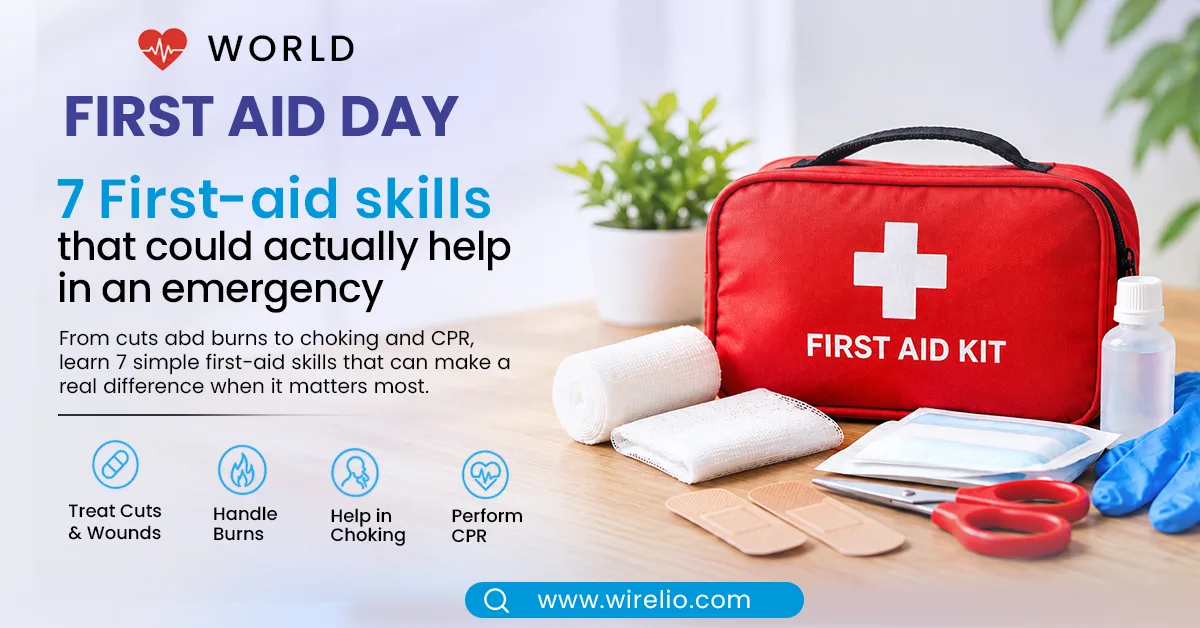
Here are seven skills worth learning properly.
1. Know What to Do When Someone Is Unresponsive
You might think that everyone in your family is healthy and you might not need to learn this skill, but emergencies always come at points when you least expect it.
One of the most important first-aid skills is also the most basic: Knowing how to assess the situation before doing anything else. If someone collapses, first make sure the scene is safe for you to approach.
Then check whether the person responds and whether they are breathing normally. If they are unresponsive and not breathing normally—or are only gasping—treat it as an emergency and call the local emergency medical service immediately.
If possible, send someone to get an automated external defibrillator, or AED. The Red Cross advises beginning CPR promptly for a person who is unresponsive and not breathing normally, and using an AED as soon as one is available.
Why This Matters
Cardiac arrest is time-critical. CPR helps maintain some blood flow to the brain and other vital organs while professional help is on the way.
Hands-on training matters enormously because correct technique—including hand position, compression rate and depth—is easier to learn through practice than by reading alone.
Learn How to Respond to Choking
Choking can turn a normal meal into an emergency within seconds.
A person with a partial blockage may still be able to cough or speak. Someone with a severe airway obstruction may be unable to breathe, speak or cough effectively.
If the person can cough forcefully, encourage coughing.
If they cannot, trained first-aid techniques such as back blows and appropriate abdominal or chest thrusts may be needed. If the person becomes unresponsive, emergency services should be contacted and CPR started according to local first-aid guidance and your level of training.
One Important Mistake to Avoid: Do not blindly put your fingers into someone's mouth trying to find an object you cannot see. That can push the obstruction deeper.
Children Are Different: Techniques can differ for infants, children, pregnant people and adults. This is another reason a proper first-aid course is far better than trying to memorise a social-media clip.
Know How to Control Severe Bleeding
There are instance when we can get hurt majorly while doing a normal household chore. It can happen that kids get hurt while playing or our mother gets hurt while cooking. Major bleeding can become life-threatening quickly.
The first priority is to call emergency services and control the bleeding.
For obvious external bleeding, current first-aid guidance emphasizes direct pressure over the wound. Use gloves or another barrier if available. Apply firm, continuous pressure using gauze, a clean cloth or suitable dressing.
If the material becomes soaked, Place additional clean absorbent materials (gauze, towels, or dressings) directly over the soaked original layer rather than repeatedly lifting the original dressing to check the wound, because that can interfere with clot formation.
What Matters Most: Don't get distracted by how frightening blood looks.
Focus on: Call for help. Apply direct pressure. Keep monitoring the person.
Know How to Treat a Burn—And Forget the Home Remedies
Kitchen burns are common. Unfortunately, so are bad home remedies.
Butter. Toothpaste. Cream. Oil. Ice. These may be traditional responses, but they are not appropriate first-aid substitutes.
For many thermal burns, first-aid guidance recommends cooling the affected area promptly with clean, cool running water. The Red Cross advises cooling with clean running water and specifically says not to use butter or cream on a burn.
Remove jewellery or clothing near the burn if it is not stuck to the skin. Do not pull away anything stuck to the burn.
Seek Urgent Medical Help for Serious Burns
Particularly concerning burns include those that are:
- deep,
- extensive,
- on the face, airway, hands, feet, joints or groin,
- caused by electricity or chemicals,
- or associated with other significant injuries.
Know When Not to Intervene
Perhaps the most underrated first-aid skill is knowing the limits of your ability. Emergencies create pressure to "do something."
But unnecessary intervention can sometimes cause harm.
You should not:
- move someone unnecessarily when a spinal injury is suspected,
- give food or drink to a seriously injured or unresponsive person,
- put substances on serious burns,
- perform techniques you have never been trained to perform when safer alternatives exist,
- or place yourself in danger to reach someone.
The first step in recognised first-aid guidance is to check whether the scene itself is safe. A live electrical wire, fire, traffic, unstable structure, toxic fumes or violent environment can turn one casualty into two.
First Rule of Helping: Do not create another emergency.
The importance of a First Aid Kit
Every home, workplace and car should ideally have access to a suitable first-aid kit.
Depending on the setting, it may include items such as:
- sterile gauze,
- adhesive bandages,
- roller bandages,
- wound care supplies,
- disposable gloves,
- antiseptic supplies,
- scissors,
- and other locally recommended items.
But the best-equipped kit is of limited value if nobody knows how to use it. Think of first-aid equipment the same way you think about a fire extinguisher. Owning one is useful. Knowing how to use it safely is better.
World First Aid Day Should Be About Readiness, Not Just Awareness
World First Aid Day can easily become another date on the awareness calendar.
A poster gets shared.
A hashtag trends briefly.
Then everyone moves on.
But first aid is different from many awareness subjects because there is something practical almost anyone can do.
Learn CPR.
Learn how to use an AED.
Learn how to help someone who is choking.
Learn how to control severe bleeding.
Learn how to respond to burns.
Learn when to stop and call professionals.
These skills do not make someone a medical professional. They make them better prepared for the minutes before a medical professional arrives. And sometimes those minutes matter enormously.
The emergency may never happen. Hopefully, it won't.
But if it does, knowing what to do can be far more valuable than wishing you had learned earlier.
Wirelio — Beyond Headlines. Understanding What Matters.
Explore more health awareness, safety and practical-life explainers at Wirelio — Beyond Headlines.
Medical note: This article is for general awareness and does not replace certified first-aid training, professional medical advice or local emergency protocols. In a serious emergency, contact your local emergency medical service immediately.

No comments posted yet. Be the first to express your thoughts!