

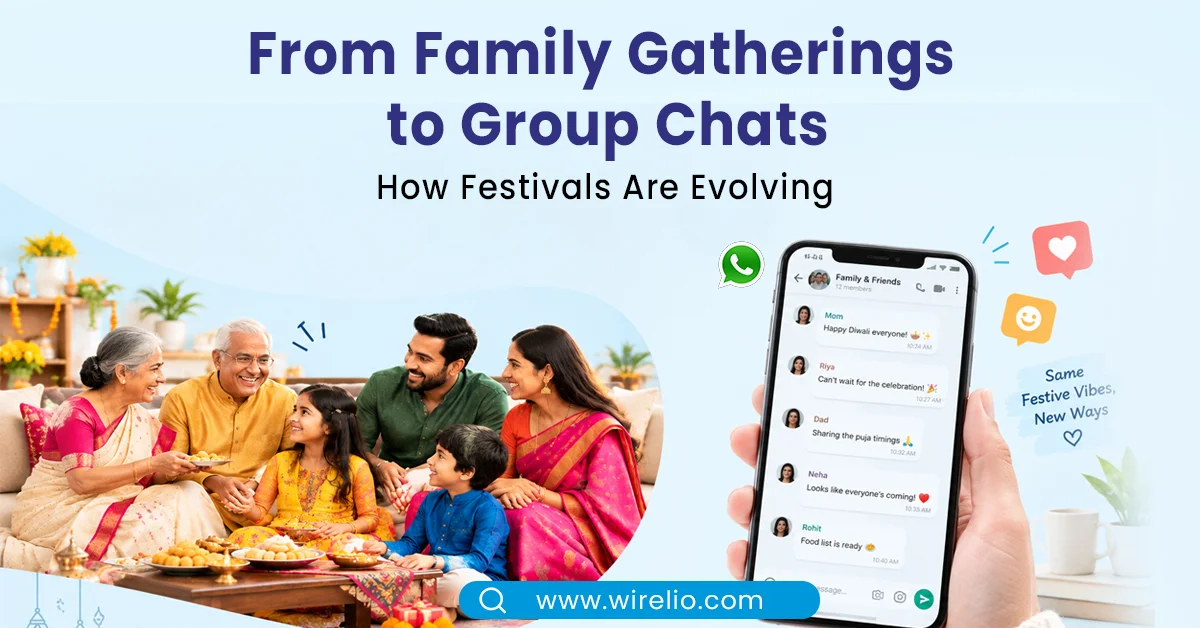
There was a time when festivals meant the sound of Mum in the kitchen, Dad cross-examining the shopping list in his hands for the tenth time and someone somewhere asking, "Have you bought the sweets yet?"
The house would be full. Cousins would be running up and down the halls. Grandparents recounting their stories for the millionth time and somehow, everyone found a place at the same dining table.
Not anymore.
Many people live away from home and festivals have taught me something that is not always obvious - that sometimes it is the little things that make a celebration what it is.
They may be a video call while Mum decorates the house, a family whatsapp group full of pictures of the diyas, a sibling sending a picture of sweets before anyone else gets to eat them. And of course, the ever-so-important message asking when I am coming back home.
Festivals are changing. The family set up is changing, and our celebrations are changing with them.
But are we losing touch with each other?
Well, not really. We may be learning new ways of connecting to each other.
1. From One Big Family Home to Many Little Homes
Growing up, festivals often meant the whole family coming together at one house
Grandparents, uncles, aunts, cousins and siblings would come together to make preparations.
Someone would be decorating the house, someone making sweets and someone always arriving late, but somehow getting the most attention!
Joint families meant that a festival was a family affair. Everyone had their role to play, and the house rarely felt empty.
However, as generations pass, so do the structures of society.
Youngsters may choose to move away for college, jobs and career opportunities. Couples may decide to live on their own. Families are spread out and living in different cities or even countries.
As a result, many households find themselves separated from each other, living their own lives.
This is not necessarily to say that joint families are disappearing, or that nuclear families have lost their closeness. They haven't - both joint and nuclear families live on today. But for many of us, the idea of all our family members coming together at one home is no longer a part of our everyday lives.
As a result, we have to make slight changes to our festival preparations.
The decorate-the-house brigade may be split up, and the cooking may happen in several kitchens. But that doesn't mean that the excitement is any less.
2. Growing Up Means Learning to Celebrate Away from Home
Here is something that no one really prepares you for - celebrating your first festival away from your family. Things have changed a lot since the past few years, children are leaving home to study afar and people are creating their own small world in big cities as a part of adulthood.
When you are younger, you may think that growing up and moving away means that you finally have your own space, and you can make your own choices.
And that is exciting, isn't it? You can decorate your room the way you want, plan what you are going to wear, and decide if you are making sweets, ordering them, or getting your favourite mithai from the local shop.
But then the festival comes. And you realize that the house is eerily quiet. That no one is asking you to help with the decorations. That no one is telling you to take a plate of sweets to the puja room. That your sibling isn't stealing sweets from the packet before it is offered to the deities.
Suddenly, every little thing that you used to love about festivals seems to have disappeared!
For students living in a hostel, young professionals starting their first job in a different city, and people living on their own for the first time, a festival can be exciting, but also lonely. You want to enjoy your new journey, but you also want to connect to the traditions that you grew up on.
And so, we begin to find new ways of celebrating.
Sometimes, home means returning to your family. And sometimes, it means being connected to your family in a slightly different way.
3. The Family WhatsApp Group Is the New Festival Courtyard
Let's be honest, every family has that one WhatsApp group that is particularly loud during festivals.
Everyone starts talking days before the festival.
Greeting wishes are sent, shopping lists discussed, puja timings planned. Someone posts an old picture of the family, and suddenly everyone is debating who looked the funniest five years back!
And then comes the photograph.
Mum sends a picture of the rangoli, Dad sends a picture of the lights on the balcony. Your cousin sends a selfie with a new outfit in front of the mirror, while your aunt forwards a funny message that has been circulating through the WhatsApp world.
You reply to all of it, talking to your family, living your festival cheer from your rented place, hostel room or office break room.
It may not be the courtyard you grew up in, but the group chat has become your own little space.
How digital communication is changing festive celebrations
WhatsApp groups mean coordinating the shopping, meals, pujas and even travel.
- Video calling means that family members who can't travel can still participate.
- Sharing photos and videos means family members who can't view the decorations in person, get to see them and share in the festivity.
- Digital invitations mean that everyone can plan gatherings and celebrations without the exhausting task of individually calling everyone.
- Sharing albums means that everyone can save memories of a festival that may not have all the family in one home.
The best part is that it all doesn't have to be done at the same time.
A five minute video call can be all it takes to bring everyone together, and a silly family selfie can become a much-loved memory.
While technology cannot recreate the feeling of sitting beside your family, it helps you to feel a little closer, despite the distance.
4. Traditional Rituals Are Finding New Ways to Travel
One thing I have learned living away from home is that traditions are everywhere, as long as there are people to carry them.
Perhaps your grandmother used to teach you how to prepare for a festival. Now, she sends you a video telling you what to arrange for the puja.
Perhaps your mother always helped you choose your outfit for a festival. Now she receives pictures of three options, and tells you confidently that you should wear the second one.
Perhaps your family used to all sit together for evening prayers. Now, you join them on a video call before returning to your own celebrations.
All of it, is enough to carry a tradition forward.
Here are a few ways that families are adapting their rituals:
- Virtual family pujas: Family members who cannot travel can join in through a video call, according to the family's custom and convenience.
- Messages for recipes: Family members can share videos, handwritten notes and videos to help each other prepare traditional festive dishes.
- Online shopping together: Siblings and parents can browse through gifts, outfits and decorations together on an online platform and video call.
- Digital invitations: Families can invite family members to gatherings and festivities without having to coordinate with each individual separately.
- Festive memory albums: Families can share a digital album of photographs and videos, of a festival that may have been in several different homes.
Of course, being a part of a ritual digitally cannot recreate the feeling of being physically present in it. Some rituals are specifically connected to certain places, communities and people.
However, technology can help you participate in your rituals, even when you are not able to be there.
And sometimes, a little participation is all it takes.
5. The Generation Gap Is Getting a Digital Makeover
Reminiscing about the good old days, I remember that festival preparations used to mean handwritten shopping lists, going with your family to the market, and waiting patiently for your relatives to arrive.
Today, we have young people who may compare prices online, order gifts, discover decorations online, learn recipes through videos, send digital invitations, make playlists and coordinate outfits through group chats.
But our parents and grandparents may still enjoy the traditional markets, traditional recipes and face to face meetings.
And that is fine!
The interesting thing is how these differences can come together.
Grandparents can teach traditional recipes while being recorded by a grandchild for the family. Parents can share the meanings behind different rituals, while a child makes a digital photo album to help preserve it. One generation brings tradition, while another brings innovation.
And together, they create something unique - a version of the festival that is connected to the past, while exploring the future.
What the younger generation is changing:
- How we shop: Online browsing and comparing often happens before heading to the market.
- How we communicate: Messages, voice notes and video calls can help coordinate the festival across long distances.
- How we preserve memories: Photographs and digital albums can help us remember our family at festivals.
- How we express ourselves: Younger people may blend traditional festivals and rituals with contemporary music, decoration and attire.
- How we stay connected: Friends and flatmates can become our festival family, when our real family is far away.
These changes do not necessarily make our celebrations better or worse, but they do show us that traditions can evolve.
6. Friends and Flatmates Are Becoming Part of the Festive Family
Living away from home can also teach us that family traditions can travel with us, even if our own family can't come to us.
Perhaps we can celebrate Diwali with our flatmates, arranging for a small puja in the apartment, and share sweets with our neighbours. Perhaps we can have a festival dinner with our friends, and arrange for everyone to contribute to decorations, food and playlist. Perhaps all that is needed is one person to buy the diyas, one to bring the snacks, one to put up the decorations and one to play the music, and suddenly everyone is dancing in the apartment.
For students staying in hostels, or young people living in rented homes, a festival celebration can be something that connects them with others.
This may be an opportunity to learn about their customs, share our own regional celebrations and create new friendships outside of the regular group.
Perhaps we can learn a new way of celebrating and make it a part of our own family festival every year.
And when we finally go back home, we can take pictures with us, show our parents new festivals traditions, and learn new recipes from our grandparents.
That is the nice thing about growing up. We don't have to leave our traditions behind, and we can bring them wherever we go.
Hosting friends and neighbors for Diwali Dinner? Check out our blog on Festive Home Makeover!
7. Digital Gifting Is Making Long Distance Celebrations Easier
Let's talk about gifts!
When you live away, you can't always show up with a gift in hand. But you can help bring people together.
Online shopping and digital services have made long-distance gifting easier. You can arrange for a gift to be delivered to your parents, order sweets for your siblings, or send a digital gift card when you are unsure what they need.
Some families also share wishlists and coordinate gifts together, making it easier to get something that is needed.
Here are some ideas for staying involved, while living away from home:
- Send a festive hamper: Choose sweets, snacks or other treats your family enjoys.
- Gift something personal: A framed photograph, keepsake or handwritten note can be meaningful.
- Order something useful: A gift chosen according to need can be more cherished than something bought simply for a festival.
- Plan a shared experience: Get everyone together for an online game night, film marathon or dinner.
- Send a surprise delivery: A surprise gift on the day of the festival can be enjoyable.
The most important thing is that it is thoughtful. And remember, you don't always have to buy something to show affection. A call or message saying "I wish I could be there today" can be meaningful.
8. Social Media Is Changing How We Experience Festivals
Festivals have always been about sharing joy. Social media has simply given us more ways to share.
Now, a festival can be a chance to share a picture of your outfit, post a video of the decorations, upload a recipe or watch another family celebrate in a different city.
For someone away from home, watching another family prepare or decorate can be a reminder of home. You can watch your family prepare in another city, or discover a new way that people are celebrating the same festival.
Social media can also be an opportunity to learn about new traditions.
However, keep in mind that not every celebration needs to be photographed or perfected for social media. When you are far away, it can be easy to feel that what we are doing is not as good as what you see online.
But a dinner with friends in your apartment is no less meaningful than a large family gathering. Enjoy the moment, take the picture, and remember that the best celebrations are those that we cherish, no matter how small they seem.
9. Can Digital Festivals Ever Replace Being Together?
If I had to answer that question, I would have to say - not really.
A video call can't recreate the smell of sweets being made in the kitchen. A photograph can't replace a warm hug. And no amount of messages can compare to sitting beside your family after a long day of celebrations.
But digital celebrations are not meant to replace these things. They are meant to keep us involved when we are unable to be physically present.
For people living in different cities, studying away from home, living overseas or simply unable to travel, a digital connection can be meaningful.
And when physical gatherings are possible, technology can help us plan them, remember them and stay connected in the meantime.
The most important thing is to use technology to help us stay close to each other.
Call your parents. Listen to your grandparents' stories. Ask your siblings what they are doing for the festival. When you can visit, plan a trip back home. When you can't, call for a long conversation.
The screen can be our medium, but it is how we connect that is important.
From Family Gatherings to Group Chats: How Festivals Are Evolving
1. How are festivals evolving in modern India?
Festivals in modern India are becoming more flexible and digital, as well as keeping up the traditions followed by families. As people get busier and the distances increase, video calls, group chats, online gifting and virtual celebrations help people to stay connected.
2. How do young adults celebrate festivals away from their families?
Most young adults who are away from home, tend to celebrate with friends, colleagues or their roommates. They can also do virtual prayers with their families and share photos, gifts or even food to keep the festival spirit alive.
3. How has technology changed the way families celebrate festivals?
Technology has helped people connect virtually and have a shared experience. Family celebrations involving greetings, gift exchanges, rituals and gatherings can be done seamlessly even when family members can't meet up due to distance.
4. Do digital celebrations take the place of traditional family gatherings?
Digital celebrations don't have to replace traditional gatherings, rather; they serve as a great alternative for those who struggle to travel due to various reasons like distance or time. For most, however, family get-together are irreplaceable. So, most people opt to celebrate virtually as well as with their families when possible.
5. How have nuclear families changed festive traditions?
Due to nuclear families, festivities tend to change in accordance to the host's or the family's convenience. Celebrations are flexible and can be adapted to any lifestyle or time constraints of the family.
6. Why do festivals feel different for people living away from home?
Festivals feel different for people living away from home due to the lack of familiar family ritual and the absence of the home cooked dishes and meals. However, people can make the most out of the situation by celebrating with friends, having virtual family gatherings or following their family's traditions.
7. How can families stay connected during festivals when they live in different cities?
Families can stay connected during festivals when they live in different cities by setting aside a time for a video call or sharing photos, videos, gifts or even cooking a similar dish. It's also a good idea to set aside the distractions and share precious one-on-one time.
8. Are younger generations changing the meaning of festivals?
Yes and No. While younger generations tend to change most ritualistic practices, the meaning behind them is often preserved. Most times, the young generation would adjust the festival according to their preferences and lifestyles.
9. How can families bridge the generation gap during festivals?
Families can bridge the generation gap during festivals by finding a middle ground where everyone's needs and preferences matter. Elders should communicate their preferences and needs to the younger generations while respecting their choices. The younger generations, on the other hand, should understand their elders and accommodate them as much as possible.
10. How can you make festivals special when you cannot travel home?
To make festivals special when you cannot travel home, you can cook a special family recipe, decorate your room and dress up as you would for a festival at home. You can also call your family members, exchange gifts, video chat or even spend time with your friends.
For more fun and relatable articles, check out our articles on daily phases of life!
Worries about your Festive Budget this year - Check out our blog on Managing and Making better Financial Desicions!
Stay connected at Wirelio- Beyond Headlines!

No comments posted yet. Be the first to express your thoughts!