

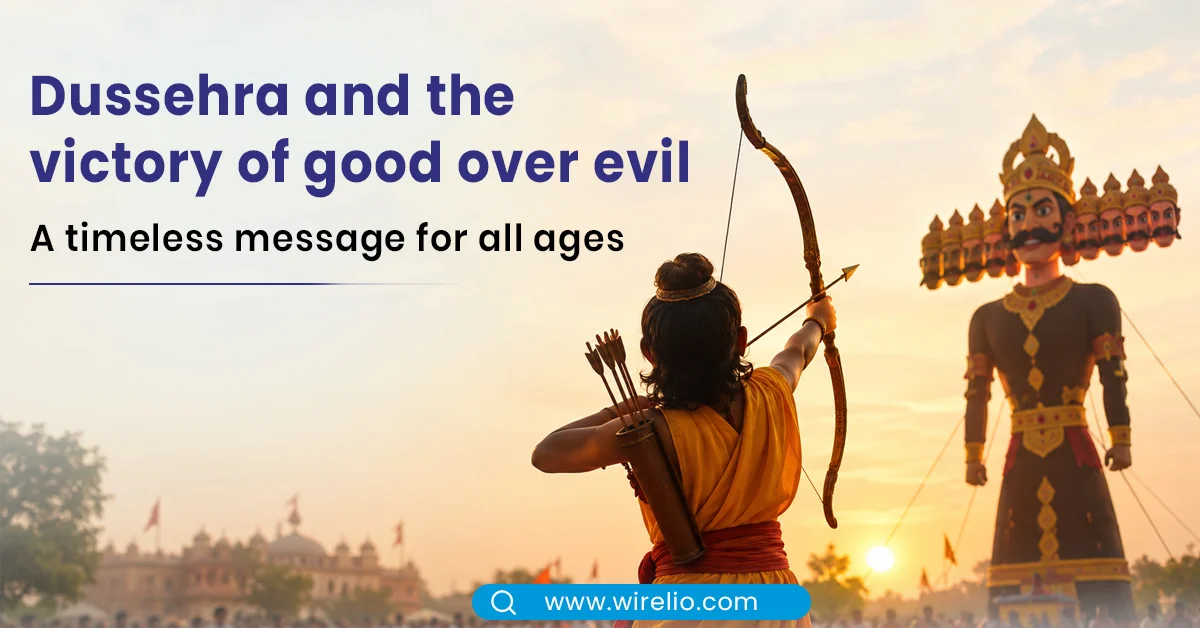
Imagine a night sky set aglow by fireworks. Crowds cheer. Kids gasp in awe. Ahead of them, a towering effigy of Ravana is set on fire, flames leaping and curling into the air. The pyre dies down, cheers erupt, and everyone agrees - good will always triumph over evil.
That is the spirit of Dussehra.
Now take a step back. What does the burning of Ravana really symbolise? Why is Dussehra, also called Vijayadashami, celebrated by millions of people? What does the ancient legend of Rama and Ravana have to do with the modern world?
The answer is not what you think.
Dussehra teaches us that power without principles is dangerous, that the weak must rise up against the tyrannical, and that it is never too late to do what is right.
The Night the Darkness Fell: Why Dussehra Is More Than a Festival
Celebrated at the end of Navratri, Dussehra brings together piety, history, tradition and an important lesson for the generations. In various parts of the country, the festival celebrates the victory of Lord Rama over Ravana or Goddess Durga over Mahishasura. Both epic tales share the same underlying message - no matter how powerful the evil, it will always be defeated. Source: Incredible India
What Is Dussehra? Understanding Its Meaning and Significance
Dussehra is a prominent Hindu festival that is observed on the tenth day of the Ashwin month of the lunar calendar. Also called Vijayadashmi, the name literally translates to 'tenth day of victory'.
This day marks the end of the nine-day Navratri festival in various parts of the country. While the northern parts of the country observe Ramlila and Ravan Dahan, the eastern and southern regions mostly follow Durga Puja traditions.
For some, Dussehra is a pious day of prayers while for others, it is a day filled with merriment and festivals. Children wait in eager anticipation for Ravan Dahan while adults reflect on the moral lessons of the epic tales. For some, it is a day to eat and have fun while for others, it is a day to teach their children about what is right and wrong.
It is this versatility, this ability to connect with all sections of society, that makes Dussehra so special.
Want to know more about the 9 days of Navratri and its significance? Learn more about the 9 days of Navratri!
The Story of Lord Rama and Ravana: When Righteousness Faced Arrogance
Let us go back to the days of the Ramayana. One of India's oldest and most beloved epic heroes, Lord Rama, was faced with an arrogant villain - Ravana.
A master of all the vedas, Ravana was a powerful and feared king with great knowledge of astronomy and medicine. He had ten heads, ten hands and unimaginable powers. But despite all his talents and magical abilities, Ravana was condemned to be the villain of the epic. The reason? His arrogance and ego.
When Ravana kidnapped Goddess Sita, Lord Rama went to war with the help of his brother Lakshmana, his most devoted disciple Hanuman Ji and an army of monkeys and bears. The legendary ten-day battle between Rama and Ravana was ultimately won by Rama.
Ravana's tale serves as a constant reminder that no matter how powerful a villain may be, the ultimate victory always goes to good over evil. It is this basic tenet that is celebrated during Dussehra through the performance of Ramlila and the burning of Ravana's effigy.
What Does Ravana's Ten-Headed Effigy Symbolise?
The ten heads of Ravana have been said to represent ten negative traits that are detrimental to living a virtuous life. Some people believe that each head of the burning Ravana effigy stands for a particular undesirable characteristic. For instance:
- Ego: Thinking that you are better than everyone else.
- Anger: Feeling hatred towards people and situations.
- Greed: Wanting more than what you have.
- Jealousy: Feeling envious of others' achievements.
- Pride without wisdom: Thinking you are always right.
- Dishonesty: Being corrupt and selfish.
These are just a few of the many negative traits that we must strive to stay away from in order to lead good lives.
Why Is Goddess Durga Worshipped During Navratri and Dussehra?
While the stories of Lord Rama and Ravana are an important part of the Dussehra festival, there is another legend that lies at the heart of the Navratri and Dussehra celebrations across the country. The legend of Goddess Durga.
To truly understand the story of Durga, we need to understand what Durga actually symbolises to the people. What do people pray to Goddess Durga for?
Goddess Durga, a form of the Divine Mother, represents infinite power and the ultimate form of female energy. She is believed to grant people blessings of prosperity, strength and compassion. Devotees pray to her for power, strength and the power to triumph over evil.
The Story of Goddess Durga and Mahishasura
According to the legend, Mahishasura was a powerful demon who grew arrogant after being granted boons by the gods. The gods tried to kill him but failed and sought the help of the universe's combined female energy. This energy took the form of a female warrior called Durga.
Goddess Durga fought Mahishasura for nine days and eventually slayed him with her weapons. The nine-day battle culminated in Mahishasura's death on the tenth day - Vijayadashmi.
What Do People Actually Pray to Goddess Durga For?
People's prayers to Maa Durga are as diverse as the people themselves. Different people pray to her for different things. Some of the common things that people pray for are:
- Strength: The inner strength to face life's challenges.
- Protection and peace: The assurance of the blessings of family and friends.
- Wisdom and insight: The ability to understand the right thing to do in all circumstances.
- Freedom from fear: The confidence to face life's trials and tribulations.
- Freedom from weakness: The ability to overcome all vices.
- Prosperity and well-being: The blessings of a happy and prosperous life.
The story of Durga is particularly powerful because it pits feminine power against evil. Not only does the goddess have to confront the villain, but she has to vanquish him using sheer strength, power and willpower. Her very existence is a powerful reminder that feminine power should not be underestimated.
Goddess Durga is revered and respected during the Durga Puja and Navratri festivals as a powerful weapon against evil. She teaches people that power is not the result of how strong you are but what you do with the power that you have.
The real victory is not simply knowing the story of good over evil. It is learning how to choose good when life puts that choice to the test.
The Real Meaning of Dussehra in Today's World
Although the tale about Ravana and Mahishasura is ancient, it can be applied to some contemporary issues raised by humans against the society.
Cases like harassment, bribery and racism do exist, not to mention the arrogance, pretension, and jealousy. But how are these linked with the Dussehra celebration?
In fact, there are many reasons why the message carried by the festival is an important aspect of our society.
Below are five key life lessons for all of us that we are able to acquire through the observance of this special day for a specific period of time.
1. Choose honesty over bribery
Being sincere, straight and moral is not an easy task, especially when there is nobody to answer for your actions. However, remember the example of Rama and the decisions he has made for his country. No matter how attractive bribery may seem, it is better to choose integrity. This advice may be applicable in any situation, for instance, in completing a customer’s request.
2. Fight injustice and harassment
When someone is treated unfairly, people tend to remain silent instead of risking their reputation for standing by a stranger. However, in cases of cruelty, insult, body shaming, social discrimination or economic oppression, every individual, regardless of their social position, should take action.
It is not necessary to sacrifice your principles just to satisfy your boss. One may refuse to take part in the harassment, verbally support the victim or officially report the issue to the authorities. The main point is to take appropriate action so that an innocent person is not punished for something they did not do.
3. Stop and think before you accuse
Sometimes people make mistakes, which cannot be solved by public humiliation or insults. There are moments when the easiest way out is to admit fault, accept the consequences and move on. Such a situation may occur not only with students who have missed an important assignment, but also with a boss who was wrong in choosing a new team member.
4. Remember moral values while using your power
The story about goddess Durga is also significant, as it teaches us how to exercise power. A leader may have various sources of authority, including physical, financial and professional power. However, regardless of the resources available, a person should not harm employees, abuse their position or insult subordinates. If someone has received special abilities, they have to be used for the benefit of the oppressed ones. The more advantages you have, the more help you should bring to those who need support.
5. Verify information and oppose lies
There are times when rumors, social shaming, irrelevant information, or pseudo-news may be spread because of a lack of verification. Remember that not all the news reported on the Internet are true, even if they have millions of likes.
Before sharing a suspicious report, first verify its authenticity, checking several reliable sources. In addition, if there are false reports, comment on them in a dignified manner, not insulting people who may feel offended by them. In particular, this rule applies to social networks, which arePurna used to spread rumors about various companies or customers with fake reviews. Such Internet resource may actually be taken seriously by many people, including those who do not know the real meaning of Dussehra and its underlying message.
One of the greatest advantages of Dussehra is that its basic ideas develop throughout life. Therefore, a child may see Dussehra as a day filled with bright stories narrated by elders, highlighting the importance of being moral and honest. Moreover, the principles may be easily understood by adolescents, who face challenges like body shaming, social bullying or pressure from peers to adopt unacceptable habits.
As for adults, they usually see the occasion as a day dedicated to reflecting on their actions. Finally, for the elderly, it is fun to tell stories to grandchildren and teach them family values.
Need to start getting your house ready for festivities but don't know what to change? Check out this article and get you Home Festival Ready!
FAQs
1. Why is Dussehra celebrated?
Dussehra is celebrated to mark the victory of good over evil. In many parts of India, it commemorates Lord Rama's victory over Ravana, while other traditions celebrate Goddess Durga's victory over Mahishasura.
2. What is the significance of Dussehra?
The significance of Dussehra lies in its message of truth, righteousness, courage and justice. It reminds people to overcome negative qualities and stand against wrongdoing.
3. What is the story behind Dussehra?
The most widely known Dussehra story comes from the Ramayana, in which Lord Rama defeats Ravana and rescues Goddess Sita. In many other traditions, the festival marks Goddess Durga's victory over Mahishasura after a fierce battle.
4. Why is Dussehra also called Vijayadashami?
Dussehra is also called Vijayadashami because it is associated with victory on the tenth day of the Hindu lunar calendar's Ashwin period. The name reflects the festival's central theme of triumph over evil.
5. What does Ravana Dahan symbolise?
Ravan Dahan, or the burning of Ravana's effigy, symbolises the victory of good over evil. It also encourages people to reflect on destructive qualities such as arrogance, greed, anger and dishonesty.
6. Why is Goddess Durga worshipped during Dussehra?
Goddess Durga is worshipped for strength, courage, protection, wisdom and the ability to overcome adversity. In traditions celebrating her victory over Mahishasura, Dussehra marks the triumph of divine feminine power over destructive forces.
7. What is the difference between Dussehra and Durga Puja?
Durga Puja is a major festival dedicated to Goddess Durga, especially celebrated in West Bengal and other eastern regions. Dussehra, or Vijayadashami, is observed on the tenth day and is associated with the conclusion of Durga Puja in these regions, as well as Lord Rama's victory over Ravana in many other parts of India.
8. What is the moral of the Dussehra festival?
The moral of Dussehra is that truth, righteousness and courage are more powerful than arrogance and wrongdoing. The festival encourages people to practise honesty, control negative tendencies and stand up for what is right.
9. How can we apply the message of Dussehra in daily life?
People can apply the message of Dussehra by choosing honesty over deception, standing against bullying and injustice, treating others with respect, accepting their mistakes and using their influence to help others.
10. When is Dussehra celebrated in India?
Dussehra is celebrated on Vijayadashami, the tenth day of the Ashwin lunar period. Its Gregorian date varies each year, usually falling in September or October, depending on the Hindu calendar.
Check out more articles for more valuable stories and beliefs.
For more insights - Wirelio, Beyond Headlines!

No comments posted yet. Be the first to express your thoughts!