

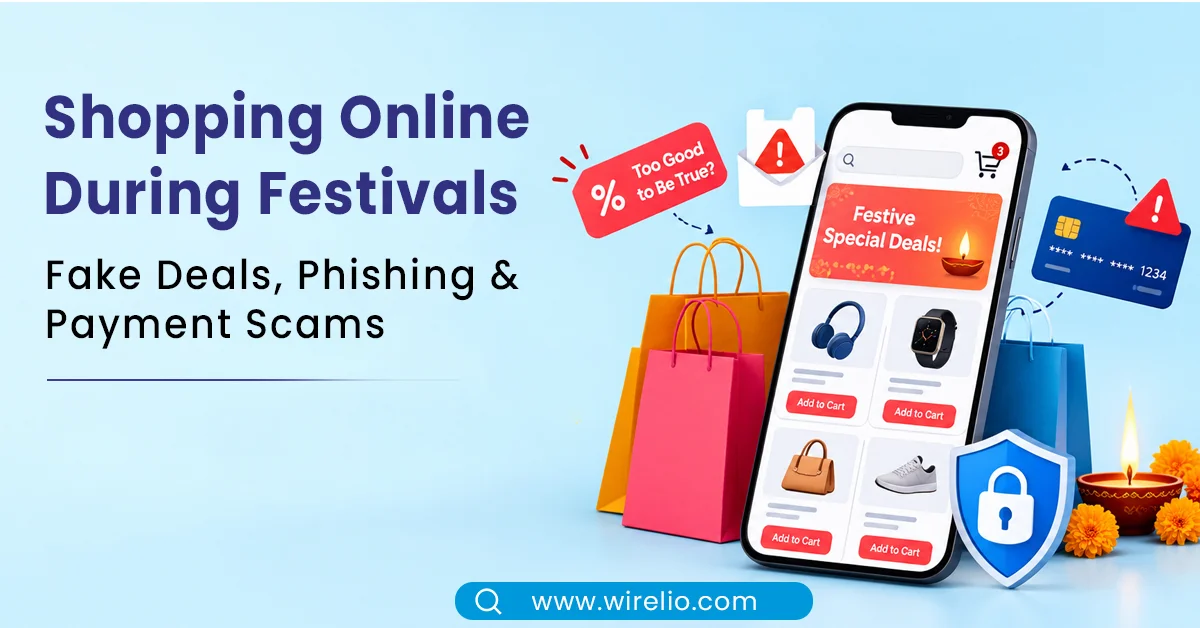

Festival sales are exciting. Your wishlist suddenly looks achievable, that phone you've been eyeing finally seems affordable, and the “Add to Cart” button starts looking dangerously tempting.
But while shoppers are busy hunting for discounts, scammers are busy hunting for shoppers.
From fake shopping websites and phishing messages to UPI fraud, fake customer support and payment scams, online shopping fraud can take many different forms. And the tricky part? Not every scam looks like a scam at first.
A message may look like it came from a delivery company. A website may look like a familiar shopping platform. A caller may claim to be helping you get a refund.
So, before you start chasing the best festive deals, let's understand what these online scams actually are, how they work in everyday situations and what you can do to spot them.
What Are Online Shopping Scams?
In simple terms, an online shopping scam happens when someone uses a fake offer, message, website, account, payment request or identity to trick you into giving away money or sensitive information.
The scammer doesn't always need to steal your money directly.
Sometimes, they first try to get:
- Your phone number
- Email address
- Shopping account password
- Card number
- CVV
- OTP
- UPI details
- Banking information
The information can then be used for fraudulent transactions or further scams.
The Indian Cyber Crime Reporting Portal officially recognises several forms of digital fraud, including phishing, vishing, smishing, card fraud and impersonation.
The important thing to understand is that different scams use different tricks.
Let's break them down without the complicated cyber-security jargon.
Phishing: “We Need You to Verify Your Account”
Phishing is when a scammer pretends to be a trusted company or service and tries to get you to reveal sensitive information.
Think of it as a digital version of someone wearing a fake uniform and pretending to work for a company.
The message may say:
“Your account needs verification.”
“Your payment failed.”
“Confirm your delivery address.”
“Your account will be blocked.”
The aim is to make you click a link and enter your information on a fake page.
A real-life example
You are waiting for an online order. You suddenly receive an SMS:
“Your order cannot be delivered because your address is incomplete. Update your address immediately.”
There is a link underneath. You click it.
The page looks professional and asks for your mobile number, card information or login details. You think you're fixing a delivery problem.
In reality, there may never have been a delivery problem. The message was designed to get you to the fake website.
Smishing: Phishing Through SMS
Smishing is basically phishing through text messages.
The name sounds complicated, but the idea is simple:
SMS + phishing = smishing.
The scammer sends a text containing a link, phone number or instruction designed to make you take an action.
The National Cyber Crime Reporting Portal describes smishing as fraud using text messages to lure people into calling fraudulent numbers, visiting fake websites or downloading malicious content.
Example
You receive:
“Your parcel is on hold. Pay Rs. 25 to reschedule delivery.” Rs. 25 doesn't sound like much.
That's exactly why someone may be tempted to click. But the payment page could be designed to collect your card details or other information.
The lesson
A small payment request doesn't automatically mean a small risk.
Vishing: The “Customer Care” Phone Call
Now imagine the same scam, but instead of a text, someone calls you. That's where vishing comes in.
Vishing means fraudulent attempts to collect sensitive information through phone calls.
The caller might claim to be:
- Customer support
- Your bank
- A delivery company
- A shopping platform
- A payment service
- A seller
The Cyber Crime Reporting Portal specifically lists vishing as a scam involving attempts to obtain information such as OTPs, card details, CVVs, PINs and passwords over the phone.
Example
You have ordered a washing machine during a festive sale. Someone calls:
“Sir/Ma'am, I'm calling from customer support. Your order is stuck because the payment hasn't been verified.”
They sound convincing.
Then they ask:
“Please tell me the OTP you just received.”
That's when the alarm bells should go off.
Remember:
A caller sounding professional doesn't prove that they are genuine.
Fake Shopping Websites
This one is particularly dangerous because the scam doesn't necessarily arrive in your inbox.
You may find the website yourself through a search engine or social media advertisement.
The website may have:
- Familiar logos
- Product photographs
- Discount banners
- Customer reviews
- Countdown timers
- “Limited stock” messages
- Professional-looking checkout pages
It can look completely legitimate.
Example
You search:
“Diwali sale smartphone deals 2026.”
You click an advertisement offering a flagship phone at an unbelievably low price. The website looks like a major e-commerce platform.
You enter your details. You pay.
And then... nothing.
The website may disappear, the order may never arrive or your information may have been collected.
The important point
A website looking professional doesn't prove that it is genuine.
Always check the actual website address before entering sensitive information.
Fake Deals and Bait Pricing
Now we come to the scam most people immediately think about when they hear “online shopping fraud.” A fake deal uses an extremely attractive price to get you to act quickly.
The product may be advertised at a price that seems almost impossible.
Example
You see:
“Latest iPhone — Rs. 19,999 only!”
Your brain immediately goes:
“BUY IT BEFORE IT'S GONE.”
That's exactly the reaction the scammer wants.
You click the link, pay a small “booking amount” or complete the purchase on an unfamiliar website.
The product may never arrive.
But here's an important distinction
Not every unbelievably cheap product is automatically a scam. Real festive sales can have significant discounts.
The problem is when the offer comes from an unverified source or requires you to leave the official shopping platform to make the payment.
Fake Customer Support Scams
This scam becomes especially convincing when you already have a genuine problem.
Imagine your order is delayed.
You search online for customer support.
You find a phone number or social-media account that claims to belong to the shopping platform.
You contact them.
The “agent” offers to solve your problem.
Then comes the trick.
They ask you to:
- Share an OTP
- Install an app
- Share your screen
- Scan a QR code
- Enter your UPI PIN
- Transfer a “verification amount”
Example
You say:
“My refund hasn't arrived.”
The fake support agent responds:
“No problem. I'll process it immediately. Just scan this QR code.”
You follow the instructions.
Instead of receiving money, you may end up authorising a payment.
Simple rule
For customer support, use the contact options inside the official app or website instead of random numbers found online.
UPI and QR Code Scams
UPI has made payments incredibly convenient. Unfortunately, scammers have also learned how to use that convenience.
One common trick is:
“Scan this QR code to receive your refund.” It sounds reasonable. But scanning a QR code and entering your UPI PIN can authorise a payment.
Example
You cancel an expensive festive purchase.
Someone contacts you claiming to be from customer support:
“Your refund has been approved. Scan this QR code to receive Rs. 15,000.”
You scan it.
Your UPI app opens.
You enter your PIN.
Instead of receiving Rs. 15,000, you may have authorised money going out of your account.
Remember this sentence:
You don't need to enter your UPI PIN simply to receive money. If someone tells you otherwise, stop.
OTP Scams
An OTP may look like just another six-digit number. It isn't. An OTP can be used to authorise certain transactions, logins or account actions.
Scammers therefore try to convince you to share it.
Example
You receive an OTP while talking to someone claiming to be customer support.
They say:
“Don't worry, this OTP is only for verification.”
You share it.
The scammer uses it for whatever transaction or account action they were trying to complete.
The easiest rule to remember:
If an OTP arrives on your phone, don't share it with someone just because they say they're from customer support.
Fake Bank Offers and Cashback Scams
Festive shopping is filled with genuine:
- Bank discounts
- Cashback
- EMI offers
- No-cost EMI offers
- Exchange benefits
- Card offers
That gives scammers an excellent opportunity to create fake versions.
Example
You see a message:
“Exclusive Diwali cashback! Get Rs. 5,000 cashback on your credit card. Activate now.”
You click. The page asks for your card number, expiry date, CVV and OTP.
You think you're activating cashback.
You may actually be giving a scammer everything needed to attempt an unauthorised transaction.
What should you do?
If an offer claims to come from your bank, check it through:
Your bank's official app or website.
Don't activate a financial offer simply because the message uses your bank's logo.
Fake Giveaways and Prize Scams
“Congratulations! You've won a festive gift!” Sounds exciting.
Especially during Diwali. But ask yourself: Did you actually enter a contest?
If you didn't, why would you have won?
Example
You receive a WhatsApp message:
“Congratulations! You have won a Rs. 10,000 shopping voucher.” To claim it, you are asked to pay Rs. 99 as a processing fee.
You pay. Then another fee appears. Then another. The prize never arrives.
The simple rule
Unexpected prizes shouldn't require you to keep paying money to receive them.
How to Identify an Online Shopping Scam
Now that you know the different types, here's the more useful question:
How do you spot one before losing money?
Look for these warning signs.
The deal is unbelievably cheap
A discount can be genuine.
But an extreme price difference deserves verification.
You're being rushed
Watch out for:
“Pay in 2 minutes.”
“Only one left.”
“Account closes today.”
“Final warning.”
Urgency is often used to stop you from thinking.
Someone asks for your OTP
Stop.
Don't share it.
Someone asks for your UPI PIN
Especially if they claim you need it to receive money.
Stop immediately.
You're asked to leave the official platform
If you're shopping on a major e-commerce platform and suddenly someone asks you to complete payment through a different website, be cautious.
The website address looks strange
Don't just look at the logo.
Look at the actual domain.
Customer support contacts you first
Unexpected calls or messages claiming to solve an order problem deserve extra scrutiny.
You are asked to install an unknown app
Don't install software simply because someone claiming to be support tells you to.
You are asked to pay to receive a refund or prize
That's a major warning sign.
Something doesn't feel right
This sounds obvious, but it matters.
If the process is unusually complicated, rushed or secretive, stop and verify it independently.
What Does This Mean for AGIF 2026 and BBD 2026 Shoppers?
Now let's bring all of this back to the biggest festive shopping moment.
The Amazon Great Indian Festival 2026 is currently live, with deals across smartphones, electronics, fashion, beauty, home, kitchen, appliances and other categories.
Meanwhile, Flipkart Big Billion Days 2026 begins for general access on October 9, with early access beginning October 8 for eligible customers.
That means shoppers are going to see an enormous number of:
- AGIF 2026 deals
- Great Indian Festival offers
- BBD 2026 deals
- Big Billion Days offers
- Bank discounts
- Cashback promotions
- Smartphone deals
- Appliance offers
- Electronics discounts
- Flash sales
- Limited-time offers
And here's the important part: Scammers don't need to create a completely new story. They can simply borrow the excitement of a genuine sale.
For example:
Fake AGIF message
“Exclusive Amazon Great Indian Festival deal! iPhone at Rs. 19,999. Click to claim.”
Instead of clicking, open Amazon separately and search for the product.
Fake BBD message
“Big Billion Days VIP offer! Pay Rs. 99 to unlock your exclusive discount.”
Instead of paying, check the offer directly inside Flipkart.
Fake festive bank offer
“Get Rs. 5,000 cashback during AGIF/BBD. Activate here.”
Instead of entering your card details, check the bank offer through your bank's official channels.
Fake delivery message
“Your BBD order is on hold. Pay Rs. 20 to release it.”
Instead of clicking, open your Flipkart order page and check the status yourself.
The Smartest Way to Shop AGIF 2026 and BBD 2026
Festive sales aren't something you need to avoid.You just need to shop them with a little more awareness.
Before buying that phone, appliance, laptop or Diwali decoration you've been waiting for:
Compare the price.
Check the seller.
Verify the website.
Read the offer terms.
Use the official shopping app whenever possible.
Never share your OTP or UPI PIN.
And don't let a countdown timer make financial decisions for you.
A genuine festive sale will still be there long enough for you to verify what you're buying.
FAQs About Online Shopping Scams
What is the most common online shopping scam?
There isn't just one. Phishing, fake websites, fake deals, payment fraud, OTP scams, fake customer support and delivery-related scams are among the different forms shoppers may encounter.
What is phishing in simple words?
Phishing is when someone pretends to be a trusted company or service and tricks you into clicking a link or sharing sensitive information.
What is the difference between phishing and smishing?
Phishing is the broader type of scam. Smishing specifically uses SMS or text messages to trick people into clicking links, calling fake numbers or providing information.
What is vishing?
Vishing is fraud carried out through phone calls, where scammers may pretend to be banks, companies or customer-support representatives and try to obtain sensitive information.
Can a fake shopping website look real?
Yes. A fraudulent website can imitate the appearance of a legitimate shopping platform. That's why checking the actual website address and using the official app are important.
Can I share my OTP with customer support?
No. You should not share OTPs with people who contact you claiming to be customer support.
Do I need a UPI PIN to receive money?
No. Be suspicious if someone tells you that entering your UPI PIN is necessary to receive a refund or payment.
How can I stay safe during AGIF 2026?
Use the official Amazon app or website, verify deals before paying, check sellers and don't trust unexpected messages containing AGIF links or payment requests.
How can I stay safe during BBD 2026?
Use the official Flipkart app or website, verify BBD offers there, avoid unknown links, don't share OTPs and never make unusual payments to claim a deal or refund.
What should I do if I lose money to an online scam?
Contact your bank or payment provider immediately, secure your accounts, save evidence and report the incident through India's National Cyber Crime Reporting Portal or by calling 1930.

No comments posted yet. Be the first to express your thoughts!